Showing posts with label CME. Show all posts

Tuesday, April 29, 2014

An X-class solar flare on April 25th irradiated Earth's upper atmosphere with extreme ultraviolet radiation, causing a widespread blackout of shortwave radio transmissions.

 Space Weather. com

by Dr. Tony Phillips.

RADIO BLACKOUT:

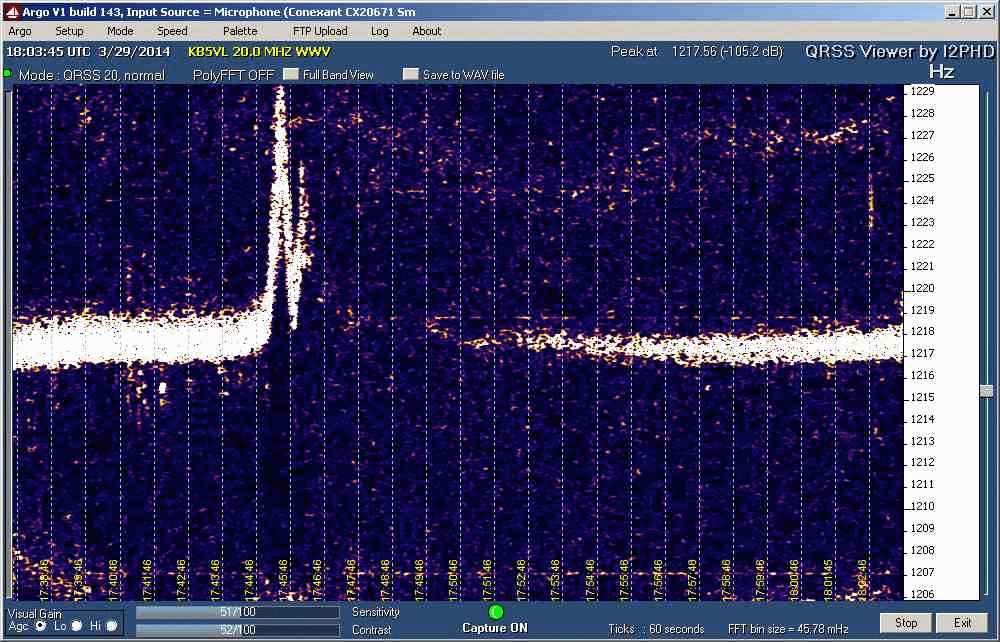
An X-class solar flare on April 25th irradiated Earth's upper atmosphere with extreme ultraviolet radiation. Waves of ionization rippled around the dayside of the planet, causing a widespread blackout of shortwave radio transmissions. Radio astronomer Dick Flagg recorded the event at his observatory at the Windward Community College on Oahu:
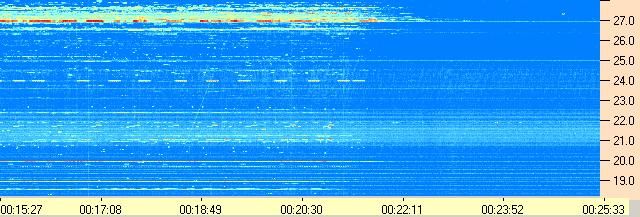
"This is a dynamic spectrum," explains Flagg. "The vertical axis is frequency (MHz) and the horizontal axis is time (UTC)." All of the horizontal lines corresponding to terrestrial radio stations vanished in the aftermath of the flare.
The active region responsible for the flare rotated off the solar disk yesterday, so even if it flares again, another radio blackout is unlikely this weekend. NOAA forecasters estimate the odds of an X-flare on April 26th to be a scant 1%.

.....

Space .com

Sun Unleashes Major Solar Flare (Video)

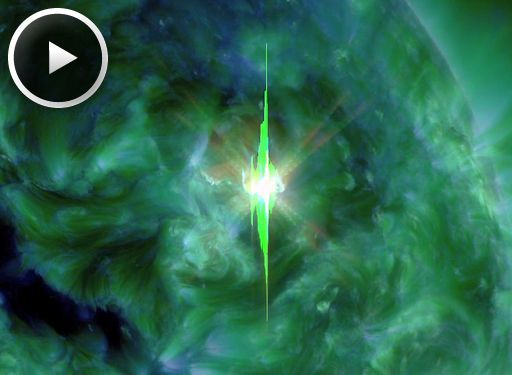
An X1.3-class solar flare (far right) erupts from the surface of the sun on April 24, 2014 EDT  (April 25 GMT).
An X1.3-class solar flare (far right) erupts from the surface of the sun on April 24, 2014 EDT (April 25 GMT).
Credit: NASA/Solar Dynamics Observatory
X-class flares top the scale with the most energy and potential to disrupt communications on Earth.
X-class flares top the scale with the most energy and potential to disrupt communications on Earth. See how solar flares compare to each other in this Space.com inforgraphic.
Credit: Karl Tate, SPACE.com Contributor

Enhanced by Zemanta

Tuesday, April 1, 2014

Rare Ripple in Earth's Magnetic Field Occurred During Last X1 Solar Flare!


by Dr. Tony Phillips.
Enhanced by Zemanta

Saturday, January 11, 2014

5.0 Earthquake Hits Cuba As Geomagnetic Storm Hits Earth


DAHBOO77


Published on Jan 9, 2014
These are the latest quake updates for the US!
http://spaceweather.com/
http://quakes.globalincidentmap.com/

.....
Spaceweather.com
by Dr. Tony Phillips.
GROWING QUIET?
Giant sunspot AR1944 has not unleashed a significant flare in more than 48 hours. The growing quiet could be the calm between storms. AR1944 has an unstable 'beta-gamma-delta' magnetic field that harbors energy for X-class flares.  
As predicted, a CME hit Earth's magnetic field on Jan. 9th (20:00 UT). The impact was weaker than expected, however, and it failed to produce widespread geomagnetic storms. Nevertheless, some beautiful auroras appeared around the Arctic Circle. Harald Albrigtsen sends this picture from Tromsø, Norway:
It was dark in Norway when the CME arrived, so observers there witnessed a nice display. By the time night fell over North America, however, the lights had faded. US observers saw nothing remarkable.
More auroras are possible on Jan. 10th as Earth passes through the magnetic wake of the CME. NOAA forecasters estimate a 85% chance of polar geomagnetic storms before the day is over.

.....

Massive Solar storm strikes Earth following monster flare

Newsnation6 Newsnation6


Published on Jan 10, 2014
A large coronal mass ejection has reached Earth -- days after the Sun sent a massive burst of solar wind and electromagnetic radiation towards our planet. While causing no major geomagnetic storm, it has produced spectacular auroras in northern Europe.
The coronal mass ejection (CME) arrived near Earth at 2:32pm EST (7:32pm GMT) on Thursday, with its effects expected to continue throughout Friday, according to US National Oceanic and Atmospheric Administration (NOAA).
NOAA's Space Weather Prediction Center has issued a warning of a geomagnetic storm with "minor disruptions to communications and GPS."
While the world's economies braced for possible blackouts in high-frequency airline and military communications, disruptions to GPS signals and power grids, enthusiasts in the northern hemisphere rushed outdoors in the hope of viewing the stunning aurora borealis as far south as Colorado.
However, American aurora spotters have been disappointed, as, according to spaceweather.com, the CME's impact was "weaker than expected" and failed to produce widespread storms. Some frustrated Twitter users also blamed cloudy skies for not being able to see the northern lights.
Observers were luckier around the Arctic Circle in Norway, where a dark and clear night at the time of impact, as well as more favorable latitude, put an aurora on display.
NOAA forecasters still estimated an 85 percent chance of polar geomagnetic storms before the end of Friday, and media cheered the sky watchers by saying there remains a chance of some clear aurora sightings Friday night.
The CME that stroke the Earth has been associated with the large X1.2-class solar flare that was unleashed from a giant sunspot AR1944 on January 7. The flare has been described as the most powerful this year so far, with X-class denoting the most severe intensity.
,,,,,

Solar storm strikes Earth following monster flare (VIDEO)


This January 7, 2014 handout image captured by NASA's Solar Dynamics Observatory shows a false-color composite image from a blast of activity originating from an active sunspot region at the center of the sun's disk (AFP Photo)

A large coronal mass ejection has reached Earth – days after the Sun sent a massive burst of solar wind and electromagnetic radiation towards our planet. While causing no major geomagnetic storm, it has produced spectacular auroras in northern Europe.
The coronal mass ejection (CME) arrived near Earth at 2:32pm EST (7:32pm GMT) on Thursday, with its effects expected to continue throughout Friday, according to US National Oceanic and Atmospheric Administration (NOAA).

NOAA’s Space Weather Prediction Center has issued a warning of a geomagnetic storm with “minor disruptions to communications and GPS.”

While the world’s economies braced for possible blackouts in high-frequency airline and military communications, disruptions to GPS signals and power grids, enthusiasts in the northern hemisphere rushed outdoors in the hope of viewing the stunning aurora borealis as far south as Colorado.

However, American aurora spotters have been disappointed, as, according to spaceweather.com, the CME’s impact was “weaker than expected” and failed to produce widespread storms. Some frustrated Twitter users also blamed cloudy skies for not being able to see the northern lights.
Observers were luckier around the Arctic Circle in Norway, where a dark and clear night at the time of impact, as well as more favorable latitude, put an aurora on display.
NOAA forecasters still estimated an 85 percent chance of polar geomagnetic storms before the end of Friday, and media cheered the sky watchers by saying there remains a chance of some clear aurora sightings Friday night.

The CME that stroke the Earth has been associated with the large X1.2-class solar flare that was unleashed from a giant sunspot AR1944 on January 7. The flare has been described as the most powerful this year so far, with X-class denoting the most severe intensity.

Read More and Watch Videos Here
.....

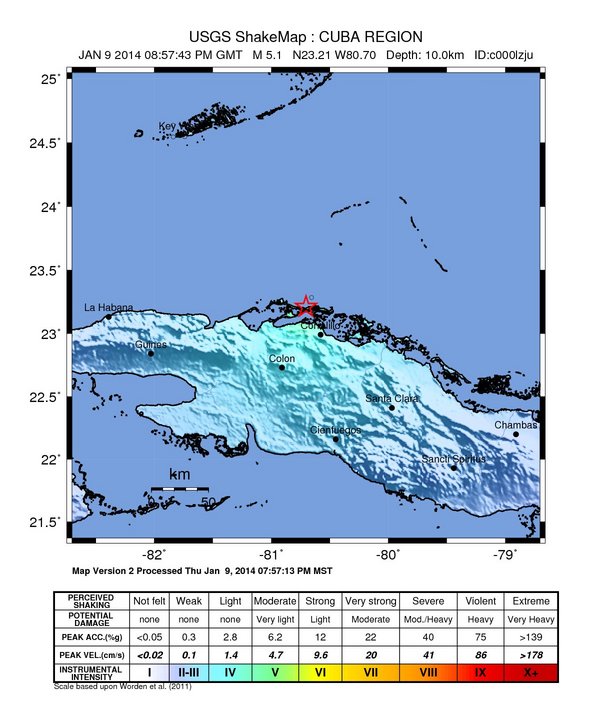
M 5.1 - 24km NNW of Corralillo, Cuba

 2014-01-09 20:57:43 UTC

Earthquake location 23.189°N, 80.677°W

Event Time

  1. 2014-01-09 20:57:43 UTC
  2. 2014-01-09 15:57:43 UTC-05:00 at epicenter
  3. 2014-01-09 14:57:43 UTC-06:00 system time

Location

23.189°N 80.677°W depth=10.0km (6.2mi)

Nearby Cities

  1. 24km (15mi) NNW of Corralillo, Cuba
  2. 36km (22mi) NE of Marti, Cuba
  3. 51km (32mi) N of Los Arabos, Cuba
  4. 56km (35mi) ENE of Cardenas, Cuba
  5. 174km (108mi) E of Havana, Cuba
....

Tectonic Summary

The January 9, 2014 M5.1 earthquake in the Gulf of Mexico occurred along the northern coast of west-central Cuba at shallow crustal depths, ~28km from Corralillo, Cuba and ~172 km east of Havana, Cuba.
The island of Cuba lies within the North American plate and is bounded by the Bahamas Platform and Florida Straits to the north and the North America-Caribbean plate boundary to the south. The plate boundary, a left-lateral transform, defines the southeast coast of the island and causes uplift of the Sierra Maestra. In the vicinity of the January 9 earthquake, a former plate boundary suture and several faults, collectively termed the Nortecubana Fault system, bound the northern coast of Cuba. Additionally, several smaller crustal faults, including the left-lateral Hicacos Fault and Las Villas fault are located in the general vicinity of the January 9 earthquake. The region of the January 9 earthquake is relatively quiet seismically. Only 6 documented events ranging from M3.0-5.6 occurred over the past 75 years within 200 km of the epicenter. The M5.6 event, which occurred in 1939, also took place along the northern coast of Cuba in the vicinity of the Nortecubana Fault system. The January 9 event occurred 686 km ESE of the September 2006 M5.8 Gulf of Mexico earthquake.
.....

Instrumental Intensity

ShakeMap Intensity Image
.....
Enhanced by Zemanta

Friday, December 20, 2013

M3.5 Solar Flare December 19, 2013

SolarWatcher SolarWatcher·


Published on Dec 19, 2013
Eruptive M-CLASS SOLAR FLARE !
A strong M3.5 Solar Flare was reported at 23:19 UTC yesterday around active region 11931. The impulsive eruption occurred while the active region was rotating onto the earth-facing side of the disk.

Facebook Live Quake Data
https://www.facebook.com/EarthquakeHu...
http://solarwatcher.net
Earthquake Forecasting Channel
http://youtube.com/thebarcaroller
Another Quality Solar youtube Channel
http://www.youtube.com/user/Skyywatch...
Earthquake Reporting Channel
http://www.youtube.com/user/EQForecaster
Soho Website
http://sohowww.nascom.nasa.gov/
Solar Soft website
http://www.lmsal.com/solarsoft/latest...
Solar Terrestrial Activity Report
http://www.solen.info/solar/
WSA-Enlil Solar Wind Prediction
http://www.swpc.noaa.gov/wsa-enlil/
Helioviewer
http://www.helioviewer.org/
Quality Solar Website
http://www.solarham.com
Estimated Planetary K index information
http://www.swpc.noaa.gov/alerts/k-ind...
GOES Xray Flux Data
http://www.swpc.noaa.gov/rt_plots/xra...
Sunspot Information from Solar Monitor
http://www.solarmonitor.org/
Quality Weather Website
http://www.westernpacificweather.com
Space Weather Website
http://www.spaceweather.com/

Music Used is composed by Zack Hemsey - "Redemption"

.....


Space Weather
by Dr. Tony Phillips.

M-CLASS SOLAR FLARE:


For more than two weeks, solar activity has been low. Hours ago, a new sunspot broke the quiet with an M3.5-class solar flare. NASA's Solar Dynamics Observatory recorded the extreme ultraviolet flash at 23:16 UT on Dec. 19th:


Radiation from the flare produced a brief wave of ionization in the upper atmosphere over the Pacific side of Earth. Otherwise, the blast was not particularly geoeffective. It did not produce an Earth-directed CME.
The instigating sunspot is still emerging over the sun's southeastern limb. Without a top-down view of the sunspot's magnetic field, it is difficult to assess the region's flare-producing potential. NOAA forecasters are estimating a 30% chance of more M-class flares on Dec. 20th
.....
Enhanced by Zemanta

Saturday, October 26, 2013

Electromagnetic radiation from yesterday's X2-class solar flare had a significant effect on Earth's upper atmosphere.


 Space Weather.com

by Dr. Tony Phillips.

X2-FLARE BLASTS EARTH'S IONOSPHERE:

As a wave of ionization swept across the dayside of the planet, the normal propagation of shortwave radio signals was scrambled. In Alachua, Florida, electrical engineer Wes Greenman recorded the effects using his own shortwave radio telescope. Click on the frequency-time plot to view an animation:
.....
Screen Captures from X2-FLARE BLASTS EARTH'S IONOSPHERE  Space Weather . com
"X2-FLARE BLASTS EARTH'S IONOSPHERE  1 photo X2-FLAREBLASTSEARTHSIONOSPHERE1_zpsf14b74ef.jpg
.....
"X2-FLARE BLASTS EARTH'S IONOSPHERE  2 photo X2-FLAREBLASTSEARTHSIONOSPHERE2_zpsab03274c.jpg
.....
"X2-FLARE BLASTS EARTH'S IONOSPHERE  3 photo X2-FLAREBLASTSEARTHSIONOSPHERE3_zps07a07081.jpg
,....
"X2-FLARE BLASTS EARTH'S IONOSPHERE  4 photo X2-FLAREBLASTSEARTHSIONOSPHERE4_zps488064a0.jpg
.....
During the time that terrestrial shortwave transmissions were blacked out, the sun filled in the gap with a loud radio burst of its own. In New Mexico, amateur radio astronomer Thomas Ashcraft recorded the sounds. "This radio burst was a strong one and might be too intense for headphones," cautions Ashcraft.
Solar radio bursts are caused by strong shock waves moving through the sun's atmosphere. (Electrons accelerated by the shock front excite plasma instabilities which, in turn, produce shortwave static.) They are usually a sign that a CME is emerging from the blast site--and indeed this flare produced a very bright CME.

Read More Here
.....

Twin X-Class Solar Flares October 25, 2013

SolarWatcher SolarWatcher


Published on Oct 25, 2013
TWIN X-CLASS SOLAR FLARES
Two major X-Class solar flares peaking to X1.7 and X2.3 were both registered from newly numbered Sunspot 1882 at 08:01 UTC this morning and15:03 UTC this afternoon . Associated with this major event was a 10cm Radio Burst (TenFlare) lasting 24 minutes and measuring 610 solar flux units and 44 minutes measuring 370 solar flux units. Two large coronal mass ejections (CME) are now visible in the latest LASCO imagery and looks to have a possible Earth directed components and we should begin to see a series of strong geomagnetic disturbances over the next 2-3 days.
.....

Space Weather . com

Dr. Tony Phillips.

INTERCONNECTED SOLAR ACTIVITY:


The X1-flare of Oct. 25th was remarkable not only for its strength, but also for its interconnectedness. The flare was bracketed by two erupting magnetic filaments, each located hundreds of thousands of kilometers from the instigating sunspot AR1882. The whole episoide, shown in this SDO movie, was reminiscent of the famous global eruption of August 2010.
Today, Oct. 26th, it happened again. Click on this image of the sun's southwestern quadrant and watch a sequence of flare activity around sunspots AR1875 and AR1877 followed by a filament eruption off the SW limb:


Instead of being a sequence of unrelated events, these flares and eruptions are likely connected by magnetic fields, which thread through the whole broad region. Like dominoes falling, one explosion triggers another as shock waves follow magnetic fields from blast site to blast site.
The filament punctuated the sequence by hurling a part of itself into space. SOHO has observed a CME emerging from the blast site, but it is too soon to say whether it is heading for Earth. Stay tuned for updates.

Read More Here
.....


Enhanced by Zemanta

Sunday, June 23, 2013

Sun Emits a Solstice CME

 NASA Sun Earth


06.20.13
A CME erupts from the left hand side of the sun in this image from SOHO taken on June 20, 2013.
› View larger
A coronal mass ejection, or CME, erupts from the left hand side of the sun in this image from the ESA/NASA Solar and Heliospheric Observatory taken on June 20, 2013 at 11:12 p.m. EDT. Credit: ESA and NASA/SOHO

On June 20, 2013, at 11:24 p.m., the sun erupted with an Earth-directed coronal mass ejection or CME, a solar phenomenon that can send billions of tons of particles into space that can reach Earth one to three days later. These particles cannot travel through the atmosphere to harm humans on Earth, but they can affect electronic systems in satellites and on the ground.
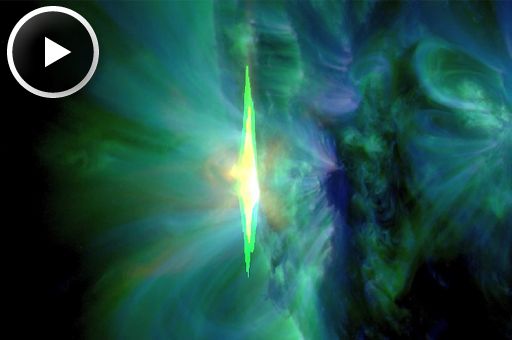
Experimental NASA research models, based on observations from NASA’s Solar Terrestrial Relations Observatory and ESA/NASA’s Solar and Heliospheric Observatory show that the CME left the sun at speeds of around 1350 miles per second, which is a fast speed for CMEs.

Earth-directed CMEs can cause a space weather phenomenon called a geomagnetic storm, which occurs when they funnel energy into Earth's magnetic envelope, the magnetosphere, for an extended period of time. The CME’s magnetic fields peel back the outermost layers of Earth's fields changing their very shape. Magnetic storms can degrade communication signals and cause unexpected electrical surges in power grids. They also can cause aurora. Storms are rare during solar minimum, but as the sun’s activity ramps up every 11 years toward solar maximum – currently expected in late 2013 -- large storms occur several times per year.

In the past, geomagnetic storms caused by CMEs of this strength and direction have usually been mild.

This image from June 20, 2013, at 11:15 p.m. EDT shows the bright light of a solar flare on the left side of the sun and an eruption of solar material shooting through the sun’s atmosphere, called a prominence eruption.
› View full disk image
This image from June 20, 2013, at 11:15 p.m. EDT shows the bright light of a solar flare on the left side of the sun and an eruption of solar material shooting through the sun’s atmosphere, called a prominence eruption. Shortly thereafter, this same region of the sun sent a coronal mass ejection out into space. Credit: NASA/SDO

In addition, the CME may pass by additional spacecraft: Messenger, STEREO B, Spitzer, and their mission operators have been notified. If warranted, operators can put spacecraft into safe mode to protect the instruments from the solar material.

NOAA's Space Weather Prediction Center (http://swpc.noaa.gov) is the U.S. government's official source for space weather forecasts, alerts, watches and warnings.

Updates will be provided if needed.


Karen C. Fox
NASA's Goddard Space Flight Center, Greenbelt, Md.


 IRIS Science Overview

At the end of June 2013, NASA will launch its newest mission to watch the sun: the Interface Region Imaging Spectrograph, or IRIS. IRIS will show the lowest levels of the sun’s atmosphere, the interface region, in more detail than has even been observed before. This will help scientists understand how the energy dancing through this area helps power the sun’s million-degree upper atmosphere, the corona, as well as how this energy powers the solar wind constantly streaming off the sun to fill the entire solar system