Showing posts with label University of New South Wales. Show all posts

Thursday, February 6, 2014

WHO predicts the number of cancer cases will reach 24 million a year by 2035, but half could be prevented.

Cancer 'tidal wave' on horizon, warns WHO

Mammograms Large numbers of people do not know there is a lot they can do to reduce their exposure to risk
The globe is facing a "tidal wave" of cancer, and restrictions on alcohol and sugar need to be considered, say World Health Organization scientists.
It predicts the number of cancer cases will reach 24 million a year by 2035, but half could be prevented.
The WHO said there was now a "real need" to focus on cancer prevention by tackling smoking, obesity and drinking.
The World Cancer Research Fund said there was an "alarming" level of naivety about diet's role in cancer.
Fourteen million people a year are diagnosed with cancer, but that is predicted to increase to 19 million by 2025, 22 million by 2030 and 24 million by 2035.
The developing world will bear the brunt of the extra cases.
Predicted global cancer cases to 2035
Chris Wild, the director of the WHO's International Agency for Research on Cancer, told the BBC: "The global cancer burden is increasing and quite markedly, due predominately to the ageing of the populations and population growth.
"If we look at the cost of treatment of cancers, it is spiralling out of control, even for the high-income countries. Prevention is absolutely critical and it's been somewhat neglected."
The WHO's World Cancer Report 2014 said the major sources of preventable cancer included:
  • Smoking
  • Infections
  • Alcohol
  • Obesity and inactivity
  • Radiation, both from the sun and medical scans
  • Air pollution and other environmental factors
  • Delayed parenthood, having fewer children and not breastfeeding
For most countries, breast cancer is the most common cancer in women. However, cervical cancer dominates in large parts of Africa.
Dr Chris Wild, WHO: "We're not going to be able to address this problem by simply improving treatment"
The human papillomavirus (HPV) is a major cause. It is thought wider use of the HPV and other vaccines could prevent hundreds of thousands of cancers.
One of the report's editors, Dr Bernard Stewart from the University of New South Wales in Australia, said prevention had a "crucial role in combating the tidal wave of cancer which we see coming across the world".
Dr Stewart said human behaviour was behind many cancers such as the sunbathe "until you're cooked evenly on both sides" approach in his native Australia.
He said it was not the role of the International Agency for Research on Cancer to dictate what should be done.
But he added: "In relation to alcohol, for example, we're all aware of the acute effects, whether it's car accidents or assaults, but there's a burden of disease that's not talked about because it's simply not recognised, specifically involving cancer.

Read More Here

Related Stories

Enhanced by Zemanta

Tuesday, November 5, 2013

Obdurodon tharalkooschild: Fossil of Giant, Toothed Platypus Discovered


Nov 5, 2013 by Sci-News.com

An Australian-U.S. team of paleontologists has found a unique fossil of a huge, carnivorous platypus that lived in what is now Australia during the late Miocene.

This is an artist's reconstruction of Obdurodon tharalkooschild. The inset shows its first lower molar. Image credit: Peter Schouten.
This is an artist’s reconstruction of Obdurodon tharalkooschild. The inset shows its first lower molar. Image credit: Peter Schouten.
The modern platypus is a duck-billed, venomous, semi-aquatic mammal with webbed feet and is covered in short waterproof fur. It is one of the five extant species of monotremes, the only mammals that lay eggs instead of giving birth.
The new extinct species of platypus, named Obdurodon tharalkooschild, has been described from a unique tooth fossil found at the famous Riversleigh World Heritage Area of Queensland.
The specific name, tharalkooschild, honors an Indigenous Australian creation story about the origin of the platypus.
Unlike the living species, Obdurodon tharalkooschild had fully functional teeth that may have been used to kill and consume a wide range of animals that lived alongside it in ancient pools and lakes. Based on the size of its tooth, it is estimated that Obdurodon tharalkooschild would have been twice the size of the modern platypus, around 3.3 feet (1 m) long.
“Like other platypuses, it was probably a mostly aquatic mammal, and would have lived in and around the freshwater pools in the forests that covered the Riversleigh area millions of years ago,” explained Prof Suzanne Hand from the University of New South Wales, a co-author of the article published in the Journal of Vertebrate Palaeontology.
Read More Here
Enhanced by Zemanta

Friday, November 1, 2013

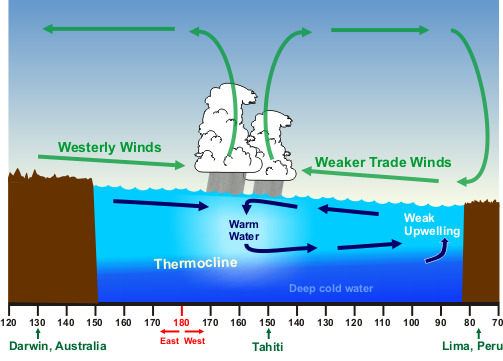
A team of scientists reveal a study that El Niño Southern Oscillation (ENSO) phenomenon activity during the 20th century has been unusually high compared to the past 600 years.

File:3 examples of internal climate variability (1950-2012), the El Niño – Southern Oscillation, the Arctic Oscillation, and the North Atlantic Oscillation (NOAA).png
3 examples of internal climate variability (1950-2012), the El Niño – Southern Oscillation, the Arctic Oscillation, and the North Atlantic Oscillation (NOAA)
Image Source  :  Wkimiedia .Org
.....
File:El Niño Conditions.jpg
El Niño Conditions. Warm water pool approaches South American coast. Absence of cold upwelling increases warming.
Image Source  : Wikimedia . Org
..........

El Niño Is Becoming More Active

Oct. 28, 2013 — A new approach to analyzing paleo-climate reconstructions of the El Niño Southern Oscillation (ENSO) phenomenon resolves disagreements and reveals that ENSO activity during the 20th century has been unusually high compared to the past 600 years. The results are published in Climate of the Past by a team of scientists from the University of New South Wales, the University of Hawaii International Pacific Research Center and the NOAA Geophysical Fluid Dynamics Laboratory.
El Niño events can wreak havoc across the globe, spawning floods or giving rise to droughts in many regions of the world. How ENSO behaves as a result of a warming planet, however, is still uncertain. One window to determine its sensitivity to climate change is a look into the past. Because the instrumental record is too short for getting a reliable picture of natural variations in ENSO magnitude and frequency, climate scientists rely on geological and biological clues, such as from lake sediment cores, corals, or tree rings as proxies for past ENSO behavior. The problem has been, though, that reconstructions of ENSO from such paleo-proxies have not been telling the same story.
Some of these discrepancies in ENSO reconstructions arise because the methods typically applied to combine individual paleo-proxy records do not handle small dating uncertainties amongst the proxies well. The usual approach has been to combine the individual ENSO proxies and then to calculate the activity of this combined ENSO signal. McGregor and his team found that by turning this analysis around -- first calculating the activity of ENSO in each of the individual paleo-climate reconstructions and then combining the activity time series -- yields a much more consistent and robust view of ENSO's past activity. The scientists confirmed this new approach with virtual ENSO data obtained from two multi-century-long climate model simulations.
Applying their improved method of reconstructing ENSO activity by synthesizing many different existing proxies and comparing these time series with instrumental data, the scientists found that ENSO was more active during 1979-2009 than during any 30-year period between 1590 and 1880.
"Our results represent a significant step towards understanding where current ENSO activity sits in the context of the past." says Axel Timmermann, professor at the University of Hawaii and co-author of the study.
"Climate models provide no clear indication of how ENSO activity will change in the future in response to greenhouse warming, so all we have to go on is past records," explains McGregor. "We can improve the projections of climate models, however, by selecting those that produce past changes in ENSO activity consistent with the past instrumental records.
"Our new estimates of ENSO activity of the past 600 years appear to roughly track global mean temperature," says McGregor, "but we still don't know why."

Story Source:
The above story is based on materials provided by University of Hawaii ‑ SOEST, via EurekAlert!, a service of AAAS.
Note: Materials may be edited for content and length. For further information, please contact the source cited above.

Journal Reference:
  1. S. McGregor, A. Timmermann, M. H. England, O. Elison Timm, A. T. Wittenberg. Inferred changes in El Niño–Southern Oscillation variance over the past six centuries. Climate of the Past, 2013; 9 (5): 2269 DOI: 10.5194/cp-9-2269-2013
Enhanced by Zemanta

Monday, August 5, 2013

As Antarctic Sea Ice Melts, Seaweed Smothers Seafloor

File:Iceberg with hole crop.jpg

Image Source  :  Wikimedia Commons
Author Brocken Inaglory
*******************************************************************************

Live Science


Seaweed could smother polar underwater ecosystems as melting sea ice exposes the seafloor to more sunlight, new research shows.
Animals that dwell on the seafloor of the Arctic and Antarctic spend most of their lives in total darkness: Sea ice blocks rays during the spring and early summer, and the sun sets completely in the winter. Late summer and early fall — when the ocean warms up enough to thaw the ice — often marks the only time these critters see light.
But as climate change causes sea ice to begin melting earlier and earlier in the summer, shallow-water ecosystems will soak up increasingly more rays. New research from a team of Australian biologists suggests this could cause a major shift in the seafloor communities along the coast of Antarctica, where invertebrates like sponges, worms and tunicates — globular organisms that anchor to rocks on the seafloor — currently dominate. A manuscript of the report is currently in press at the journal Global Change Biology. [6 Unexpected Effects of Climate Change]

"Some areas where ice breaks out early in summer are already shifting to algal domination," said Graeme Clark, a biologist at the University of New South Wales who was involved in the study.
Seasons and tipping points
Early-summer ice melt not only lengthens the amount of time photosynthesizing organisms like macroalgae (or seaweed) can thrive under the sun during the summer, but it also increases the intensity of that exposure. The sun sits highest in the sky during the summer solstice — the period when Earth tilts most directly toward the sun — that occurs between June 20 and 23 in the Northern Hemisphere and Dec. 20 and 23 in the Southern Hemisphere, depending on the phase of the Earth's orbit. Rays travel directly to the seafloor during this time. During spring and fall, however, low-angle rays reflect off the sea surface and often never make it to the seafloor.
This compounding effect of a longer sunlit season and higher-intensity rays could exponentially increase the amount of sunlight hitting benthic, or seafloor, communities in the coming decades and cause major tipping points for those invertebrate-dominated ecosystems, Clark said.
Tipping points occur when relatively minor environmental changes — like sea ice melting several days earlier than usual — cause rapid and significant ecological transformation. In this case, the tipping point would push ecosystems from invertebrate-dominated to algae-dominated.


Read More and Watch Video  Here


Enhanced by Zemanta