Showing posts with label Milky Way. Show all posts

Sunday, February 16, 2014

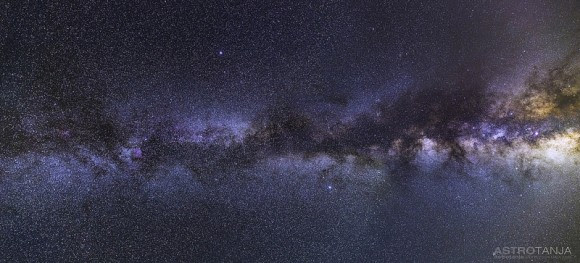
Astrophoto: Stunning Wide-Field Mosaic of the Milky Way

Universe Today

A mosaic of two wide field images taken from the Nevada desert, with the view stretching from Cepheus to the Milky Way core in Sagittarius. Credit and copyright: Tanja Sund.  
 
A mosaic of two wide field images taken from the Nevada desert, with the view stretching from Cepheus to the Milky Way core in Sagittarius. Credit and copyright: Tanja Sund.
This gorgeous view of the Milky Way was taken by astrophotographer Tanja Sund during a trip to the desert in Nevada. Made from just two images, this long exposure (180 seconds) mosaic has incredible detail and stunning clarity. You seriously need to click on this image to see a larger version!


Read More Here
Enhanced by Zemanta

Friday, January 24, 2014

Our Milky Way Galaxy formed by expanding out from the center, possibly having formed inside - out ; suggests analysis of first data from the Gaia-ESO survey


Milky Way Galaxy May Have Formed Inside-Out, Study

Jan 21, 2014 by Sci-News.com

Our Milky Way Galaxy formed by expanding out from the center, suggests analysis of first data from the Gaia-ESO survey – the ground-based extension to the Gaia space mission, launched by the European Space Agency at the end of 2013.
Radial metallicity gradients and age-metallicity relation of stars in the Milky Way disk. Image credit: University of Cambridge.
The astronomers involved with the Gaia-ESO project took detailed observations of stars with a wide range of ages and locations in the Galactic disc to accurately determine their ‘metallicity’: the amount of chemical elements in a star other than hydrogen and helium, the two elements most stars are made from.
Immediately after the Big Bang, the Universe consisted almost entirely of hydrogen and helium, with levels of “contaminant metals” growing over time. Consequently, older stars have fewer elements in their make-up – so have lower metallicity.
“The different chemical elements of which stars are made are created at different rates – some in massive stars which live fast and die young, and others in sun-like stars with more sedate multi-billion-year lifetimes,” said Prof Gerry Gilmore from the University of Cambridge, who is a co-author of the paper submitted to the journal Astronomy and Astrophysics (arXiv.org version).
Massive stars, which have short lives and die as ‘core-collapse supernovae’, produce huge amounts of magnesium during their explosive death throes. This catastrophic event can form a neutron star or a black hole, and even trigger the formation of new stars.
Read More Here
Enhanced by Zemanta

Tuesday, November 5, 2013

Astrophysicists Discover Black Hole in Globular Cluster Messier 62


Nov 5, 2013 by Sci-News.com
A team of researchers reported the first-ever discovery of a black hole in a globular star cluster in our Milky Way Galaxy.

This Chandra X-ray image of the Messier 62's central region shows the black hole M62-VLA1, orange circle. A red cross marks the cluster photometric center. Image credit: Laura Chomiuk et al.
This Chandra X-ray image of the Messier 62′s central region shows the black hole M62-VLA1, orange circle. A red cross marks the cluster photometric center. Image credit: Laura Chomiuk et al.
In 2007, Dr Tom Maccarone from Texas Tech University made the first discovery of a black hole in a globular star cluster in the neighboring NGC 4472 galaxy. But rather than finding it by using radio waves, he detected it by seeing an X-ray emission from the gas falling into the black hole and heating up to a few million degrees.
“Six years ago I had made the first discoveries in other galaxies. It’s surprisingly easier to find them in other galaxies than in our own, even though they’re a thousand times as far away as these in our own galaxy are,” Dr Maccarone said.
This year, the astrophysicist and his colleagues used the Karl G. Jansky Very Large Array in New Mexico to discover a black hole in the Milky Way globular cluster Messier 62.
Messier 62 (M62), also known as NGC 6266, is a globular cluster located in the constellation Ophiuchus about 35,000 light-years away. It measures 110 light-years across and carries around 1 million times the mass of the Sun.
The newly discovered black hole, named M62-VLA1, is the so-called stellar-mass black hole, a type of black holes that comes from the collapse of a massive star.
“Globular star clusters are large groupings of stars thought to contain some of the oldest stars in the Universe. In the same distance from our Sun to the nearest neighbor, Proxima Centauri, its nearest neighbor, these globular star clusters could have a million to tens of millions of stars.”
Read More Here
Enhanced by Zemanta

Thursday, September 12, 2013

Dwarf Galaxies Found to Harbor 1,000 Times More Dark Matter

Sgr_galaxyfield_web_highres
Astronomers at The University of Texas at Austin believe they have discovered the answer to a 20-year debate over how the mysterious cosmic “dark matter” is distributed in small galaxies. They found that the distribution, on average, follows a simple law of decreasing density from the galaxy’s center, although the exact distribution often varies from galaxy to galaxy. The findings are published today in The Astrophysical Journal Letters.
Dark matter is matter that gives off no light, but that astronomers detect by seeing its gravitational tug on other objects (like stars). Theories abound on what dark matter might be made of — unseen particles, dead stars, and more — but nobody knows for sure. Though mysterious, understanding the nature of dark matter is important, because it makes up most of the matter in the universe. The only way to understand how the cosmos evolved to its present state is to decode dark matter’s role.
For that reason, astronomers study the distribution of dark matter within galaxies and on even larger scales. Dwarf galaxies, in particular, make great laboratories to study dark matter, say astronomers John Jardel and Karl Gebhardt, because they contain up to 1,000 times more dark matter than normal matter. Normal galaxies like the Milky Way, on the other hand, contain only 10 times more dark matter than normal matter.


Read More Here


****************************************************

Multiple streams of Sagittarius dwarf galaxy

segasai segasai


Uploaded on Nov 26, 2011
The illustration of multiple streams produced by the disruption of the Sagittarius dwarf galaxy in the Milky Way halo. The orange sphere shows the location of the Sun in the Galaxy. The Sagittarius dwarf galaxy itself is located in the middle of the stream.The size of the area shown in the movie is approximately 600 thousands light years (200 kiloparsecs)
Enhanced by Zemanta