Global Weather Phenomenon-Natural/Technological Disasters-Space Events-Epidemic/Biological Hazards-
Nuclear Events :
News Affiliate of Family Survival Protocol.com
At least 30 houses were destroyed after strong winds and heavy rains
struck a surprised village in Tabina, Zamboanga del Sur, the police
reported Tuesday. Chief Inspector Ariel Huesca, spokesman of Police
Regional Office 9 (PRO), said no one was reported hurt in the disaster
that hit Barangay New Oroquita. Quoting belated reports, Huesca said
that the "sudden storm" struck the village on Friday night. Engr. Rey
Rubio of the Municipal Disaster Risk Reduction and Management Council
said at least 100 residents were forced to leave their homes during the
onslaught. He said several coconut trees were also toppled by strong
winds. Rubio said that the incident was not immediately reported to
authorities because the remote village had not phone signal and that
only a few vehicle pass through the area. He said the disaster's damage
was pegged at P500,000.
4 children feared dead in Zamboanga Sibugay landslide
ByJulie Alipala Philippine Daily Inquirer5:51 am | Friday, May 31st, 2013 ZAMBOANGA
CITY, Philippines—Four children were feared dead after they were buried
alive in a huge landslide in Kabasalan, Zamboanga Sibugay, police
reported Thursday.
Insp. Ariel Huesca, spokesman of the Western Mindanao Police
Office, told the Philippine Daily Inquirer via a text message that the
children were resting in an abandoned house in Purok 4 in Barangay
(village) Sayao around 2:30 p.m. on Tuesday when soil, mud and rocks
moved amid heavy rains.
ZAMBOANGA CITY, Philippines— While Zamboanga City has barely
moved on from the fighting between government troops and Moro National
Liberation Front last month, deaths from the incessant heavy rains
spawned by the intertropical convergence zone in the city for the past
few days rose to five on Wednesday.
More than 17,000 others displaced when floods caused by
continuous heavy rain swept through the city and outlying villages
during the past week, the authorities said.
Although much of the floods have receded, some places remain under water as the rains have continued.
ITCZ brings heavy rains
Maribel Enriquez, chief of the Philippine Atmospheric,
Geophysical and Astronomical Services Administration station in
Zamboanga City, said the Intertropical Convergence Zone was causing all
the rain.
“It’s been there hovering and it is the reason why we have long
hours of rain since last week, making our soil saturated with water,”
Enriquez said.
“When our soil is saturated with water, definitely, we are going to experience flooding and landslide,” she added.
The five-day incessant rains with occasional strong winds
battered the city since Friday last week inundated 6.47 hectares of
farmlands and fishponds.
Damage to crops was estimated to cost P57.9 million.
Sheila Covarrubias, the city’s information officer, said records
of the City Disaster Risk Reduction and Management Center show that a
total of 25 barangays, or city districts and villages, were flooded,
affecting 4,802 families or 17,026 individuals.
Five persons were reported to have drowned in the villages of Tugbungan, San Roque, San Jose Gusu and Putik.
Chief Insp. Ariel Huesca, spokesperson of the Western Mindanao
Regional Police Office, identified two of those killed as Edwina Flores,
58, and her helper Rosanna Fabella, both residents of San Roque.
November
09, 2013 - THE PHILIPPINES - More than 100 people were killed in a
major Philippine coastal city that took the brunt of Super Typhoon
Haiyan, authorities said Saturday. That death toll in Tacloban was the
first significant casualty report in a day when authorities began
surveying the devastation of a typhoon that has been described as
perhaps the strongest storm ever to make landfall in recorded history.
Capt.
John Andrews, deputy director of the Civil Aviation Authority of the
Philippines, told CNN that he received a radio report from the Tacloban
airport station manager who said there are more than 100 bodies in the
street in Tacloban and more than 100 people injured. Traveling aboard a
military cargo plane from Manila, CNN's Paula Hancocks was among the
first journalists to see the catastrophe in Tacloban on Saturday. "It
looks as though a tsunami swept through here," she said by satellite
phone.
The airport terminal was "completely
destroyed," and shell-shocked Filipinos were gathering around the
airport with the anticipation that the military was bringing food, water
and medicine, Hancocks said. Officials told her that the water surge
reached the second story of structures, she said. There were at least
two bodies at the airport, she added. Every tree was flattened or
snapped in half, and the timber landed on roads, blocking
transportation, she said. "You assume as you go inland you'll find more
people who are injured or who have lost their lives," Hancocks said.
From the plane, she said, "you could see a lot of groundwater on the
land itself, and pretty much every single tree was damaged.
"That
showed the sheer force of the surge and the wind," she said. "On the
ocean front, you can see the defenses were damaged." Residents waded
through waist-high water in the streets Saturday. Vehicles were turned
over or piled on one another. Fallen utility poles were in the middle of
roads. Philippine officials feared the death toll would grow. "Yes,
we are worried about the eastern side, the Tacloban area," said Rene
Almendras, secretary to the cabinet. In a separate report earlier
Saturday, as reports began coming in to authorities, the National
Disaster Risk Reduction and Management Council indicated at least four
people were killed. At least seven people were hurt, and four people
were missing, the council also said Saturday. The destruction is
expected to be catastrophic. Storm clouds covered the entire
Philippines, stretching 1,120 miles -- equal to a distance between
Florida and Canada. The deadly wind field, or tropical storm force
winds, covered an area the size of Montana or Germany. The typhoon
first roared onto the country's eastern island of Samar at 4:30 a.m.
Friday, flooding streets and knocking out power and communications in
many areas of the region of Eastern Visayas, and then continued its
march, barreling into five other Philippine islands. Then, predawn
Saturday, it headed toward Vietnam. Haiyan weakened Saturday and was no
longer a super typhoon, rather a typhoon with sustained winds of 130
mph. But the storm could return to super typhoon status Saturday.
..........
Typhoon Haiyan death toll in Philippines estimated at 1,200
Red Cross and other humanitarian agencies describe hundreds of bodies floating in waters and on roads amid destruction
Link to video: Philippines typhoon Haiyan: scale of devastation emerges
The Philippines Red Cross said it has received reports of 1,200 deaths in two areas devastated by typhoon Haiyan.
The
agency said that at least 1,000 had been killed in Tacloban and 200 in
Samar province. The typhoon has passed over the Philippines and is
expected to hit Vietnam later today. Communication and transports links
have been disrupted by the storm making it difficult to assess damage
and offer assistance.
Gwendolyn Pang, secretary general of the
Philippine Red Cross, said the numbers came from preliminary reports by
Red Cross teams in Tacloban and Samar, among the most devastated areas
hit by typhoon Haiyan on Friday.
"An estimated more than 1,000
bodies were seen floating in Tacloban as reported by our Red Cross
teams," she told Reuters. "In Samar, about 200 deaths. Validation is
ongoing."
The death toll from typhoon Haiyan is expected to rise
sharply as rescue workers reach areas cut off by the fast-moving storm,
whose circumference eclipsed the whole country and which late on
Saturday was heading for Vietnam.
Roads in the coastal city of
Tacloban in the central Leyte province, one of the worst-hit areas, were
either underwater or blocked by fallen trees and power lines, and
debris from homes blown away by Haiyan. Bodies covered in plastic
sheeting were lying on the streets.
"The last time I saw something
of this scale was in the aftermath of the Indian Ocean tsunami," said
Sebastian Rhodes Stampa, head of the UN disaster ssessment co-ordination
team sent to Tacloban. "This is destruction on a massive scale. There
are cars thrown like tumbleweed and the streets are strewn with debris."
The
category 5 "super typhoon" weakened to a category 4 on Saturday, though
forecasters said it could strengthen again over the South China Sea, en
route to Vietnam.
A powerful typhoon, dubbed the strongest ever to hit land, strikes
the Philippines, forcing more than a million people to flee their homes,
and is expected to hit China on Saturday. Typhoon Haiyan, a
category-five super typhoon, scoured the northern tip of Cebu province
and headed west towards Boracay island, both of them tourist
destinations, after lashing the central islands of Leyte and Samar with
275kph (170mph) wind gusts and 5-6m (15-19ft) waves. Three people were
killed and seven injured, national disaster agency spokesman Rey Balido
told a news briefing at the main army base in Manila. The death toll
could rise as reports come in from stricken areas. Power and
communications in the three large island provinces of Samar, Leyte and
Bohol were almost completely down but the government and telephone
service providers promised to restore them within 24 hours. The state
weather bureau said Typhoon Haiyan was expected to move past the
Philippines on Saturday and out over the South China Sea, where it could
become even stronger and threaten Vietnam or China.
Chief Forecaster of Guangdong Provincial Meteorological Department, Lu
Shan, said Guangdong has bore the impact of several typhoons this year.
He said: "This year tropical cyclones have affected Guangdong province
quite a lot. "There were 10 typhoons that have seriously affected or
made landfall on Guangdong, three of which made landfall were Rumbia,
Usagi and Utor, respectively. Two of these three made strong landfalls
in our province. "So the typhoons have seriously affected Guangdong this
year." Authorities warned that more than 12 million people were at
risk, including residents of Cebu city, which has a population of about
2.5 million, and areas still reeling from a deadly 2011 storm and a 7.2
magnitude quake last month. "The super typhoon likely made landfall with
winds near 195mph (313kph). This makes Haiyan the strongest tropical
cyclone on record to make landfall," said Jeff Masters, director of
meteorology at US-based Weather Underground.
The death toll from Super Typhoon Yolanda (Haiyan) started to rise
Saturday with one reported death in Iloilo, even as at least four were
reported missing by the National Disaster Risk Reduction and Management
Council. In its 6 a.m. update, the NDRRMC said one of the latest
fatalities was Rhandy Cejar, 56, of Calinog in Iloilo. It said he died
of electrocution. The NDRRMC's list of fatalities includes those whose
deaths are confirmed by the Department of Health. In an iterview on
"News TV Live" on Satruday morning, Secretary to the Cabinet Rene
Almendras said Yolanda's death toll is certainly more than three people,
but he declined to give an exact count. As to estimates to damage to
property, he said, "...inaalam pa ang extent ng damage." But a separate
report by radio dzBB's Palawan affiliate James Viernes said at least
three people were reported dead in Coron. Coron had lost its giant cross
following Yolanda's onslaught. The NDRRMC said at least four were
missing, identified as Cecilito Baluntag (Cebu), Manuelito Casipong, 35,
Emmanuel Gonzales, and Richard Gonzales (Quezon). The NDRRMC also said
Yolanda had affected 161,973 families or 792,018 people, who were
preemptively evacuated to 812 evacuation centers in 37 provinces. At
least five roads in Bicol and Eastern Visayas were not passable. Classes
in private and public schools at all levels were suspended Saturday in
Cavite, Laguna, Batangas, Rizal and Quezon. At least 3,398 passengers,
76 vessels, 743 rolling cargoes and eight motor bancas were stranded in
Southern Luzon, Bicol and Visayas, and even Zamboanga and Jolo. Power
was restored in parts of Sibulan and Dumaguete City in Negros Oriental
and in Siquijor, Siquijor.
One of the strongest storms on record slammed into the central
Philippines, killing more than 100 people whose bodies lay in the
streets of one of the hardest-hit cities, an official said Saturday.
Capt. John Andrews, deputy director general of the Civil Aviation
Authority of the Philippines, said more than 100 others were injured in
the city of Tacloban on Leyte Island, where Typhoon Haiyan hit Friday.
With power and most communications knocked out a day after the typhoon
ravaged the central region, Andrew told The Associated Press that the
information about the deaths was relayed to him by his staff in
Tacloban. "The information is reliable," he said. Nearly 750,000 people
were forced to flee their homes, and damage was believed to be
extensive. Weather officials said Haiyan had sustained winds of 147 mph
with gusts of 170 mph when it made landfall. By those measurements,
Haiyan would be comparable to a strong Category 4 hurricane in the U.S.,
nearly in the top category, a 5. Hurricanes, cyclones and typhoons are
the same thing. They are just called different names in different parts
of the world.
Because of cut-off communications in the Philippines, it was impossible
to know the full extent of casualties and damage. Officially, four
people were listed as dead as of Saturday morning, before the latest
information from Tacloban came in. Southern Leyte Gov. Roger Mercado
said the typhoon ripped roofs off houses and triggered landslides that
blocked roads. The dense clouds and heavy rains made the day seem almost
as dark as night, he said. "When you're faced with such a scenario, you
can only pray, and pray and pray," Mercado told The Associated Press by
telephone, adding that mayors in the province had not called in to
report any major damage. "I hope that means they were spared and not the
other way around," he said. "My worst fear is there will be massive
loss of lives and property." Eduardo del Rosario, head of the disaster
response agency, said the speed at which the typhoon sliced through the
central islands helped prevent its 375-mile band of rain clouds from
dumping enough of their load to overflow waterways. Flooding from heavy
rains is often the main cause of deaths from typhoons. "It has helped
that the typhoon blew very fast in terms of preventing lots of
casualties," regional military commander Lt. Gen. Roy Deveraturda said.
He said the massive evacuation of villagers before the storm also saved
many lives.
Video: Super typhoon hits Philippines with all-time record winds
Published on Nov 8, 2013
One
of the most powerful-ever tropical cyclones based on wind speed has hit
the Filipino island of Samar, forcing millions to flee the area. The
disaster has also sustained wind gusts of 170 mph (275 kph), according
to the Joint Typhoon Warning Center, besting the previous record held by
Hurricane Camile, which struck the US in Mississippi with 190 mph (305
kph) winds in 1969. READ MORE: http://on.rt.com/8r7kg9
RT LIVE http://rt.com/on-air
..........
By Matt Daniel and Deborah Byrd in
Nov 08, 2013
Super Typhoon Haiyan pounds the Philippines
Super Typhoon Haiyan on November 7. Image via NASA. Super Typhoon
Haiyan, called Yolanda in the Philippines, made landfall as one of the
strongest storms ever recorded on Earth.
UPDATE
NOV. 8, 2013, 4:30 CDT (1030 UTC): Super Typhoon Haiyan – Yolanda, as
the storm is known in the Philippines – on Thursday, November 7, became
the strongest typhoon or hurricane of 2013 and one of the strongest
storms ever recorded. The storm plowed across the Philippine islands
after making landfall on Samar, in the region of Eastern Visayas, with
maximum sustained winds at 195 mph. That’s well above the Category 5
classification used for Atlantic and East Pacific hurricanes and just 6
mph shy of an EF-5 tornado. Plus there were gusts up to 235 mph. Both
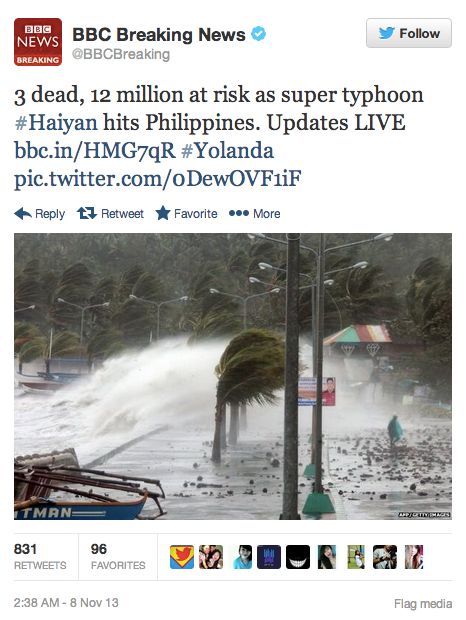
the BBC and CNN are reporting 3 dead at this time. According to CNN:
Three people were reported dead, more than 100,000 took refuge in evacuation centers and hundreds of flights were canceled.
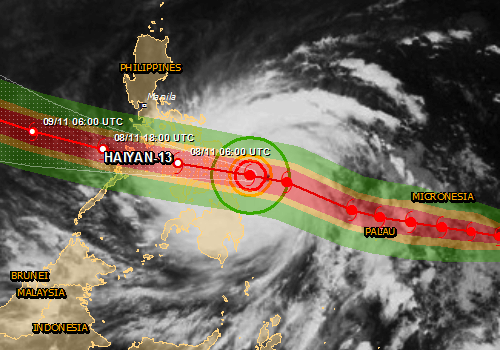
Tropical
Cyclone HAIYAN-13 can have a high humanitarian impact based on the
maximum sustained wind speed and the affected population and their
vulnerability.
Luckily, the storm was not headed for
Manila, the capital and second-most-populous city of the Philippines. In
Manila, which is prone to floods, the lowest alert in a four-level
typhoon warning system was issued. The storm passed near Tacloban, a
city of close to a quarter million people, and Cebu, a city of close to
one million people.
The U.S. Navy’s Joint Typhoon Warning Center
had earlier said it expected the storm to weaken as it crossed the ocean
to the Philippines. Instead, Haiyan intensified and accelerated as it
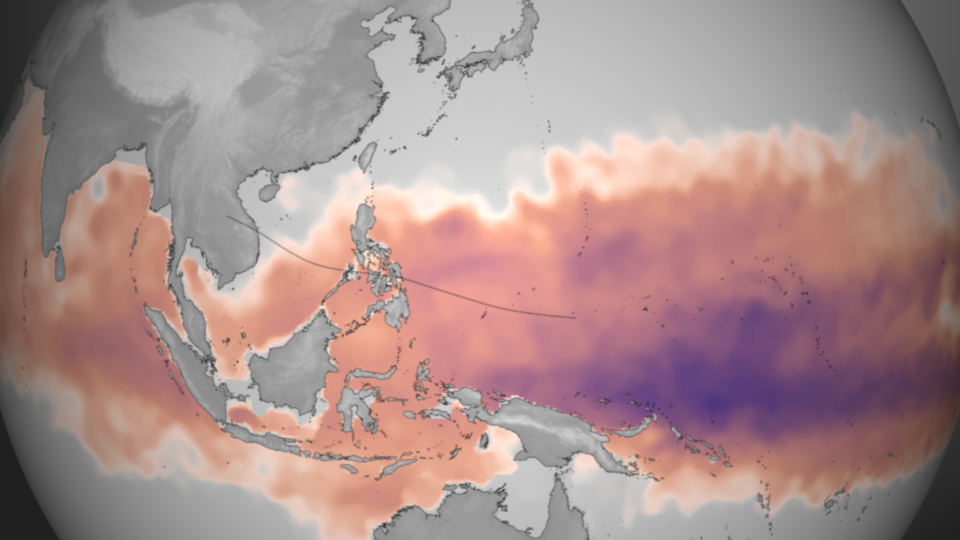
moved closer to the country. Why? According to NOAA’s Visualization Laboratory,
deep warm water in the Pacific fueled Haiyan’s intensification. NOAA
said that “ideal” environmental conditions for intensification – namely
low wind shear and warm ocean temperatures – exist in the Pacific now.
See the orange-ish image below.
NASA’s
Aqua satellite acquired this natural color image of Super Typhoon
Haiyan as it approached the east coast of the Philippines at 1:25 p.m.
local time (4:25 Universal Time) on November 7, 2013. Image via NASA.
Link to video: Typhoon Haiyan brings destruction and displacement to Philippines
Typhoon Haiyan has hit the Philippines
with winds of 195mph, with experts saying "catastrophic damage" will
result from what is predicted to be the strongest tropical cyclone to
make landfall in recorded history.
Thousands of people have been
evacuated and thousands more have fled their homes as the category five
storm sent waves as high as 5m (15ft) ashore on the islands of Leyte and
Samar in the central Philippines, overturning powerlines and leaving
streets knee-deep in water.
Haiyan – the Philippines' 25th typhoon
so far this year – is expected to barrel through the archipelago close
to Cebu, the nation's second-largest city and home to around 2.5 million
people. Image from Japan Meteorological Agency's MTSAT of Haiyan over the Leyte Gulf. Photograph: Zuma/rex
With
speeds at landfall of 195mph and gusts of up to 235mph, Haiyan is
believed to be stronger than the world's last strongest tropical
cyclone, hurricane Camille, which was recorded in the US at 190mph in
1969.



 ZAMBOANGA
CITY, Philippines—Four children were feared dead after they were buried
alive in a huge landslide in Kabasalan, Zamboanga Sibugay, police
reported Thursday.
ZAMBOANGA
CITY, Philippines—Four children were feared dead after they were buried
alive in a huge landslide in Kabasalan, Zamboanga Sibugay, police
reported Thursday.