Global Weather Phenomenon-Natural/Technological Disasters-Space Events-Epidemic/Biological Hazards-
Nuclear Events :
News Affiliate of Family Survival Protocol.com
The death toll from two storms which battered the Philippines rose to 45 Sunday as several towns remained under water and rain kept falling in northern regions, disaster monitoring officials said. The rain was caused by a cold front, dragged into the country by Typhoon Nona (international name Melor) and Tropical Depression Onyok which hit the Philippines in succession last week. Floods almost three meters deep covered some riverside areas north of the capital Manila as heavy rain kept falling, civil defense offices said. “Our home has been flooded up to the waist. It has been flooded for over two days,” said Mary Jane Bautista, 35, in the industrial town of Calumpit 50 kilometers north of the capital. Her family and several others were forced to take refuge on nearby high ground — in front of a church where their only shelter is the awning over the entrance. “My husband has to wade through the waters to go home to get supplies. If we need water, he has to go to the faucet in our kitchen,” she told AFP, expressing fears the current could wash him away.
Wednesday, December 16, 2015, 11:23 AM -
A “larger than normal” dust storm billowed through the Australian
outback town of Boulia Tuesday, creating an otherworldly spectacle.
Local
photographers jumped at the opportunity to capture the Martian-like
moment, where visibility was reportedly limited to just a few metres.
A major dust storm swept over the Queensland town of Boulia on Tuesday. Photo: Kerry Hutchins/Instagram
Photographers have captured incredible images of a major dust storm which hit central west Queensland on Tuesday.
The
outback town of Boulia, located about 500 kilometres west of Longreach,
bore the brunt of the storm which blanketed everything in its path in
red dust.
Ann Britton was on her cattle station when she saw the storm approaching.
"The winds were very strong and the dust blew for a few hours. If you were driving through it you had to stop," she said.
Ms Britton, a local photographer, said visibility was down to a few metres.
Swans
glide by a sandbag barrier on The Strand in Athlone Town, in the
ongoing battle against the rising waters of the Shannon River. Photo:
RollingNews.ie
The Irish Farmer’s Association (IFA) is urging the Government to do more to help farmers affected by flooding.
At
this stage up to 100,000 hectares of land are under water and
communities remain on alert with more rain forecast for this week.
Tonight
the risk of flooding persists along the River Shannon - however
defences are said to be holding steady in Athlone for now.
The
IFA’s Tom Turley says he is concerned about Farmer's mental health and
wants routine Department of Agriculture inspections called off.
“This is just in disarray at the moment,” Mr Turley
“I can’t emphasise this enough, the Department have got to stop these inspections forthwith.
“The
minister just needs to come out and say I’m calling of all inspections
under force majeur circumstances – end of,” he added.
The National Emergency Co-ordination group has said today that water levels in most rivers are falling.
However, water is still rising in the lower half of the River Shannon, although at a lower rate than yesterday.
An
overall view of the River Shannon flowing into Athlone Town: the
National Emergency Coordination Centre has said there is a high risk. Photo by: RollingNews.ie
Towns along the River Shannon are still feeling the effects of recent extreme bad weather, with further rain possibly flooding areas that are not yet under water.
According
to Ireland's national weather service Met Éireann, there may be further
“nasty” weather in the coming week, with the possibility of orange rain
warnings for the south and southwest over the weekend.
Weather
forecaster Gerald Fleming said at a briefing of the National Emergency
Coordination Committee that there is no immediate danger as of yet,
although it may develop into a serious weather event.
Air corps pictures over the Shannon area during Storm Desmond. Image: Air Corps/Photocall Ireland.
“There will be above normal rainfall over the course of the next six or seven days,” Fleming said.
“At
the moment none of the individual events are at the orange status
serious warnings level, but we’ll have to keep a very close eye on that
because a couple of the events have the potential to get there.
“We’re
in a situation where a number of those rain events have the potential
to turn nasty, and potentially they could cause flooding in areas where
there has been no flooding so far if that were to happen.”
Regions along the banks of the Shannon, Ireland’s longest river, are still battling with flooding
caused by Storm Desmond over a week ago, with flood levels in the Lower
Shannon area, from Lough Derg to Limerick City, only expected to reach
their peak on Tuesday.
A
resident walks past big waves spilling over a wall onto a coastal road
in the city of Legaspi in Albay province, south of Manila, on Dec. 14.
More
than 700,000 people in the central Philippines fled to safer areas for
fear of giant waves, floods or landslides as Typhoon Melor slammed into
the archipelago nation Monday, officials said.
Meteorologists
from the Philippine Atmospheric Geophysical and Astronomical Services
Administration (PAGASA) monitor and plot the direction of powerful
Typhoon Melor at their headquarters in suburban Manila on Dec. 14.
Melor
crossed the central Burias Island late Monday, with authorities warning
that traditional thatched homes were unlikely to withstand the strong
winds and that crops may suffer heavy losses. There were no immediate
reports of casualties or damage.
The typhoon brushed the northern
tip of Samar, a farming island of 1.5 million people, early Monday with
winds gusting up to 185 kilometres (115 miles) per hour, the state
weather bureau said.
Samar was among areas devastated in 2013 by
Typhoon Haiyan, when giant waves wiped out entire communities and left
7,350 people dead or missing.
Authorities warned that Melor's
powerful winds might whip up four-metre-high (13-feet) waves, blow off
tin roofs and uproot trees. They said heavy rain within its
300-kilometre diameter could trigger floods and landslides.
Westmeath
County Council has placed two families in alternative accommodation as
flooding continues to threaten parts of Athlone town. While the family's
homes on the west side of town were not flooded, both houses suffered
flooding in 2009 and the families asked to be moved because they found
the current situation too stressful. River Shannon levels in Athlone
rose by about 8cm between Wednesday and Thursday. However, due to the
efforts of locals, council staff, the Defence Forces and the civil
defence, floodwater was kept out of houses. Additional pumps have been
deployed in some of the worst-affected areas. In places such as Deerpark
Road, the water levels appear to have dropped. Despite the flood
defence measures, there are major concerns about the impact further
predicted bad weather could have on the town. Director of services at
Westmeath County Council Barry Kehoe is hoping the forecast provided by
the ESB is not accurate. It suggests a further rise of 31cm which would
see the Shannon at levels just below those of 2009. "There is a bad
forecast for Saturday of heavy rainfall," Mr Kehoe said. "The effect of
it will be to drag out the whole scenario into next week." While some
waste water had mixed with the flood water, Mr Kehoe said there was no
problem with the water supply in the town. "It [the floodwater] always
needs to be treated as dirty water and a hazard," he said, adding that
the council was prepared for evacuations. In the case of the two
families who were provided with accommodation on Tuesday and Wednesday,
Mr Kehoe said "some people have requested alternative accommodation as
it is just too stressful for them". In outlying areas such as Clonbonny
and Carrickobrien, some people were "marooned", Mr Kehoe said. A
transport service was being provided to bring children to school, to
take people to medical appointments and for other essential journeys.
Although areas like the Strand and Wolfe Tone Terrace remain under
threat on the east side of town, and Deerpark Road and The Park and
Parnell Square on the west side, the remainder of the town is continuing
to operate as normal. The Defence Forces has between 30 and 35 troops
filling sandbags and moving heavy pumps in Athlone. A spokesman said the
troops had been on flood defence operations since 7am.
Athlone fearful things will worsen next weekFriday, December 11, 2015
by Eoghan MacConnell
Westmeath
County Council has placed two families in alternative accommodation as
flooding continues to threaten parts of Athlone town.
While
the families’ homes on the west side of town were not flooded, both
houses suffered flooding in 2009, and the families asked to be moved
because they found the situation too stressful.
Flood defence
measures prevented flooding from occurring despite rising water levels
in Athlone, Co Westmeath on Wednesday night. It’s estimated that 90
houses could flood in Athlone if water levels reach those last seen in
November 2009.
River Shannon levels in Athlone rose by around 8cm
between Wednesday and Thursday. However, thanks to the efforts of
locals, council staff, the defence forces and the civil defence,
floodwater was kept out of houses.
By
Thursday morning the wind, which had been driving water towards the
town, had eased as workers continued to battle the floodwater.
Extra
pumps have been deployed in some of the worst affected areas. In places
like Deerpark Road, the water levels appear to have dropped. Despite
the flood defence measures there are major concerns about the impact
further predicted bad weather could have.
Families request evacuation as flood threatens town
Locals,
council staff, Defence Forces and Civil Defence keep floodwater out of
Athlone houses with additional pumps deployed in worst-affected areas
Thu, Dec 10, 2015, 22:00
Eoghan MacConnell
Flooding this week along the banks of the Shannon river near Athlone town. Photograph: Brenda Fitzsimons/The Irish Times
Westmeath County Council has placed two families in alternative accommodation as flooding continues to threaten parts of Athlone town.
While
the family’s homes on the west side of town were not flooded, both
houses suffered flooding in 2009 and the families asked to be moved
because they found the current situation too stressful.
River
Shannon levels in Athlone rose by about 8cm between Wednesday and
Thursday. However, due to the efforts of locals, council staff, the Defence Forces
and the civil defence, floodwater was kept out of houses. Additional
pumps have been deployed in some of the worst-affected areas.
In
places such as Deerpark Road, the water levels appear to have dropped.
Despite the flood defence measures, there are major concerns about the
impact further predicted bad weather could have on the town.
The
village of Glenridding, which had been cut off since Sunday, was hit
with a deluge of water after the river burst its banks. A "multi-agency"
response, which includes the military and fire services, got under way
last night amid concerns that the latest flooding may endanger lives.
"Although the flood water is starting to recede, it is still extremely
unsafe and would ask any members of the public not to walk or travel
through any flood water". "Cumbria police would like to urge the people
of Glenridding to stay inside their properties to keep themselves and
their families safe", police said. The Cumbria Flood Recovery Fund 2015
is created to assist any individuals or families who suffer financial
hardship as a result of the flooding caused by Storm Desmond. The
military has been called in to the village to help deliver food and
water. Mark Williamson, operations director for Electricity North West,
said: "We have now restored power to the vast majority of homes in
Cumbria". Local farmer Joe Taylforth said he witnessed "folk holding
hands" as they attempted to get out of their flood-ridden homes and
businesses adjacent to the river. "This community is strong and will
pull together again to make sure everything returns to normal as quickly
as possible". Andy Beeforth, Chief Executive of Cumbria Community
Foundation, said: "It is hard to assess the scale of the need, but we
know that the flooding will cause significant financial hardship and
emotional distress". John Bibby, 36, feared he would not be able to get
wife Katharine to hospital because the Backbarrow bridge was destroyed
and the only other road was under 3ft of water. The video shows the
hugely swollen River Eamont rushing past the remains of Pooley Bridge
following its collapse. He said work done after floods six years ago was
not enough to help when the latest rain hit. This morning Liberal
Democrat leader Tim Farron, MP for Westmorland and Lonsdale, described
the situation as "absolutely horrendous" and said lessons must be
learnt. There are reports that the water is 3ft deep in places, after
flood defences were overtopped in two places. "They definitely need to
do some upstream flooding rather than just waiting for it all to come
down". "Events like this serve as a harsh reminder of the finite
capacity of our flood defences, and the destructive impact extreme
flooding has on our communities", says Professor David Balmforth, Flood
Expert and Past President of the Institution of Civil Engineers. The
Glenridding Hotel was under water again prompting the owners to issue an
online appeal for people to bring sandbags to help cope with the
problem.
...........
Storm Desmond
claims its THIRD victim: Pensioner, 70, hit by sign blown over in high
winds dies in hospital - as new aerial pictures show the awesome scale
of the floods that have hit Cumbria
Pensioner, 70, has become the third person to die from Storm Desmond after he was hit by a falling sign in Berwick
Residents of Cumbrian village Glenridding are facing further torment after flooding hit the region for a second time
As homeowners began huge clean-up operation from weekend's floods, nearby River Beck broke its banks again
Police warning residents to stay indoors amid fears floods could 'endanger lives' and homes remain without power
The Met Office has also issued a weather warning about the risk of snow in parts of northern England on Saturday
George Osborne has announced additional £51million to support households and businesses affected by flooding
The Mail has launched an appeal to help those affected by the floods. See the information below on how to donate
Published: 19:09 EST, 9 December 2015 | Updated: 01:57 EST, 11 December 2015
A
70-year-old man has become the third person to die because of Storm
Desmond after he suffered fatal injuries when he was hit by a falling
sign which was blown over in high winds.
The
pensioner was struck by the sign as he walked along a street in
Berwick, Northumberland, as more than 13.5 inches of rain lashed the
region on Saturday – bringing widespread flooding which has devastated
entire communities.
He was taken to
hospital but police today confirmed he died from his injuries last
night, making him the third person to be killed as a result of the
storm.
It comes after Ernie Crouch, 90,
died when he was blown into the side of a moving bus by strong winds
near Finchley Central Tube station in London on Saturday, and the body
of a 78-year-old man was recovered after he fell into fast-flowing
floodwater in the swollen River Kent in Kendal, .
Meanwhile,
incredible aerial photographs taken today show the vast extent of the
flooding which forced thousands of people out of their homes and left a
wake of deluge and devastation.
The
images show how much of Carlisle remains besieged by floodwater more
than five days on from the record rainfalls which saw the worst flooding
across the region in decades.
Incredible
aerial photographs taken today show the vast extent of the flooding
which forced thousands of people out of their homes in Carlisle and left
a wake of devastation after Storm Desmond brought record amount of
rainfalls including 13.5 inches in just 24 hours
These
aerial photos show how Carlisle United Football Club's ground has
finally dried out after being besieged by waist-high floodwater
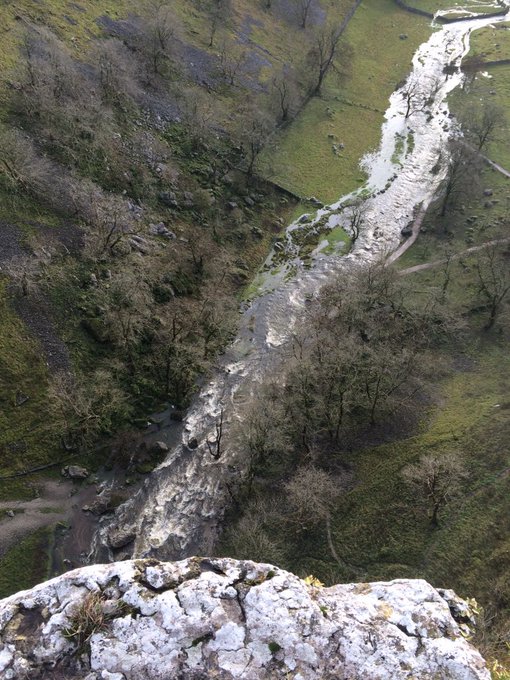
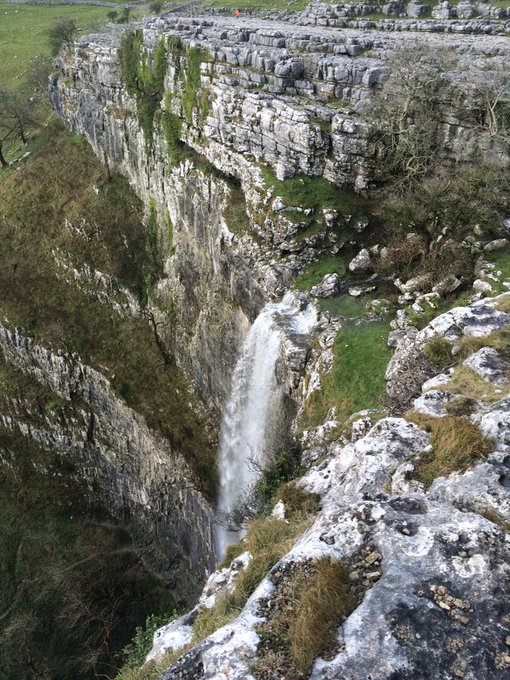
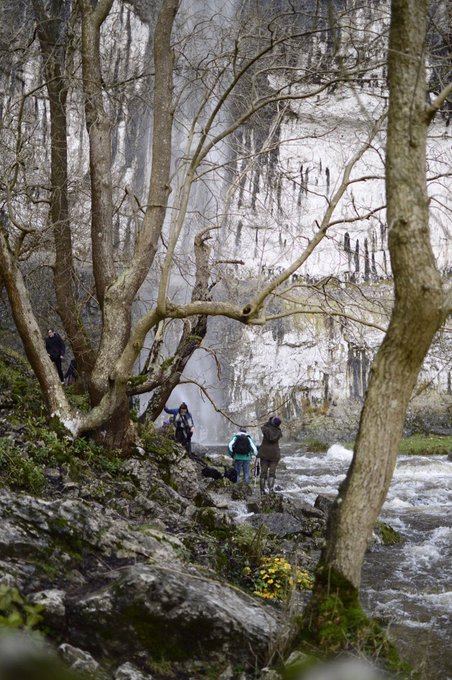
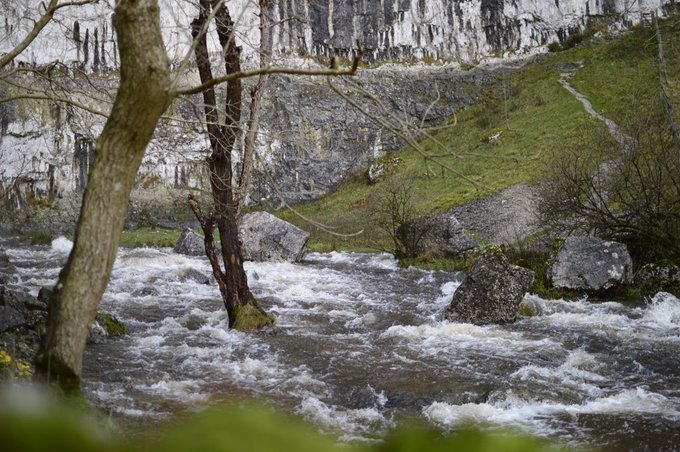
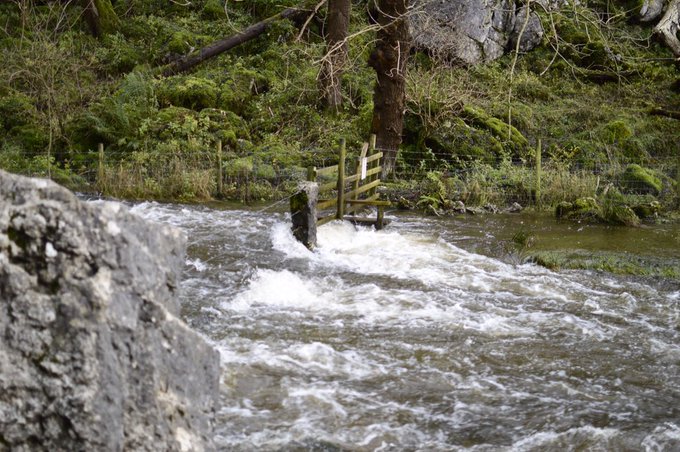
Storm Desmond has brought a waterfall back to life at a famous beauty spot for the first time in living memory.
While
they last, the falls at Malham Cove in the Yorkshire Dales are believed
to be the highest in England, thundering off a cliff 260ft (80m high).
Local residents
and tourists gathered on Sunday to see the phenomenon, which is
believed to be the first time the falls have flowed in hundreds of
years.
Stu
Gledhill, who filmed the scene, wrote on YouTube: “Talking to two
neighbours who are both around 80 and have both lived in Malhamdale all
their lives.
"They
have never seen this happen before, and some suggestions are that it
could be nearly 200 years since it was last recorded.”
A rescue team helps to evacuate people from their homes after Storm Desmond floods Carlisle Getty
Hundreds
of people have been made homeless and thousands more left without power
by Storm Desmond, which is thought to have broken the rainfall record
set in 2009.
46 severe flood warnings remain in place in north-west England, where Cumbria was declared a major incident.
The
army has been drafted in to help evacuate people from their homes and
rescue those stranded after the river Eden burst its banks at
Appleby-in-Westmorland, sweeping away bridges and sinking some
properties under a metre of water.
About 350 soldiers were dispatched
from the 2nd Battalion the Duke of Lancaster's Regiment to Carlisle,
one of the worst affected towns. A Chinook helicopter and mountain
rescue teams were also sent out to assist victims.
11,000 homes in Lancaster have had electricity restored, with 44,000 more expected to have power back by Monday evening.
According to the BBC,
provisional figures suggest more than 340mm of rain fell in 24 hours in
the Lake District, breaking the record of 316.4mm previously held by
Seathwaite, Cumbria, in 2009.
STORMS UPDATE: Army drafted in to deal with Storm Desmond chaos
Crook O Lune near Lancaster
16:42Sunday 06 December 201512:43Saturday 05 December 2015
The
extent of the devastating flooding from the torrential rain and gale
force winds that have hit Lancashire in the last 36 hours is being
revealed.
Army trucks have been stationed at a hospital in
Lancaster to act as ambulances after flooding cut the city off from the
power grid and blocked all but one access route.
Crook O Lune near Lancaster
The
hospital has also cancelled all non-emergency operations tomorrow and a
number of clinics as emergency services struggle to deal with the scale
of the incident.
The north of the county - in particular Lancaster and surrounding areas - has been by far the worst hit.
From
domestic electrical faults to people stuck in cars in flood water,
Lancashire Fire and Rescue Service has been inundated with calls for
help.
A spokesperson for the service said this morning: “In the
last 24 hours we’ve had approximately 300 calls, and we’ve attended
probably 200 incidents.
Storm Desmond: Homes flooded and thousands without power
6 December 2015
Tens
of thousands of homes are without power after Storm Desmond caused
severe flooding and travel disruption across northern England and parts
of Scotland.
Power at about 55,000 homes could be off for "days" following flooding at an electricity substation in Lancaster.
Prime Minister David Cameron said the government was doing all it can to help people and prevent further damage.
Mr Cameron will chair a meeting of the Cobra contingencies committee on Monday to co-ordinate the emergency response.
"I
would like to pay a huge tribute to all those emergency workers and
troops who have worked tirelessly to respond to this weekend's events,"
he said.
"There has been a tremendous response from local communities too, with people taking in families affected by the flooding."
Storm
Desmond has lashed large areas of England and Scotland as severe
flooding and winds of up 80mph caused police to declare a major
incident.
More than 30 severe storm warnings – indicating danger
to life – were issued in Cumbria and Northumberland, and two severe
storm alerts were issued in south-west Scotland as heavy rain
continued well into Sunday.
Read more
Man, 90, dies after ‘gust of wind blows him against moving bus’
Homes
in the Cumbrian towns of Appleby and Keswick were evacuated and drivers
were rescued from stranded cars as flood waters breached defences,
submerged streets and disrupted road and rail services.
In London,
a 90-year-old man died near Finchley Central station after he was blown
into the side of a moving bus by a gust of wind.
The storm also
caused disruption in north Wales, Northern Ireland and North Yorkshire,
where thousands of homes were left without electricity.
Wettest day in Portland history causes landslides, floods
KGW.com Staff 8:14 p.m. PST December 7, 2015
PORTLAND,
Ore. -- Monday was the wettest calendar day in recorded history in
Portland, and the rain is expected to stick around for days.
KGW
meteorologist Matt Zaffino said nearly 2.7 inches of rain on Monday tied
a record for one day, from 12:01 a.m. to 12:00 a.m. The previous record
was set on Nov. 19, 1996. More rain is forecast for Monday night, and
Zaffino said the record is sure to break.
The storm that caused
floods, landslides, road closures and even a sinkhole is expected to
bring its next wave of heavy rain on Tuesday, possibly during the
evening commute.
People should expect delays in every mode of
transportation in the metro area for the next several days, according to
the Portland Bureau of Transportation.
Authorities were offering sand bags to any area residents who need them.
At
a news conference Monday afternoon, Portland Bureau of Transportation
spokesman Dylan Rivera called the weather an "extraordinary event that
had extraordinary impacts."
Rivera said 5.61 inches of rain have fallen so far this month, with three inches falling within a 12-hour period.
The December average for rainfall in the metro area is 5.49 inches.
KGW
Meteorologist Rod Hill said said the worst of the storm has not even
hit yet. That will likely happen on Tuesday night and continue into
Thursday.
Severe flooding has been reported in parts of southern Norway
after heavy rain brought by storm Synne between 04 and 06 December
2015. Maudal in Gjesdal, Rogaland saw just under 300 mm of rain in 3
days.
No injuries or deaths have been reported. However the flooding
has caused some damage to roads, bridges and homes in Rogaland,
Aust-Agder and Vest-Agder counties. Around 100 families had to be
evacuated from their homes in Eigersund, Rogaland county. Norway’s state
broadcaster, NRK, reports that around 30 farms have also been severely hit, suffering major damage. Floods in Eigersund, Norway, December 2015. Photo: Eigersund KommuneThe
rain has now stopped but river levels remain high. Authorities in
Sweden also report high river levels in western parts of Götaland and
nothern part of Halland.
Parts of southern Norway saw flooding earlier this year after 97 mm of rain fell in Melsom during a 24 hour period between 01 and 02 September 2015.
A
rescue team searches for survivors and remove bodies after a landslide
at Jemblung village in Banjarnegara, central Java province, on December
13, 2014. PHOTO: AFP
JAKARTA: A
landslide triggered by torrential rains on Thursday engulfed a village
in western Indonesia, burying 18 people, an official said.
Three
have been found dead and rescuers are searching for the bodies of 15
others after the landslide hit the village of Lebong Tandai on Sumatra
island, a hilly area known for gold mining.
Several houses were
buried when mounds of earth and rocks surged down a hillside in the
early hours, said disaster agency spokesman Sutopo Purwo Nugroho.
Meteorology directorate warns against heavy snowfall across Turkey
The
Central Anatolian city of Sivas was quickly covered by heavy snow on
Wednesday. There has also been snowfall in the capital, Ankara. (Photo:
Cihan)
December 02, 2015, Wednesday/ 18:40:36/ TODAY'S ZAMAN / ISTANBUL
The General Directorate of Meteorology has released a statement saying that heavy snowfall is expected in Turkey on Wednesday night and warns of traffic-related problems.
The
warning came after snow started falling in the capital city of Ankara
early on Wednesday, covering the city in a short time. There has also
been snowfall in Kayseri, Nevşehir, Sivas and Yozgat provinces.
As
the snowfall intensified in Bolu and Ankara, highway maintenance teams
shoveled the snow and salted the roads trying to open up the blocked
highways, especially the TEM and D-100 near Bolu. The police also
advised that people residing in these provinces should be careful when
driving.
The directorate emphasized in its statement that heavy
snowfall and blizzards will be seen on Thursday in some provinces that
include Ağrı, Bitlis, Hakkari and Van and in the eastern parts of
Şırnak, Siirt and Muş. “People [residing in these provinces] should be
careful about possible ice and frost that might cause problems to
traffic,” the statement read.
Britons are braced for more lashing rain as flood warnings were issued for parts of the country as Storm Clodagh wreaked havoc.
Flights
were diverted, trains delayed and traffic held up on motorways at the
weeknd as heavy rain and strong winds hit Scotland and the north west of
England.
There is little sign of
respite with the Environment Agency issuing yellow flood warnings for
Wales and the north of England for Monday and Tuesday. By Wednesday, two
days of rain could leave parts of north Wales under 60mm of
precipitation.
The north of England
could see 30-40mm of rain during the same period, say the Met Office. A
spokeswoman also warned that parts of Scotland, which is on a yellow
snow warning, could have 2.5cm of snow on Monday.
A
Tynemouth RNLI Lifeboat recovers a small boat in the mouth of the Tyne
after rescuing its participants following its capsizing in gale force
winds Photo: Owen Humphreys/PA
On Sunday in Ireland, thousands of properties were left without electricity after Storm Clodagh battered the republic.
Meanwhile,
coastguards had to pull a windsurfer out of the water at Seaburn Beach,
Sunderland, after he was separated from his board in 60 mph winds. Two
people were rescued from the Tyne by the RNLI after their boat was
capsized by the wind.'
Storms
in the US Midwest have claimed at least 14 lives as temperatures
plunged below freezing point over the holiday weekend. Tens of thousands
of homes have been left without electricity, while driving conditions
are treacherous due to icy roads.
A
wintry storm system that has been moving through parts of the Great
Plains and the Midwest since Thursday has brought extremely cold weather
to the region. Eight people have lost their lives in Texas, with a
further six dying in the state of Kansas.
The icy conditions are
also causing havoc for local residents. Some 78,000 people in parts of
Oklahoma have been left without power after trees collapsed onto power
lines, according to Oklahoma Gas and Electric Co.
(CNN) —The governor of Oklahoma, Mary Fallin, has declared a state of emergency for her state, according to KOCO.
This follows an ice storm and flooding that has knocked out power for thousands of people throughout the state.
Meanhwhile,
flooding and wintry precipitation have led to at least 10 deaths in
Texas and Kansas as a storm system moves across the central Plains,
authorities reported.
Five people died in single-vehicle accidents
in Kansas, according to Lt. Adam Winters with the state's Highway
Patrol. He said all of the accidents could be attributed to black ice or
hazardous road conditions.
Flooding claimed at least three lives
in the Dallas area. The victims include a man in Garland, northeast of
Dallas. Benjamin Floyd, 29, was on his way to work when raging
floodwaters swept his car off the road, according to CNN affiliate KTVT.
He was unable to get out of his vehicle before it was submerged Friday,
Garland city officials said.
The two other flooding deaths came in Johnson County, south of Fort Worth, county emergency management officials said.
The
National Weather Service reported ice storms in the Texas Panhandle.
Three people died in a road accident on Interstate 40 about 45 miles
west of Amarillo, the weather service reported.
Keep those summer beach memories close to hand - the first winter snow is here.
Almost
the entire Lika region was caught in snowy weather last night. In
Gospić, more than 30 centimetres of snow has fallen, while in
mountainous areas the snow cover is even higher. Snow has caused the
falling down of many trees which have damaged electrical lines, so the
wider area of Gospić was without power this morning. Director of
Elektrolika Ernest Petri said that two transmission lines that supply
electricity to Gospić have broken down. There are problems with the
local phone lines as well, reports Index.hr and Vecernji List on November 22, 2015.
Snow
and strong winds are causing traffic problems in the Primorje region.
The Lika-Senj Police Department has announced that the Adriatic highway
from Karlobag to Sveta Marija Magdalena is completely closed down, and
on all the roads in Lika winter tyres are mandatory.
Winter
Storm Bella not only brought the first, not to mention locally heavy,
accumulating snow of the season for some in the Great Lakes and Midwest,
but also was one of the heaviest November snowstorms of record for
some.
Despite lacking strong
surface low pressure, these systems are notorious heavy snow generators
in the Midwest. Below is a recap of the snow totals from Winter Storm
Bella.
Snowfall Totals
Numerous locations
from southeastern South Dakota to southern Wisconsin, northern Illinois
and lower Michigan have reported a foot or more of snow from the storm.
Here is a sampling of official snowfall totals around the area, by state:
Indiana: Crown Point (5 inches), Lafayette (3.5 inches), near South Bend (3 inches), Tipton (2 inches)
Bella also produced the season's first flakes as far south as northwest Arkansas Saturday morning, and left a dusting of snow in Springfield, Missouri, as well.



 A major dust storm swept over the Queensland town of Boulia on Tuesday. Photo: Kerry Hutchins/Instagram


 Flooding this week along the banks of the Shannon river near Athlone town. Photograph: Brenda Fitzsimons/The Irish Times


A rescue team helps to evacuate people from their homes after Storm Desmond floods Carlisle Getty


 Homes
in the Cumbrian towns of Appleby and Keswick were evacuated and drivers
were rescued from stranded cars as flood waters breached defences,
submerged streets and disrupted road and rail services.
Homes
in the Cumbrian towns of Appleby and Keswick were evacuated and drivers
were rescued from stranded cars as flood waters breached defences,
submerged streets and disrupted road and rail services.


 A
A 


