Thursday, February 27, 2014

Tornado - New Zealand, South Island, [North Canterbury]

Earth Watch Report  -  Tornado


.....
February 26 2014 06:35 PM Tornado New Zealand South Island, [North Canterbury] Damage level Details

.....
Description
A tornado has ripped its way through North Canterbury in New Zealand as rough weather and lightning caused extensive damage. The Civil Defence has arrived at the scene to inspect the damaged properties. According to fire service shift manager Andrew Norris, a group of homes in Amberley have been heavily damaged. The town is 50km north of Christchurch. Based on fire service reports, strong winds from the tornado had lifted the tiles off roofs of homes near the Burnham Military Camp. Southern Fire Communications Shift Manager Karl Patterson said he received reports of one house losing an entire roof. The tornado, barreling its way through South Island, also knocked down trees and caused power poles to catch fire. Mr Patterson said the fire service put out fires in Halsquell Quarry which were caused by lightning. Despite the damages to some homes and power lines, no casualties or injuries were reported. The clean-up continues in tornado-damaged areas, although 30 homes reported having no electricity by the afternoon of Feb 24. A resident from Amberley, Donna Graham, told Radio New Zealand that she and her husband, Geoff, saw the tornado form from hanging black clouds and realised the twister was moving straight to her house. She and her husband began running away from the house. They could hear the noises made by the tornado as it moved. The couple came out when they noticed they could not hear the tornado anymore. Civil Defence inspector Kerry Walsh said the damage caused by the tornado was worse than he expected. He said the clean-up was doing well. South Island's lines company Mainpower remarked that some of the power poles had to be replaced before electricity will be restored to homes. Aside from the tornado in Amberley, a smaller tornado was spotted in Leeston and was captured on video by "stormchaser" Stephen Burrows. Mr Burrows said the smaller tornado was approximately 100 metres wide but looked weaker in comparison to the one in Amberley. The tornadoes were caused by a severe thunderstorm in parts of Canterbury. The MetService has warned residents in the area to prepare for a storm with torrential rain and large hail. According to weather authorities, the storm had formed near the coast of Timaru and made its way to Christchurch. The storm was classified as a "supercell" because it caused large hailstones and small tornadoes.

.....

The New Zealand Herald


Tornado strikes homes as storm lashes town


A damaged building on a plant farm near Amberley, north Canterbury. Photo / Martin Hunter
Rough weather, lightning, and reports of a tornado caused extensive damage in North Canterbury last night.
Video
Fire service shift manager Andrew Norris said a "cluster of houses" in Amberley, 50km north of Christchurch, had been badly damaged about 6.30pm.
Southern fire communications shift manager Karl Patterson said the strong winds lifted tiles off roofs near the Burnham Military Camp area and three houses in Amberley, 50km north of Christchurch, were also affected.
"One house completely lost its roof. Another house had extensive roof damage [and] windows blown in."
The weather also caused power pole fires and trees to be knocked down," Mr Patterson said.
"Apparently a tornado of some description sort of went through just near the coast - it caused a little bit of damage, but we did a check of all the houses in the area and they were ok.
"We had a couple of fires started by lightning, we had a fire in Halswell Quarry, out the south-west side of town.
"Also, in Little River we had a tree catch on fire in the middle of a tree plantation of some description."
There were no reports of injuries, Mr Patterson said.

Read More Here

.....


Enhanced by Zemanta

Biological Hazard - France, Brittany Region, [Finistere area] : Mass Animal Die Off (Birds)

Earth Watch Report  -  Biological Hazards - Mass Animal Deaths


.....
February 26 2014 05:39 PM Biological Hazard France Brittany Region, [Finistere area] Damage level Details

.....
Description
Weakened and exhausted by successive storms, more than 21,000 dead seabirds washed up on the beaches of the Atlantic coast since late January, an unprecedented "massacre" for at least a century, announced today the League for the Protection of Birds (LPO). Until February 24, 21,341 dead seabirds are registered in the Basque country in southern Finistère and 2,784 sent in rescue centres. Atlantic puffin and guillemot are the most affected species, and to a lesser extent, razorbill.
Biohazard name: Mass. Die-off (birds)
Biohazard level: 1/4 Low
Biohazard desc.: Bacteria and viruses including Bacillus subtilis, canine hepatitis, Escherichia coli, varicella (chicken pox), as well as some cell cultures and non-infectious bacteria. At this level precautions against the biohazardous materials in question are minimal, most likely involving gloves and some sort of facial protection. Usually, contaminated materials are left in open (but separately indicated) waste receptacles. Decontamination procedures for this level are similar in most respects to modern precautions against everyday viruses (i.e.: washing one's hands with anti-bacterial soap, washing all exposed surfaces of the lab with disinfectants, etc). In a lab environment, all materials used for cell and/or bacteria cultures are decontaminated via autoclave.
Symptoms:
Status: confirmed

.....

 Huffpost Green


21,000 Birds Killed In France By Slew Of Storms

Posted: Updated:

Main Entry Image

Photo taken on February 10, 2014 shows the bodies of puffins washed up on a beach in Sainte-Marie-de-Re, western France, after heavy storms. The Atlantic storms that have buffeted Europe in recent days have killed at least 5,000 sea birds on the French coast, half of them puffins. Most of the birds whose bodies have been washed up on beaches between the Pyrenees and Brittany died of exhaustion or starvation as a result of days of gale-force winds, which made it impossible for them to fish. | XAVIER LEOTY via Getty Images


Thousands of birds have been killed in France. The culprit? Winter storms.
In a statement, the League for the Protection of Birds said that violent storms in January and February were responsible for the deaths of 21,341 birds. The country has apparently not seen a bird "slaughter" that large since 1900, the Agence France-Presse reports.
An initial estimate released earlier this month put the death toll at 5,000. But once the organization enlisted volunteers to help with the count from the start of the month through Feb. 24, the number rose dramatically.
Of the species of sea birds affected, the Atlantic puffin had the highest numbers of deaths, with more than 12,229 deceased found. Large numbers of the common murre (or black guillemot) and razor-billed auk were also killed. The league expects the overall death toll to rise as it continues to track the bodies through the end of the month.

Read More Here

.....

Storms wash up 500 dead seabirds: Bodies of guillemots and razorbills recovered after they died of exhaustion due to the weather

  • Storms over the past month have made it hard for birds to hunt and feed
  • Majority of dead birds were washed up at Chesil Cove in Dorset
  • But numbers pale in comparison to 15,000 puffins found dead in France
By Daily Mail Reporter
|

Hundreds of seabirds have been washed up along the south-west coast after dying of exhaustion in the recent storms.
The bodies of almost 500 birds, mostly guillemots and razorbills, have been recovered from the beaches of Cornwall, Devon and Dorset after they perished at sea.
Experts at the Dorset Wildlife Trust said consistent gale-force storms in the English Channel during the past month had made it very hard for the creatures to hunt and feed.
Devastated: The bodies of almost 500 birds, mostly guillemots - like the one pictured in this stock image - and razorbills, have been recovered from the beaches of Cornwall, Devon and Dorset after they perished at sea

The malnutrition coupled with flying in ferocious winds meant they became exhausted and died.
Birds fared even worse across the Channel, where 15,000 puffins were found dead on the shores of France.
The French League for the Protection of Birds said the tragedy could have a devastating effect on the coming breeding season.
The majority of the dead birds have washed up at sheltered Chesil Cove in Dorset, having being swept across Lyme Bay by south westerly winds.
Some conservationists have claimed the birds have been killed by a pollutant similar to palm oil but this has been ruled out by the Dorset Wildlife Trust (DWT).

Read More Here

.....
Enhanced by Zemanta

Volcano Activity - Indonesia, West Sumatra, [Mount Merapi Volcano]

Earth Watch Report  -  Volcanic Events

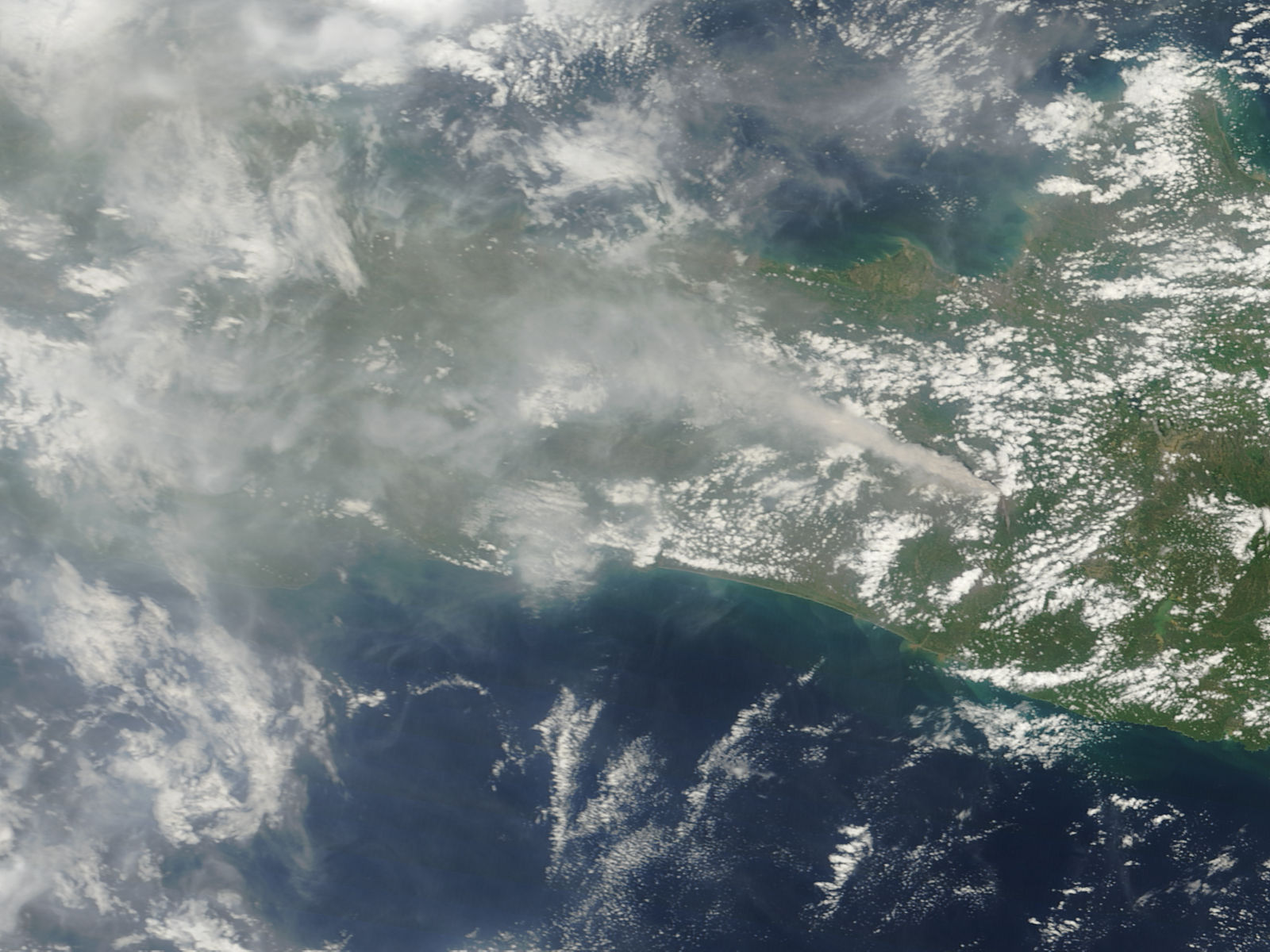
 File:Merapi ash plume MODIS sat image 10 Nov 2010.jpg
Thick plume of ash rising from the Merapi Volcano on November 10, 2010 and travelling to the west. From Moderate Resolution Imaging Spectroradiometer (MODIS) on NASA’s Terra satellite, A dark brown streak down the southern face of the volcano is ash and other volcanic material deposited by a pyroclastic flow or lahar.
Author  -   NASA  public domain


.....
February 26 2014 05:34 PM Volcano Activity Indonesia West Sumatra, [Mount Merapi Volcano] Damage level Details

.....

Description
Another ash eruption occurred at the volcano this afternoon at 16:15 local time. According to local news quoting the local VSI volcano observatory spokesman, the eruption today was the largest in a series since the alert status had been raised on 3 August last year. Ash fell in a radius of 3 km where some villages are located. Also according to the article, the volcano has had a total of 57 recorded eruptions since January 2014. Since all of these have been small, and Indonesia is very used to small volcanic eruptions, they hardly make any news at all (while such an event at other volcanoes would). The alert status remains unchanged at 2 out of 4. People were recommended to avoid exposure to ash if possible and wear dust masks.

.....

Metro TV News


The Citizens Of Merapi Prompted To Be Alert


Kamis, 13 February 2014 | 15:10 WIB
ANTARA/Noveradika/ip


Metrotvnews.com, Klaten district: citizens around Merapi are asked to remain vigilant of  activity. In the meantime, residents have asked that the damaged to evacuation routes on the slopes of  the Mount  be repaired immediately.

Citizens are urged  to take precautions against disasters , the volcano's activity in some areas has increased  of late.

"Despite the conditions,  the mountain looks to still be active,  citizens who live in KRB III Merapi should remain vigilant. As the anticipated  eruptions could occur at any time, "is explained to the Indonesian Media .

The number of residents at KRB III Merapi, according to Joko,  are about 5,700 inhabitants. They are scattered throughout a number of villages in the subdistrict of Kemalang, among them  the villages of Sidorejo, Balerante, Tegalmulyo..

The government   has set up three refugee shelters in case of eruption .  Each of which has a capacity of about 2,000 people.  The  centers built  by BNPB are located in Prambanan, Karangnongko, and Kebonarum.

In the meantime, Sukamto, a 50 year old socialite in Balerante Village, has asked that the Government   repair a damaged evacuation path on the slope of Merapi.   Repairs would make for a smooth evacuation and ensure security if the mountain erupted.

In addition, the bridge that was badly damaged on the evacuation route also needs to be repaired.

Editor: Henri Solomon Siagian

.....

Merapi volcano (Sumatra, Indonesia): new ash explosions

Wednesday Feb 26, 2014 17:41 PM | BY: T

Another ash eruption occurred at the volcano this afternoon at 16:15 local time. According to local news quoting the local VSI volcano observatory spokesman, the eruption today was the largest in a series since the alert status had been raised on 3 August last year.

Read More Here


.....


Enhanced by Zemanta

Wednesday, February 26, 2014

Fukushima triggers jump in airline pilot/passenger heart attacks, cancers, rad symptoms

Alfred Lambremont Webre


Published on Feb 21, 2014
FAQ: Effect of Fukushima radiation on flying in commercial airliners
http://bit.ly/1bK8dld
Radchick: Fukushima triggers unprecedented increase in airline pilot & passenger heart attacks, cancers, radiation illness symptoms
http://exopolitics.blogs.com/peaceins...

.....

1. RADIATION IN FLIGHT
Radchick: During normal solar activity, radiation levels at 10-11 kilometers cruise altitude are about 2-3 uSv/h, which is 20 to 30 times the radiation you're exposed to on the ground (prior to Fukushima). Thus, you get about the same dose as from 1-2 chest x-rays if you fly for 11 hours (but distributed to all of your body - not just the chest, of course).
Waters M, Bloom TF, Grajewski B. The National Institute for Occupational Safety and Health/Federal Aviation Administration (NIOSH/FAA) working women's health study: Evaluation of the cosmic-radiation exposures of flight attendants. Health Phys 79(5): 553–559; 2000. <------Notice year of study
Radiation dose levels represent a complex function of duration of flight, latitude, and altitude.
 Based on data collected for this study, radiation dose levels that would be experienced by a flight crew are well below current occupational limits recommended by the ICRP and the FAA of 20,000 uSv y-1.
The National Council on Radiation Protection and Measurements (NCRP) recommends a monthly equivalent dose limit of 500 uSv. The ICRP recommends the radiation limit during pregnancy be 1000 uSv.
Only flight crews flying both a large number of hours during pregnancy (for example, 100 hours in a month) and strictly the highest dose-rate routes (typically global routes such as United States to Buenos Aires or United States to Tokyo) would exceed the NCRP monthly guideline.
http://www.hps.org/publicinformation/ate/faqs/commercialflights.html
2. RADCHICK: MY PERSONAL RADIATION IN FLIGHT EXPERIENCE
Radchick: On my flight to Cancun, we were exposed to 900-1400 cpms for 2 hours. While ascending and landing rad levels dropped considerably, it was at the cloudline before they resume 'normal' ranges of 200 cpms. The majority of the journey, from Charlotte to Cancun leg was 4 hours long. Using the uSv to cpm conversion (which is being highly debated right now in radiation measurement circles) our total exposure on just one leg of our journey was approximately  (of course this is dependent on the model of Geiger and type of radiation -- In my case I was using an Inspector reading cpm and a Soeks uSv) 108,000 counts in just 2 hours. Overall a 4 hr. flight was approximately 200,000 total counts over 4 hrs. or 50,000 counts per hour 833 cpm rough average. And that is using the lower range to estimate of 900. Assuming a conversion factor of 100 cpm per uSv, my exposure was approximately 8.33 uSv.
Just this flight would expose an airline worker to 1/10 of their yearly exposure limits. ASSUMING as all flights encounter this level of rads within 10 4-hour flights a person would reach guidelines for airline industry workers of 20 uSv/year. That's only 40 hours of flying!! Flight attendants fly an average of 80 hours a month. Pilots 75-85 hrs. per month. Within 2 weeks they would have reached their exposure guidelines. NO WONDER the pilots are dropping dead. I would also like to remind you I went into kidney failure within hours of landing, and my 28 y/o daughter was hospitalized for kidney failure 2 weeks after we returned from our trip. A number of students on the trip as well suffered from skin problems, swollen eyes and other ailments during and after. I also observed that 2 out of 4 stewardesses on this particular flight had some major skin problems, possibly eczema? on their face. It was severe enough that I was surprised they were working/not on sick leave.
FYI: Comparisons with X-rays and CT scans “meaningless” — Inhaling particles increases radiation exposure by “a factor of a trillion” says expert
http://enenews.com/comparisons-with-x-rays-and-ct-scans-meaningless-inhaling-particles-increases-radiation-exposure-by-a-factor-of-a-trillion-says-expert

3. OTHER INFLIGHT READINGS (3)
A. Connie Fogal, Former Vancouver, BC Parks Board Commissioner:
Date of flight: 1/11/2014  Average Alt. 35,000 feet Air Canada
Vancouver, BC (YVR) –Heathrow UK  (LHR)
Average Geiger counter reading 2.45 uSv/hour

Date of flight: 1/19/2014  Average Alt. 35,000 feet Air Canada
Heathrow UK  (LHR) - Vancouver, BC (YVR)
Average Geiger counter reading range:
2.89 - 3.60 uSv/hr.
B. Tom Clearwater, Lawyer, Vancouver, BC:
Readings On Flight From Vancouver, BC To Hong Kong
Date/Vancouver time/altitude in feet/reading in micro Sieverts per hour uSv [locational data]
16/11/Vancouver (home) 0.06 uSv
16/13/airport (departure) 0.04-0.08
16/13:30/plane (ground) 0.04-0.06
16/14:00/13k 0.25-0.32
16/14:08/26k 1.02-1.18
16/14:15/30k 1.71-1.80
16/14:30/30k 1.63-1.86
16/15:30/32k 1.70-2.09 (held above my fish dinner)
16/16:30/32k 1.84-2.06
16/17:30/32k 2.10-2.20 [W of Alaska] uSv
16/19:11/32k 1.53-1.91 [E of Kamchatka]
16/19:50/32k 1.76-1.95 [S of Kamchatka]
16/21:45/32k/1.31-1.53 [just SE of Sapporo Japan]
16/22:00/32k/1.42-1.53 [NE of Sendai
16/22:15/32k/1.20-1.46 [just NE of Sendai]
16/22:30/32k/1.27-1.46 [just N of Sendai, over land]
16/22:45/32k/0.98-1.30 [just S of Niigata]
17/1:11/32k/1.35-1.53 [E of Shanghai]
17/2:45/28k/1.02-1.07 [descent for Hong Kong]
17/3:00/11k/0.12-0.15
17/3:25/ground/0.19-0.23 uSv
We flew almost directly over Fukushima.

On Flight From Hong Kong To Johannesburg
I also checked rad levels on our flight from Hong Kong (HK) to Johannesburg. Flying time was night until we reached J. Levels were consistently 50% of those on our day flight to Hong Kong, so 0.1 uSv thereabouts until the sun started rising, then levels equaled to-HK levels. I interpret this data to suggest that sun exposure was the main determining factor apart from altitude. Under this interpretation, there is no or negligible Fukushima rad in the air.
Also notice that to HK levels slowly dropped as sun exposure faded.

C. Chile to Portland, OR Flight (Reported by Rense.com) http://bit.ly/1faGQkQ
Date of Flight: July 1, 2013
Chile, South America – Portland, OR (USA)
Geiger counter readings (CPM)
Chile 366 CPM
Equator 614 CPM
Oregon 1208 CPM
1208 CPM is about the same as 20Bq.
NOTE: Assuming a conversion factor of 100 cpm per uSv, the exposure level over Oregon was approximately 12.08 uSv.
PILOT'S BLOG - MAPPING RADIATION LEVELS
Radchick: From a pilot's blog who is mapping rad levels, excellent info:
"So, finally, with all the flying I’ve done lately, I’d like to say that I’m getting a very firm grasp on where the radiation is and what you can do about it.  What I’ve discovered, to date, can be summarized like this:
Aircrew get more radiation than nuclear power plant workers.
Aircrew are classified as radiological workers by the NCRP (National Center for Radiation Protection)
On average, north of 35 degrees north-latitude, radiation increases rapidly above about 35,000′.  Pilots who do not need to go higher than that, operationally, might as well stay at a lower altitude if they want to avoid high radiation levels.
Altitude has little affect on the radiation level when flying at latitudes south of about 30 degrees north.  I’ve seen almost zero variation between 35,000′ and 45,000′ when flying from 30 degrees all the way down to the equator.
Flying over the North pole is the most hazardous of all.  Radiation levels will normally be 12-18 micro-Seiverts per hour, at 40,000′.  From 31,000′ upwards, the radiation level will double about every 6500′.  Pilots need to check on solar flare activity because, sometimes, levels can exceed 100 uSv/hr.
An affordable dosimeter, that accurately measures all of the different types of radiation at flight altitude, does not seem to be readily available.  There is 3x more up there than just Gamma.  I think the other main components are radioactive electrons, protons and X-Rays.
 "Currently, the best prediction center, I’ve found, for flight radiation, is the NAIRAS website.
"Above excerpt from: http://jetradjamesblog.wordpress.com/

Read More Here

.....
Enhanced by Zemanta

global seed bank in Norway some 20,000 plant species from more than 100 countries and institutions. Brazilian beans and Japanese barley the latest additions.

Brazilian beans and Japanese barley shipped to Svalbard seed vault

Some 20,000 plant species from more than 100 countries and institutions will be added to the global seed bank in Norway
The entrance of Svalbard Global Seed Vault a repository for seeds, Norway
The Svalbard global seed vault is primarily designed as a back-up for the many gene banks around the world that keep samples of crop diversity for agricultural businesses. Photograph: Alamy
A Noah's Ark of 20,000 plant species will unload this week at a remote Arctic port to deposit humanity's latest insurance payment against an agricultural apocalypse or a man-made cock-up.
Brazilian beans and Japanese barley are among the botanical varieties that are carried aboard the ship that is shortly expected to dock near the Svalbard global seed vault, that celebrates its sixth anniversary this week.
The facility, which is bored into the side of a mountain by the Barents Sea, is primarily designed as a back-up for the many gene banks around the world that keep samples of crop diversity for agricultural businesses.
But its operators, the Global Crop Diversity Trust, say the "Doomsday Vault" could also help to reboot the world's farms in the event of a climate catastrophe or a collapse of genetically modified crops.
Built to withstand a nuclear strike, a tectonic shift or rising sea levels, the vault has the capacity to store 4.5m different seed varieties for centuries.
Currently, it holds 820,619 samples of food crops and their natural relatives, but this is steadily increasing with one or two shipments each year, according to the trust, which maintains the seed vault in partnership with the Norwegian government and the Nordic Genetic Resources Centre.

Read More Here
Enhanced by Zemanta