Showing posts with label Amateur astronomy. Show all posts

Monday, December 30, 2013

Confirmation of Huge Comet Ison Debris Field

DAHBOO77


Published on Dec 30, 2013
This is the latest imaging on Comet Ison, Or , What is left of it! As we can see , it looks like we have a massive debris trail following where Ison Should Have Been !

http://groups.yahoo.com/neo/groups/co...

https://secure.flickr.com/photos/hiro...

https://twitter.com/SungrazerComets/s...

.....

Jan. 16 May Be Last Best Chance to Search for Comet ISON’s Remains

by Bob King on December 30, 2013

Want to stay on top of all the space news? Follow @universetoday on Twitter
Comet ISON revolves around the sun in steeply inclined orbit. Earth will pass through the plane of that orbit on Jan. 16. As we look "up" toward the comet our edgewise perspective could cause a temporary brightening of ISON's dust remnant. Credit: solarsystemscope.com with annotations by the writer.
Comet ISON revolves around the sun in steeply inclined orbit. Earth will pass through the plane of that orbit on Jan. 16. As we look “up” toward the comet, ISON’s dust stacks up along our line of sight and could appear temporarily brighter. Credit: solarsystemscope.com with annotations and additions by Bob King
Is there any hope of detecting what’s left of Comet ISON after the sun proved too much for its delicate constitution? German amateur astronomer Uwe Pilz suggest there remains a possibility that a photographic search might turn up a vestige of the comet when Earth crosses its orbital plane on January 16, 2014. 
 
Comet ISON is located high in the northern sky near the familiar "W" or "M" or Cassiopeia during the time of orbital crossing. Stellarium
Comet ISON is located high in the northern sky near the familiar “W” or “M” or Cassiopeia during the time of orbital crossing. Stellarium

On and around that date, we’ll be staring straight across the sheet of debris left in the comet’s path. Whatever bits of dust and grit it left behind will be “visually compressed” and perhaps detectable in time exposure photos using wide-field telescopes. To understand why ISON would appear brighter, consider the bright band of the Milky Way. It stands apart from the helter-skelter scatter of stars for the same reason; when we look in its direction, we peer into the galaxy’s flattened disk where the stars are most concentrated. They stack up to create a brighter band slicing across the sky. Similarly, dust shed by Comet ISON will be “stacked up” from Earth’s perspective on the 16th.

.....
Enhanced by Zemanta

Saturday, November 16, 2013

COMET ISON UPDATE


by Dr. Tony Phillips.
spaceweather.com
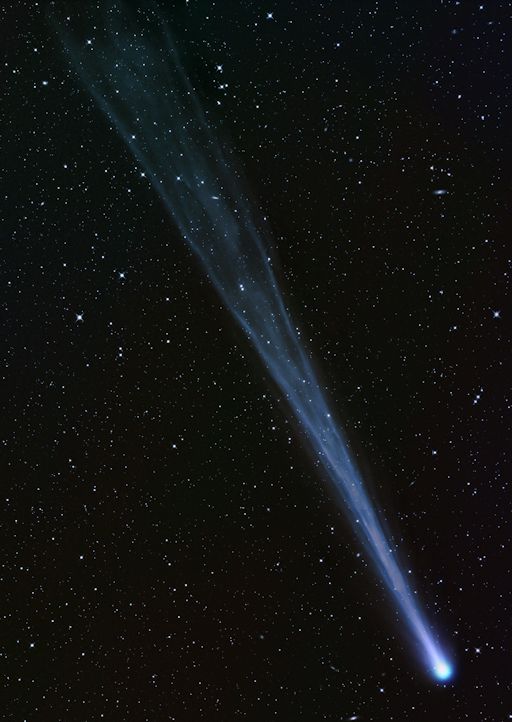
Reports of naked-eye sightings of Comet ISON are coming in from around the world. Experienced observers put the comet's magntitude at +5.5 on Nov. 16th. This means it is now fully 10 times brighter than it was only three days ago before the outburst. To the naked eye, ISON appears as a faint smudge of pale green light low in the pre-dawn sky. The view through a telescope is more dramatic. The comet's tail has become a riotous crowd of gaseous streamers stretching more than 3.5 degrees across the sky. Amateur astronomer Waldemar Skorupa sends this picture from Kahler Asten, Germany:
The tail is so long, he couldn't fit the whole thing in the field of view. How long is it? Comet ISON's tail extends more than 8 million kilometers behind the comet's nucleus. For comparison, that's 21 times the distance between Earth and the Moon.
Because so much gas and dust is spewing from the comet's core, it is impossible to see clearly what caused Comet ISON's outburst on Nov. 13-14. One possibility is that fresh veins of ice are opening up in the comet's nucleus, vaporizing furiously as ISON approaches the sun. Another possibility is that the nucleus has completely fragmented.
"If so, it will still be several days before we know for sure," says Karl Battams, an astronomer with NASA's Comet ISON Observing Campaign. "When comet nuclei fall apart, it’s not like a shrapnel-laden explosion. Instead, the chunks slowly drift apart at slightly different speeds. Given that ISON’s nucleus is shrouded in such a tremendous volume of light-scattering dust and gas right now, it will be almost impossible to determine this for at least a few days and perhaps not until the comet reaches the field of view of NASA's STEREO HI-1A instrument on November 21, 2013. We will have to wait for the chunks to drift apart a sufficient distance, assuming they don't crumble first."
In short, no one knows for sure what is happening to Comet ISON. This could be the comet's death throes--or just the first of many brightening events the comet experiences as it plunges toward the sun for a close encounter on Thanksgiving Day (Nov. 28th).
Monitoring is encouraged. Comet ISON rises in the east just before the sun. Amateur astronomers, if you have a GOTO telescope, enter these coordinates. Dates of special interest include Nov. 17th and 18th when the comet will pass the bright star Spica, making ISON extra-easy to find. Sky maps: Nov. 15, 16, 17, 18, 19.


Enhanced by Zemanta

Saturday, October 26, 2013

The sun isn't the only thing exploding. Almost 450 million km from Earth, Comet C/2012 X1 (LINEAR) is having its own outburst.

COMET LINEAR X1:

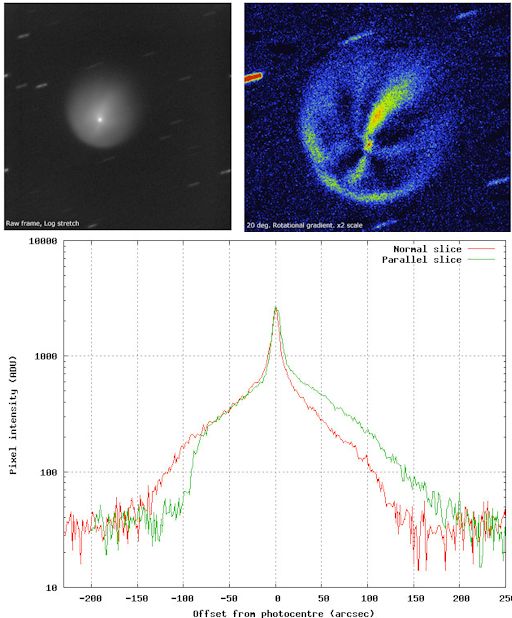
The sun isn't the only thing exploding. Almost 450 million km from Earth, Comet C/2012 X1 (LINEAR) is having its own outburst. On Oct. 20th, amateur astronomers realized that the comet's brightness had increased 100-fold and its morphology resembled that of exploding Comet 17P/Holmes in 2007. Follow-up images in recent nights seem to show jet-like structures in Comet LINEAR X1's expanding atmosphere. Amateur astronomer Nick James of Chelmsford, UK, obtained these data on Oct. 26th:

Another set of images taken by James shows the comet's atmosphere or "coma" expanding over a period of two days. "The coma's diameter is increasing at a rate of 30 arcseconds per day," says James. "At a distance of 2.95 AU this corresponds to 65,000 km/day or a little less than 1 km/s." He made these observations using an 11-inch Celestron telescope.
Located in the constellation Coma Berenices, Comet LINEAR X1 rises in the east about an hour before the sun. The low altitude of the comet in morning twilight is a challenge, but because the comet is fairly bright, magnitude +8.5, it is still a relatively easy target for backyard telescopes equipped with digital cameras. Monitoring is encouraged! Resources: 3D orbit, ephemeris, sky map.

Read More Here

..........
Enhanced by Zemanta