Showing posts with label H5N1 (Highly Pathogenic Avian Influenza). Show all posts

Tuesday, April 8, 2014

Biological Hazard - Egypt, Governorate of Beheira, Damanhur : H5N1 (highly pathogenic avian influenza)

Earth Watch Report  -  Biological Hazards

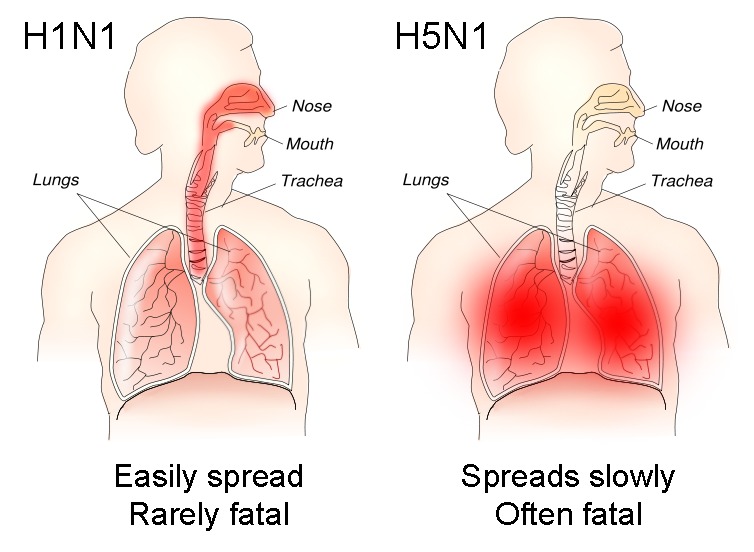
File:H1N1 versus H5N1 pathology.png
Different sites and outcomes of H1N1 versus H5N1 influenza infections. Based on Respiratory system.svg with annotations.
Author  :  TimVickers
.....
Biological HazardEgyptGovernorate of Beheira, DamanhurDamage levelDetails

.....
Biological Hazard in Egypt on Monday, 07 April, 2014 at 03:05 (03:05 AM) UTC.
Description
A(n) 86-year-old woman from the capital city of Damanhur in the Egyptian coastal governorate of Beheira is the latest human case of H5N1 avian influenza in the North African country, according to a EGYNews rport Saturday (computer translated). The report notes that the elderly woman is hospitalized in intensive care and is currently in "poor condition". She also has the underlying condition of diabetes. She is being treated with Tamiflu. This human H5N1 avian flu case follows 2 confirmed cases 2 weeks ago (one case was from Damanhur also) Since 2006, Egypt has reported 175 (not including this current case) cases of human H5N1 bird flu with 63 deaths (Case fatality ratio - 36 percent).
Biohazard name:H5N1 (highly pathogenic avian influenza)
Biohazard level:4/4 Hazardous
Biohazard desc.:Viruses and bacteria that cause severe to fatal disease in humans, and for which vaccines or other treatments are not available, such as Bolivian and Argentine hemorrhagic fevers, H5N1(bird flu), Dengue hemorrhagic fever, Marburg virus, Ebola virus, hantaviruses, Lassa fever, Crimean-Congo hemorrhagic fever, and other hemorrhagic or unidentified diseases. When dealing with biological hazards at this level the use of a Hazmat suit and a self-contained oxygen supply is mandatory. The entrance and exit of a Level Four biolab will contain multiple showers, a vacuum room, an ultraviolet light room, autonomous detection system, and other safety precautions designed to destroy all traces of the biohazard. Multiple airlocks are employed and are electronically secured to prevent both doors opening at the same time. All air and water service going to and coming from a Biosafety Level 4 (P4) lab will undergo similar decontamination procedures to eliminate the possibility of an accidental release.
Symptoms:
Status:confirmed

.....

The Global Dispatch

Egypt reports third H5N1 avian influenza case of 2014

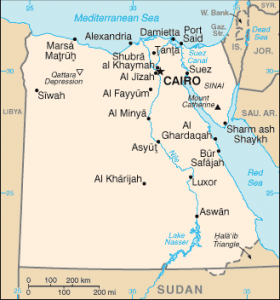
Image/CIA


A(n) 86-year-old woman from the capital city of Damanhur in the Egyptian coastal governorate of Beheira is the latest human case of H5N1 avian influenza in the North African country, according to a EGYNews rport Saturday (computer translated).
The report notes that the elderly woman is hospitalized in intensive care and is currently in “poor condition”.
She also has the underlying condition of diabetes. She is being treated with Tamiflu.
This human H5N1 avian flu case follows two confirmed cases two weeks ago (one case was from Damanhur also).

Read More Here

.....


H5N1: Egypt reports third H5N1 case of 2014  
crofsblogs.typepad.com1 day ago
Enhanced by Zemanta

Thursday, August 15, 2013

Biological Hazard - Nepal, Central Region, Makwanpur : H5N1 - Highly pathogenic avian influenza virus

Earth Watch Report  -  Biological Hazards

Chickens in a farm.
...
13.08.2013 Biological Hazard Nepal Central Region, Makwanpur Damage level
Details
...

Biological Hazard in Nepal on Tuesday, 13 August, 2013 at 16:13 (04:13 PM) UTC.

Description
Around 1,000 chicken s have died of suspected bird flu in two poultry farms in Makwanpur district within the past four days. About 600 fowls died in a farm belonging to Dipak Neupane, while 400 fowls died in Hem Gurung's farm in Hetauda. A medical team from the District Veterinary Office visited the farms after farmers informed about the incident. The team sent some dead chicken s for a laboratory test. "It could be bird flu or any other disease. It will be confirmed after the lab report," said Chetnarayan Kharel of the veterinary office. Of late, the Capital and other adjoining districts have been hit hard by the serial outbreak of the deadly bird flu virus, which has accounted to the death and culling of thousands of fowls.
Biohazard name: H5N1 - Highly pathogenic avian influenza virus
Biohazard level: 4/4 Hazardous
Biohazard desc.: Viruses and bacteria that cause severe to fatal disease in humans, and for which vaccines or other treatments are not available, such as Bolivian and Argentine hemorrhagic fevers, H5N1(bird flu), Dengue hemorrhagic fever, Marburg virus, Ebola virus, hantaviruses, Lassa fever, Crimean-Congo hemorrhagic fever, and other hemorrhagic or unidentified diseases. When dealing with biological hazards at this level the use of a Hazmat suit and a self-contained oxygen supply is mandatory. The entrance and exit of a Level Four biolab will contain multiple showers, a vacuum room, an ultraviolet light room, autonomous detection system, and other safety precautions designed to destroy all traces of the biohazard. Multiple airlocks are employed and are electronically secured to prevent both doors opening at the same time. All air and water service going to and coming from a Biosafety Level 4 (P4) lab will undergo similar decontamination procedures to eliminate the possibility of an accidental release.
Symptoms:
Status: suspected
...

1,000 chickens die in Hetauda; bird flu suspected


HETAUDA, AUG 13 - Around 1,000 chicken s have died of suspected bird flu in two poultry farms in Makwanpur district within the past four days.
About 600 fowls died in a farm belonging to Dipak Neupane, while 400 fowls died in Hem Gurung's farm in Hetauda.
A medical team from the District Veterinary Office visited the farms after farmers informed about the incident.


Read More Here
...

...
Enhanced by Zemanta

Biological Hazard - Cambodia, MultiProvinces, [Provinces of Battambang, Kandal] : H5N1 - Highly pathogenic avian influenza virus

Earth Watch Report  -  Biological Hazards


Image Source...

13.08.2013 Biological Hazard Cambodia MultiProvinces, [Provinces of Battambang, Kandal] Damage level
Details
...

Biological Hazard in Cambodia on Tuesday, 13 August, 2013 at 09:14 (09:14 AM) UTC.

Description
Two more new human cases of avian influenza have been confirmed for the H5N1 virus in Cambodia, bringing the number of the cases to 16 so far this year, a joint statement by the World Health Organization and Cambodian Health Ministry said Tuesday. The statement said that one case is a nine-year-old boy from northwestern Battambang Province, who was admitted to the Jayavarman VII Hospital in Siem Reap with fever, cough, vomit, abdominal pain and dyspnea on Aug. 4, and was confirmed positive for human H5N1 avian influenza on Friday last week. "The boy is currently in a stable condition," the statement said. The other case is a five-year-old girl from Southern Kandal Province, who was admitted to Kantha Bopha Hospital in Phnom Penh on Friday last week with fever, cough, sore throat, abdominal pain, diarrhea and dyspnea, and she was confirmed positive for human H5N1 avian influenza a day later. "The girl was treated with Tamiflu and is currently in a critical condition," it said. The two patients have touched dead or sick poultry before they became sick, the statement said. Avian influenza H5N1 remained a serious threat to the health of all Cambodians, Health Minister Mam Bunheng said.
Biohazard name: H5N1 - Highly pathogenic avian influenza virus
Biohazard level: 4/4 Hazardous
Biohazard desc.: Viruses and bacteria that cause severe to fatal disease in humans, and for which vaccines or other treatments are not available, such as Bolivian and Argentine hemorrhagic fevers, H5N1(bird flu), Dengue hemorrhagic fever, Marburg virus, Ebola virus, hantaviruses, Lassa fever, Crimean-Congo hemorrhagic fever, and other hemorrhagic or unidentified diseases. When dealing with biological hazards at this level the use of a Hazmat suit and a self-contained oxygen supply is mandatory. The entrance and exit of a Level Four biolab will contain multiple showers, a vacuum room, an ultraviolet light room, autonomous detection system, and other safety precautions designed to destroy all traces of the biohazard. Multiple airlocks are employed and are electronically secured to prevent both doors opening at the same time. All air and water service going to and coming from a Biosafety Level 4 (P4) lab will undergo similar decontamination procedures to eliminate the possibility of an accidental release.
Symptoms:
Status: confirmed
...

Cambodia reports two more human cases of H5N1 avian influenza, brings total in country to 16 in 2013


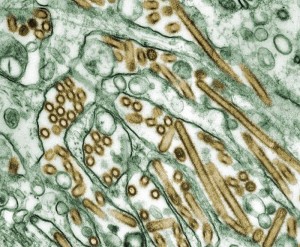
H5N1 avian influenza Image/CDC
H5N1 avian influenza
Image/CDC
The Cambodian Ministry of Health is reporting two additional human cases of avian influenza H5N1. These two cases are number 15 and 16 reported in the Kingdom so far this year.
According to the Ministries news release, The 15th case, a 9-year-old boy from Damnak Dangkor Village, Raing Kesey commune, Sang Ke district in Battambang province was confirmed positive for human H5N1 avian influenza on 9th August 2013 by Institut Pasteur du Cambodge.
The boy developed fever and vomiting on 26th July. He was given home-treatment by a health centre staff. On 2nd August, his condition became worse and his parents took him to a private clinic in Battambang. The private clinic referred him to the Battambang Provincial Hospital the same day. On 4th August, he was transferred to the Jayavarman V11 Hospital in Siem Reap with fever, cough, vomit, abdominal pain and dyspnea and treated with Tamiflu on 9th August. The boy is currently in a stable condition.
The 16th case is a 5-year-old girl from Knong Prek Village , Prey Koy commune, Saang district in Kandal province. She was confirmed for the virus on Aug.10 by the Institut Pasteur du Cambodge.
She developed a fever on Aug. 1 when her parents sought treatment. The next day she was taken to a private clinic when her condition worsened and was admitted to KanthaBopha Hospital. She was treated with Tamiflu and is currently in critical condition.
Investigation reveals the boy had contact with sick poultry. In the girl’s case, cases of dead poultry have been reported from the village.
Excerpt from the Joint statement from Cambodian MOH and the WHO


Read More Here

...

...
Enhanced by Zemanta

Saturday, July 13, 2013

Biological Hazard - Cambodia, Province of Prey Veng, [Kantha Bopha Hospital ] : A three-year-old boy from Cambodia's eastern Prey Veng province has been confirmed positive for the avian influenza H5N1

Earth Watch Report  -  Biological Hazards


....
 12.07.2013Biological HazardCambodiaProvince of Prey Veng, [Kantha Bopha Hospital ]Damage level
 
Details
....

Biological Hazard in Cambodia on Friday, 12 July, 2013 at 19:16 (07:16 PM) UTC.

Description
A three-year-old boy from Cambodia's eastern Prey Veng province has been confirmed positive for the avian influenza H5N1, bringing the number of the cases to 14 so far this year, a joint statement by the World Health Organization and Cambodian Health Ministry said Friday. Only five cases out of the 14 cases this year survived. The 14th victim was confirmed positive for H5N1 on Wednesday, the statement said, adding that the boy was admitted to the Kantha Bopha Hospital with fever, dyspnea and cough Monday. "At the hospital, he was treated with Tamiflu and is currently in stable condition,"it said. "There were recent deaths among poultry in the village and the boy was likely to be exposed to sick and dead poultry before he became sick,"it added. Avian influenza H5N1 remained a serious threat to the health of all Cambodians, Health Minister Mam Bunheng said. "Children also seem to be most vulnerable and are at high risk because they like to play where poultry are found,"he said in the statement."I urge parents and guardians to keep children away from sick or dead poultry and make sure children wash their hands with soap and water after any contact with poultry."
Biohazard name:H5N1 (highly pathogenic avian influenza)
Biohazard level:4/4 Hazardous
Biohazard desc.:Viruses and bacteria that cause severe to fatal disease in humans, and for which vaccines or other treatments are not available, such as Bolivian and Argentine hemorrhagic fevers, H5N1(bird flu), Dengue hemorrhagic fever, Marburg virus, Ebola virus, hantaviruses, Lassa fever, Crimean-Congo hemorrhagic fever, and other hemorrhagic or unidentified diseases. When dealing with biological hazards at this level the use of a Hazmat suit and a self-contained oxygen supply is mandatory. The entrance and exit of a Level Four biolab will contain multiple showers, a vacuum room, an ultraviolet light room, autonomous detection system, and other safety precautions designed to destroy all traces of the biohazard. Multiple airlocks are employed and are electronically secured to prevent both doors opening at the same time. All air and water service going to and coming from a Biosafety Level 4 (P4) lab will undergo similar decontamination procedures to eliminate the possibility of an accidental release.
Symptoms: 
Status:confirmed
....

Cambodia reports 14th human case of bird flu this year 


English.news.cn   2013-07-12 18:50:05
PHNOM PENH, July 12 (Xinhua) -- A three-year-old boy from Cambodia's eastern Prey Veng province has been confirmed positive for the avian influenza H5N1, bringing the number of the cases to 14 so far this year, a joint statement by the World Health Organization and Cambodian Health Ministry said Friday.
Only five cases out of the 14 cases this year survived.
The 14th victim was confirmed positive for H5N1 on Wednesday, the statement said, adding that the boy was admitted to the Kantha Bopha Hospital with fever, dyspnea and cough Monday. "At the hospital, he was treated with Tamiflu and is currently in stable condition,"it said. "There were recent deaths among poultry in the village and the boy was likely to be exposed to sick and dead poultry before he became sick,"it added.
Avian influenza H5N1 remained a serious threat to the health of all Cambodians, Health Minister Mam Bunheng said. "Children also seem to be most vulnerable and are at high risk because they like to play where poultry are found,"he said in the statement."I urge parents and guardians to keep children away from sick or dead poultry and make sure children wash their hands with soap and water after any contact with poultry."
H5N1 influenza is a flu that normally spreads between sick poultry, but it can sometimes spread from poultry to humans, the statement said, adding that it is a very serious disease that requires hospitalization.
Cambodia sees the worst outbreak of the virus this year since the disease was first identified in 2004. To date, the country has recorded 35 human cases of the virus, killing 28 people.
Since 2003, there have been 633 laboratory confirmed human cases of H5N1 virus globally with 376 related deaths, the statement said.
Editor: Yang Yi
....
Enhanced by Zemanta