Global Weather Phenomenon-Natural/Technological Disasters-Space Events-Epidemic/Biological Hazards-
Nuclear Events :
News Affiliate of Family Survival Protocol.com
Shell and Exxon's €5bn problem: gas drilling that sets off earthquakes and wrecks homes
Groningen
has been one of Europe’s richest gas fields for 30 years, and thousands
of people say their homes have been damaged by the tremors that
drilling sets off. Now a class action may finally bring them
compensation – and force a rethink of European energy security
‘Nobody is taking this seriously, not the school or the mayor, no one’ …
Annemarie Heite, whose home in Groningen has been scheduled for
demolition after earthquakes caused by oil drilling. Photograph: Hans
Knikman/Demotix
Lucas Amin
Five
years ago, Annemarie Heite and her husband, Albert, bought their dream
home; a traditional 19th-century farmhouse in Groningen province in the
northern Netherlands.
The couple planned to raise their two young daughters in this charming
corner of the Dutch countryside. “Then, the living was still easy, and
affordable,” Annemarie says, her tone bittersweet and nostalgic. Today,
their house is scheduled for demolition.
Hundreds of earthquakes
have wrecked the foundations of the Heites’ home and made it unsafe to
live in. Annemarie’s biggest fear is the safety of her daughters. She
points to a room. “This is where my children sleep,” she says, “and
everyday I’m just picking up pieces of bricks and stuff from the
ceiling.”
Heite fears that her children may not be any safer at
school. Her daughter Zara goes to a local primary school that has not
been structurally reinforced to withstand strong earthquakes. “I feel
powerless. It feels like I can’t do anything,” Heite says. “It’s not
like I’m a frantic, hysterical person, but nobody is taking this
seriously, not the school or the mayor, no one.”
Next door,
Heite’s neighbour’s farmhouse is already a pile of rubble, which yellow
JCBs are clearing away. “It’s collapsed. It’s gone,” Heite says. “They
lived there for 30 years … and over there behind the trees, they
demolished another house.”
Farmhouses like Heite’s are
disappearing across the Groningen countryside as a peculiar, profound
environmental crisis grips the province. At the heart of it are two oil
companies, Shell and Exxon Mobil,
and a government that, for two decades, denied responsibility for its
actions and ignored the voices of citizens and scientists. The scandal
has already cost the oil companies €1.2bn [£880m], but last month a
landmark court ruling gave the victims fresh hope that their voices
could be ignored no longer. And if they are right, the consequences
could be profound: a compensation bill that could stretch to more than
€5bn in Holland, an energy security headache for Europe, and an
invocation for the world to think about the real cost of burning fossil
fuels.
PublicSource |November 4, 2013 1:49 pm
By Emily DeMarco
The U.S. Coast Guard, which regulates the country’s waterways, will allow shale gas companies to ship fracking wastewater on the nation’s rivers and lakes under a proposed policy published Wednesday.
Industry
officials say barges are the safest, and cheapest, way to move fracking
wastewater, but a spill would severely contaminate waterways. Photo
credit: Keith Robinson/ Flickr
The Coast Guard began
studying the issue nearly two years ago at the request of its Pittsburgh
office, which had inquiries from companies transporting Marcellus Shale
wastewater. If the policy is approved, companies can ship the
wastewater in bulk on barges on the nation’s 12,000 miles of waterways, a
much cheaper mode than trucks or rail.
The public will have 30 days to comment.
Under
the policy, companies would first have to test the wastewater at a
state-certified laboratory and provide the data to the Coast Guard for
review. The tests would determine levels of radioactivity, pH, bromides
and other hazardous materials. In addition, the barges would also have
to be checked for the accumulation of radioactive particles that might
affect workers.
If the test results meet the limits outlined in
the policy, the companies would receive Coast Guard approval to ship the
wastewater in bulk. It is unclear whether the barge companies would
self-report the test results.
All records outlined in the proposed
policy must be held by the barge companies for two years, but would be
available to the Coast Guard. Normally, the information also would be
available to the public under the Freedom of Information Act. However,
“the identity of proprietary chemicals may be withheld from public
release,” the policy states.
Environmental groups, academics and
the media have tried to get information about the chemicals used in
fracking in the past. However, gas drilling companies have refused to
release the specific amounts of chemicals they pump underground to
release gas from the shale formation. Read More Here
by Staff WritersWashington (AFP) Nov 04, 2013
A method of storing harmful greenhouse gases by injecting them below
ground has likely triggered a series of earthquakes in Texas, some
larger than magnitude 3, a US study said Monday.
The findings in the Proceedings of the National Academy of Sciences mark
the first time that carbon storage has been linked to temblors ranging
from 3.0 to 4.4 in severity.
Researchers warned last year in the same journal that carbon capture and
storage risked causing earthquakes, but there had been no direct
evidence of such quakes until now.
The study focused on seismic activity in petroleum fields in Scurry and
Kent Counties in northwest Texas, known as the Cogdell and Kelly-Snyder
oil fields.
A process called water flooding was used in the Cogdell field to boost
oil production from 1957 to 1982, and previous research has found that
the practice caused small quakes in the area from 1975 to 1982.
More recently, methane and CO2 have been injected into the oil field at
high volumes, said the research by Wei Gan and Cliff Frohlich at The
University of Texas at Austin's Institute for Geophysics.
Contact Information: U.S. Department of the Interior, U.S. Geological Survey Office of Communications and Publishing 12201 Sunrise Valley Dr, MS 119 Reston, VA 20192
Since
January 2009, more than 200 magnitude 3.0 or greater earthquakes have
rattled Central Oklahoma, marking a significant rise in the frequency of
these seismic events.
The U.S. Geological Survey and Oklahoma
Geological Survey are conducting collaborative research quantifying the
changes in earthquake rate in the Oklahoma City region, assessing the
implications of this swarm for large-earthquake hazard, and evaluating
possible links between these earthquakes and wastewater disposal related
to oil and gas production activities in the region.
Studies show
one to three magnitude 3.0 earthquakes or larger occurred yearly from
1975 to 2008, while the average grew to around 40 earthquakes per year
from 2009 to mid-2013.
"We've statistically analyzed the recent
earthquake rate changes and found that they do not seem to be due to
typical, random fluctuations in natural seismicity rates," said Bill
Leith, USGS seismologist. "These results suggest that significant
changes in both the background rate of events and earthquake triggering
properties needed to have occurred in order to explain the increases in
seismicity. This is in contrast to what is typically observed when
modeling natural earthquake swarms."
The analysis suggests that a
contributing factor to the increase in earthquakes triggers may be from
activities such as wastewater disposal--a phenomenon known as
injection-induced seismicity. The OGS has examined the behavior of the
seismicity through the state assessing the optimal fault orientations
and stresses within the region of increased seismicity, particularly the
unique behavior of the Jones swarm just east of Oklahoma City. The USGS
and OGS are now focusing on determining whether evidence exists for
such triggering, which is widely viewed as being demonstrated in recent
years in Arkansas, Ohio and Colorado.
This "swarm" includes the
largest earthquake ever recorded in Oklahoma, a magnitude 5.6 that
occurred near Prague Nov. 5, 2011. It damaged a number of homes as well
as the historic Benedictine Hall at St. Gregory's University, in
Shawnee, Okla. Almost 60 years earlier in1952, a comparable magnitude
5.5, struck El Reno and Oklahoma City. More recently, earthquakes of
magnitude 4.4 and 4.2 hit east of Oklahoma City on April 16, 2013,
causing objects to fall off shelves.
Following the earthquakes that occurred near Prague in 2011, the agencies issued a joint statement,
focusing on the Prague event and ongoing seismic monitoring in the
region. Since then, the USGS and OGS have continued monitoring and
reporting earthquakes, and have also made progress evaluating the
significance of the swarm.
Important to people living in the
Oklahoma City region is that earthquake hazard has increased as a result
of the swarm. USGS calculates that ground motion probabilities, which
relate to potential damage and are the basis for the seismic provisions
of building codes, have increased in Oklahoma City as a result of this
swarm. While it’s been known for decades that Oklahoma is "earthquake country," the increased hazard has important implications for residents and businesses in the area.
To more accurately determine the locations and magnitudes of earthquakes in Oklahoma, the OGS operates a 15-station seismic network. Data
from this system, and from portable seismic stations installed in the
Oklahoma City region, are sent in real-time to the USGS National
Earthquake Information Center, which provides 24x7 reporting on
earthquakes worldwide.
USGS provides science for a changing world. Visit USGS.gov, and follow us on Twitter @USGS and our other social media channels. Subscribe to our news releases via e-mail, RSS or Twitter.
Links and contacts within this release are valid at the time of publication.
..........
Oklahoma 'Earthquake Swarm' May Be Linked Wastewater Disposal From Fracking
The Huffington Post
|
By Ryan Grenoble
Posted: 10/24/2013 4:41 pm EDT | Updated: 10/24/2013 4:50 pm EDT
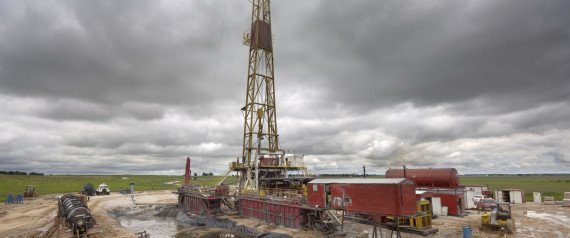
The USGS has suggested injecting wastewater produced by oil wells back
into the earth could be responsible for a "swarm" of earthquakes in
Oklahoma.
| Getty
From 1975 to 2008, central Oklahoma experienced an average of one to
three magnitude 3.0 earthquakes or larger. Since 2008, that average has
increased to around 40 per year, according to data collected by the U.S.
Geological Survey.
"We've statistically analyzed the recent earthquake rate changes and
found that they do not seem to be due to typical, random fluctuations in
natural seismicity rates," USGS seismologist Bill Leith said in a
statement. "This is in contrast to what is typically observed when modeling natural earthquake swarms."