Global Weather Phenomenon-Natural/Technological Disasters-Space Events-Epidemic/Biological Hazards-
Nuclear Events :
News Affiliate of Family Survival Protocol.com
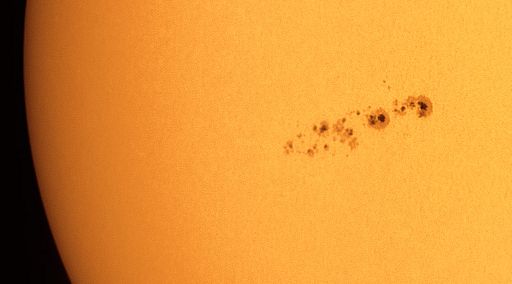
Sunspot
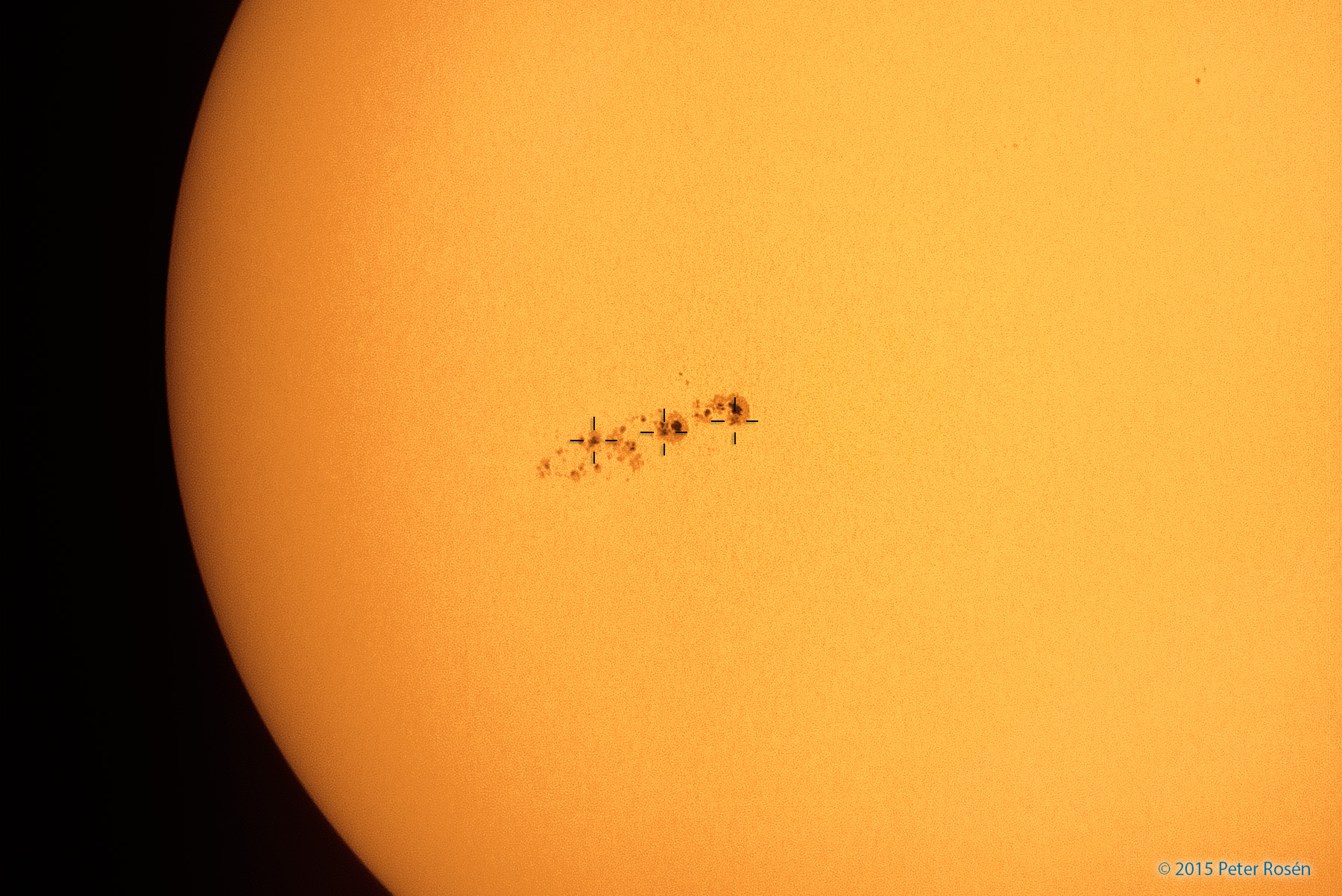
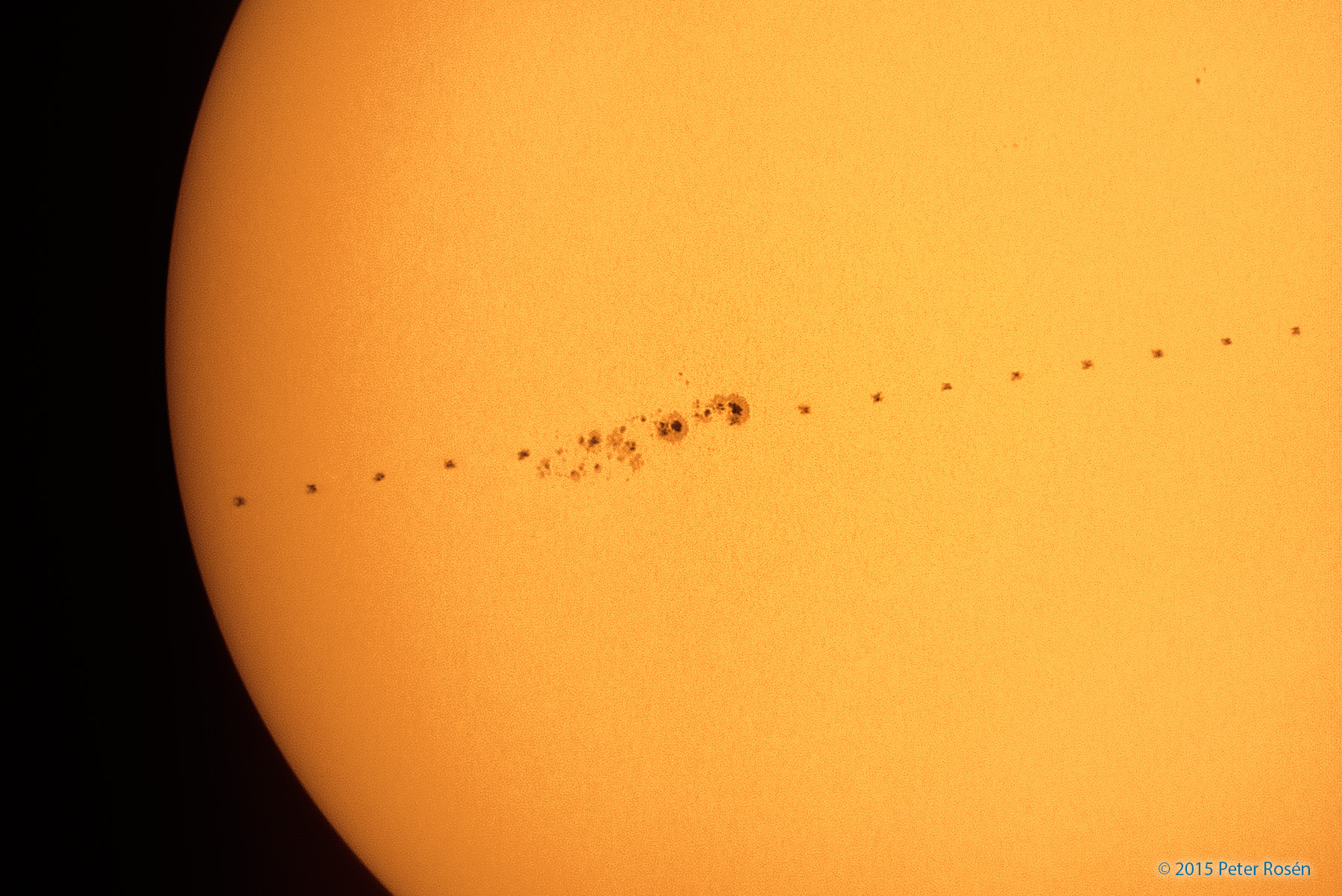
AR2443 is so big, it is attracting the attention of astrophotographers
around the world. Earlier today when Peter Rosén of Stockholm, Sweden,
photographed the sprawling complex, he found a spaceship hiding among
its dark cores. Seriously. Take a close look at the image below:
Can't find the spaceship? Click here and here. "It is the International Space Station," explains Rosén. "I caught it making a split-second transit of the giant sunspot."
Indeed,
AR244 is huge. From end to end it measures almost 200,000 km. Many of
the dark cores are as large as terrestrial continents--and a couple are
as large as Earth itself. These dimensions make it an easy target for
backyard solartelecopes.
Of
greater interest is the sunspot's potential for explosive activity. The
spotty complex has a 'beta-gamma' magnetic field that harbors energy
for strong M-class solar flares. Any such explosions will be geoeffective as the sunspot turns squarely toward Earth in the days ahead.
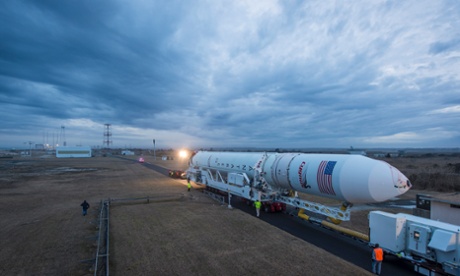
Orbital
Sciences Corp's Antares rocket before its planned launch in Wallops
Island, Virginia. Photograph: Bill Ingalls/Nasa/Getty Images
A strong solar storm is interfering with the latest grocery run to the International Space Station.
On
the bright side, the orbiting lab has won a four-year extension,
pushing its projected end-of-lifetime to at least 2024, a full decade
from now.
"This is a big plus for us," said Nasa's human exploration chief, Bill Gerstenmaier.
On Wednesday, Orbital Sciences Corp delayed its space station delivery mission for the third time.
The
company's unmanned rocket, the Antares, was set to blast off from
Wallops Island, Virginia, with a capsule full of supplies and science
experiments, including ants for an educational project. But several
hours before Wednesday afternoon's planned flight, company officials
took the unusual step of postponing the launch for fear solar radiation
could doom the rocket.
Orbital Sciences' chief technical officer,
Antonio Elias, said solar particles might interfere with electronics
equipment in the rocket, and lead to a launch failure.
Although
the solar storm barely rated moderate, some passenger jets were being
diverted from the poles to avoid potential communication and health
issues. GPS devices also were at risk.
But the six men aboard the
space station were safe from the solar fallout, Nasa said, and
satellites also faced no threat. The Cygnus cargo ship aboard the
rocket, for example, is built to withstand radiation from solar
flare-ups.
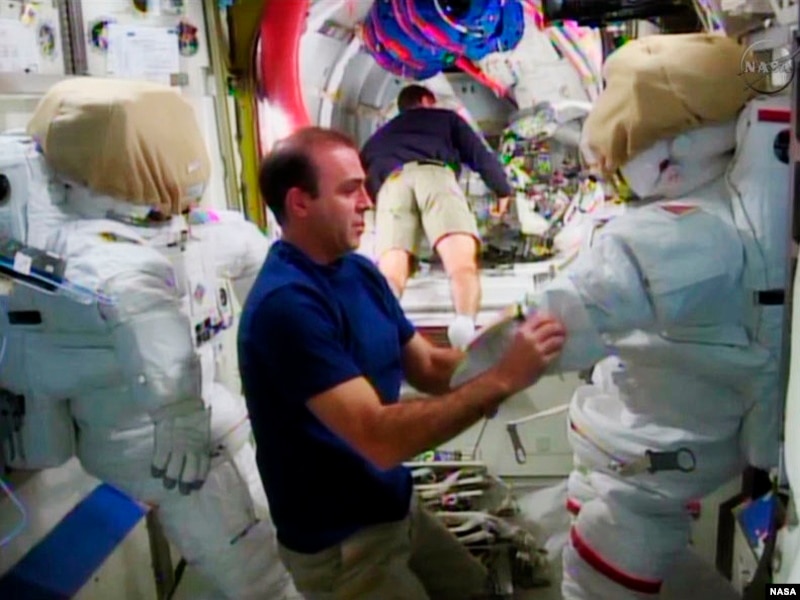
Expedition
38 crew member Rick Mastracchio (L) checks out the spacesuit that he
will wear during a spacewalk with crew member Mike Hopkins, in the Quest
airlock in the International Space Station in this undated image taken
from video from NASA TV, Dec. 20, 2013.
Reuters
December 23, 2013
CAPE
CANAVERAL, FLORIDA — Astronauts aboard the International Space Station
are planning a second and final spacewalk early Tuesday to fix the
outpost's cooling system, a NASA official said.
NASA
astronauts Rick Mastracchio and Mike Hopkins are expected to leave the
station's Quest airlock to install a new ammonia pump, space station
flight director Judd Frieling said during an interview on NASA
Television on Monday.
During an initial spacewalk on Saturday,
Mastracchio and Hopkins removed a failed pump, accomplishing about half
the work planned for the second spacewalk. That prompted the National
Aeronautics and Space Administration to drop plans for a third
spacewalk, provided that no problems occur on Tuesday.
“It's apparent now that we'll be able to get most of our critical objectives done tomorrow [Tuesday]," said Frieling.
CAPE CANAVERAL, Fla. (AP) — NASA has ordered up a series of
urgent spacewalks to fix a broken cooling line at the International
Space Station, a massive repair job that could stretch to Christmas Day.
Station managers decided Tuesday to send two American astronauts out
as soon as possible to replace a pump with a bad valve. The task will
require two and possibly three spacewalks on Saturday, Monday and next
Wednesday — Christmas Day.
"The next week will be busy with space walks so not much
tweeting from here," NASA astronaut Rick Mastracchio said from space via
Twitter soon after the decision was announced.
The spacewalks are taking priority over the launch of a supply ship
from Virginia. The commercial delivery had been scheduled for this week,
but is now delayed until at least mid-January.
Officials stressed that the six
occupants of the International Space Station were in no danger after the
shutdown, and that the orbiting complex was in a stable situation.
CAPE CANAVERAL, Florida (AP) — Half of the
International Space Station's cooling system suddenly shut down during
the weekend, forcing the astronauts to power down equipment and face the
likelihood of urgent spacewalking repairs.
After huddling Sunday, NASA
managers gave preliminary approval for a pair of spacewalks, the first
of which would take place later this week. Two of the Americans on board
were already scheduled to conduct a spacewalk Thursday for routine
maintenance, though the repairs would supersede the original chores.
Officials stressed that the six occupants were in no danger, and that the orbiting complex was in a stable situation.
The trouble arose Saturday night, when one of the
two ammonia-fed cooling loops shut down. Alarms sounded throughout the
sprawling outpost as the circuit breaker for the pump in that line
tripped, causing the pump to stop working.
The cooling system is critical for on-board
operations. The two ammonia lines ensure that all the station's
electronic equipment does not overheat and with one of those out of
commission, there is no safeguard in case of a second failure.
Astronaut Tracy Caldwell
Dyson hustled through the equipment shutdown procedures and, with
crewmate Douglas Wheelock, installed a jumper cable to keep all the
rooms cool.
Russia
may build its own space station with International Space Station (ISS)
units after 2020 if the ISS partners choose not to extend the project
and there is political will to do so, a source from the national space
industry said on Monday.
"A new orbital station
of Russia is under consideration. Apart from doing research, it will
assemble interplanetary expedition complexes for missions to the Moon,
Mars and Lagrangian points," he said.
The Multirole
Laboratory Module (MLM) is supposed to be connected to the ISS in 2014
although "the project has been experiencing certain problems," he said.
"This is a landmark module for Russia's manned program."
"We
will create a node unit with a service life of 30 years in 2014-2015.
The MLM, two research and power modules, the node and, possibly, the ISS
service module will make up a national orbital station to operate
during the period from 2020 until 2040," the source said.
"The
prospective manned spaceship [on which the Energia Corporation is
working] will have a trial unmanned mission by 2020," he added.