Showing posts with label Mass Animal Die Off (Dolphins). Show all posts

Saturday, December 21, 2013

Study links BP oil spill to dolphin deaths

Study links BP oil spill to dolphin deaths

US government scientists have for the first time found direct evidence of toxic exposure in the Gulf of Mexico
A dolphin is seen swimming through an oil sheen from the Deepwater Horizon oil spill
A dolphin is seen swimming through an oil sheen from the Deepwater Horizon oil spill off East Grand Terre Island, where the Gulf of Mexico meets Barataria Bay, on the Louisiana coast, July 31, 2010. Photograph: Gerald Herbert/AP
US government scientists have for the first time connected the BP oil disaster to dolphin deaths in the Gulf of Mexico, in a study finding direct evidence of toxic exposure.
The study, led by scientists from the National Oceanic and Atmospheric Administration, found lung disease, hormonal abnormalities and other health effects among dolphins in an area heavily oiled during the BP spill.
A dead bottlenose dolphin that was found on Ono Island
An Institute for Marine Mammal Studies veterinary technician examines a dead bottlenose dolphin that was found on Ono Island. Photograph: Patrick Semansky/AP
The diseases found in the dolphins at Barataria Bay in Louisiana – though rare – were consistent with exposure to oil, the scientists said.
"Many disease conditions observed in Barataria Bay dolphins are uncommon but consistent with petroleum hydrocarbon exposure and toxicity," the scientists said.
Half of the dolphins were given a guarded prognosis, and 17% were expected to die of the disease, the researchers found.
"I've never seen such a high prevalence of very sick animals – and with unusual conditions such as the adrenal hormone abnormalities," Lori Schwake, the study's lead author, said in a statement.
Read More Here
.....
LiveScience

BP Oil Spill May Have Contributed to Dolphin Deaths, Study Finds


The 2010 BP oil spill contributed to an unusually high death rate for dolphins in the Gulf of Mexico, a new study suggests.
Between January and April 2011, 186 dead bottlenose dolphins washed ashore between Louisiana and western Florida. Most alarmingly, nearly half of these casualties were calves, which is more than double the usual proportion of young to old dolphins found dead. Scientists now blame both natural factors and human catastrophe for the unusual die-off.
"Unfortunately, it was a 'perfect storm' that led to the dolphin deaths," study researcher Graham Worthy, a biologist at the University of Central Florida, said in a statement. "The oil spill and cold water of 2010 had already put significant stress on their food resources. … It appears the high volumes of cold freshwater coming from snowmelt water that pushed through Mobile Bay and Mississippi Sound in 2011 was the final blow." [Gulf Oil Spill: Animals at Risk]

Cold water and spilled oil
The winter of 2010 was a cold one, the researchers reported July 18 in the open-access journal PLoS ONE. Oil began spilling into the Gulf in April 2011, after the Deepwater Horizon platform exploded following a blowout.
The unusually harsh winter of 2010 already dealt wildlife a disadvantage, Worthy and his colleagues wrote. Finfish, marine birds, sea turtles and manatees had been hit hard, with about 6 percent of the U.S. population of manatees lost to cold weather.
Just before the baby dolphins began washing ashore in January 2011, meltwater from an unusually heavy Mobile Bay watershed snowfall hit the Gulf. A comparison of dolphin stranding sites and water conditions revealed that the discovery of the carcasses followed temperature dips from meltwater by two to three weeks, indicating that the dolphins were stressed, died, washed ashore and were eventually found and recorded.
Read More Here
.....
.....
Enhanced by Zemanta

Wednesday, December 11, 2013

Biological Hazard USA State of Georgia, [Jekyll Island Coastal region] : Mass Die Off (Bottlenose Dolphin)

Earth Watch Report  -  Biological Hazards

File:Bottlenose Dolphin KSC04pd0178.jpg
Image Source  :  Wikimedia . Org
Bottlenose Dolphin - Tursiops truncatus A dolphin surfs the wake of a research boat on the Banana River - near the Kennedy Space Center.
Author   NASAs
.....

Biological Hazard USA State of Georgia, [Jekyll Island Coastal region] Damage level Details
.....
Description
A disease that has killed hundreds of bottlenose dolphins in the mid-Atlantic and southeastern United States has been confirmed in Georgia, state wildlife officials said Tuesday. Four dolphins found dead at Wassaw and Jekyll Islands in November have tested positive for dolphin morbillivirus, Department of Natural Resources officials said. The virus is similar to measles and affects the lungs, brain and immune system of marine mammals. Marine wildlife suffering from morbillivirus may develop skin lesions, brain infections and pneumonia, according to the National Oceanic and Atmospheric Administration. The virus, which follows the seasonal migration pattern of dolphins from the upper mid-Atlantic, is spread through inhalation of respiratory particles or direct contact between mammals, according to the NOAA. The virus can also spread through the eyes, mouth, stomach, skin wounds and the urogenital tract. Department of Natural Resources officials have said they've found 23 dead dolphins in Georgia since Nov. 15. The state usually sees 21 dolphins stranded on its shores per year, said state Department of Natural Resources wildlife biologist Clay George. He added that most dolphin deaths seem to be impacting migratory populations and not resident dolphins. Researchers identify dolphin populations by taking photos of their dorsal fins. "Unfortunately, there's nothing we can do to stop the disease from spreading," Clay said. "We can only hope that this is part of the natural cycle, and that populations will rebound to healthy levels soon." Outbreaks of morbillivirus killed harbor seals in the northeast in 2006, according to NOAA. Officials say it also killed dolphins in the northeast from 1987-88 and in the Gulf of Mexico in 1992 and 1994. More than 930 bottlenose dolphins have been found dead or dying on shores stretching from New York to Florida between July 1 and Dec. 1, 2013, according to the NOAA. Officials say the average was about 113 for the same time period between 2007 and 2012.
Biohazard name: Mass. Die-off (bottlenose dolphins)
Biohazard level: 2/4 Medium
Biohazard desc.: Bacteria and viruses that cause only mild disease to humans, or are difficult to contract via aerosol in a lab setting, such as hepatitis A, B, and C, influenza A, Lyme disease, salmonella, mumps, measles, scrapie, dengue fever, and HIV. "Routine diagnostic work with clinical specimens can be done safely at Biosafety Level 2, using Biosafety Level 2 practices and procedures. Research work (including co-cultivation, virus replication studies, or manipulations involving concentrated virus) can be done in a BSL-2 (P2) facility, using BSL-3 practices and procedures. Virus production activities, including virus concentrations, require a BSL-3 (P3) facility and use of BSL-3 practices and procedures", see Recommended Biosafety Levels for Infectious Agents.
Symptoms:
Status: confirmed
.....

Marietta Daily Journal

Dolphins killed by measles-like virus


by The Associated Press
December 10, 2013 11:26 PM | 209 views | 0 0 comments | 5 5 recommendations | email to a friend | print
JEKYLL ISLAND — A disease that has killed hundreds of bottlenose dolphins in the mid-Atlantic and southeastern United States has been confirmed in Georgia, state wildlife officials said Tuesday.

Four dolphins found dead at Wassaw and Jekyll Islands in November have tested positive for dolphin morbillivirus, Department of Natural Resources officials said. The virus is similar to measles and affects the lungs, brain and immune system of marine mammals.

Marine wildlife suffering from morbillivirus may develop skin lesions, brain infections and pneumonia, according to the National Oceanic and Atmospheric Administration.

The virus, which follows the seasonal migration pattern of dolphins from the upper mid-Atlantic, is spread through inhalation of respiratory particles or direct contact between mammals, according to the NOAA. The virus can also spread through the eyes, mouth, stomach, skin wounds and the urogenital tract.

Department of Natural Resources officials have said they’ve found 23 dead dolphins in Georgia since Nov. 15. The state usually sees 21 dolphins stranded on its shores per year, said state Department of Natural Resources wildlife biologist Clay George. He added most dolphin deaths seem to be impacting migratory populations and not resident dolphins. Researchers identify dolphin populations by taking photos of their dorsal fins.

Read More Here
.....
Enhanced by Zemanta

Saturday, November 9, 2013

Largest 'dolphin measles' outbreak in history kills 753 and threatens whales as Bottlenose herds migrate south


US East Coast: dolphins dying in record numbers of viral infection


US East Coast: dolphins dying in record numbers of viral infection

According to America's National Oceanic and Atmospheric Administration, a whopping 753 bottlenose dolphins washed up dead on the Atlantic coast from New York to Florida between July 1 and November 3.

This represents a roughly tenfold increase in the number of dolphins that would typically turn up dead along the East Coast during this four-month period.
The killer is a measles-type virus which causes fatal pneumonia and brain inflammation.
The previous similar outbreak occurred in 1987 and 88, resulting in 740-plus dolphin strandings.
Officials say the current die-off is only halfway through its expected time frame, and the final beach death toll in the bottlenose population may climb to around 1,500.
And without a way to vaccinate the wild population, there is little officials can do but collect the carcasses and examine them. The Virginia Aquarium alone has performed necropsies on 333 dead dolphins.
Scientists have already speculated about a possible link between marine die-offs and phenomena like climate change and human-produced pollution. 
Al-Jazeera America, AFP

..........

Dolphin virus kill in U.S. East soars

AFP-JIJI


The deadliest known outbreak of a measleslike virus in bottlenose dolphins has killed a record number of the mammals along the U.S. Atlantic coast since July, officials said Friday.
A total of 753 bottlenose dolphins have washed up from New York to Florida from July 1 until Nov. 3, the National Oceanic and Atmospheric Administration said. That is more than 10 times the number of dolphins that would typically turn up dead along East Coast beaches, said Teri Rowles, program coordinator of the NOAA Fisheries Marine Mammal Health and Stranding Response Program.
“Historic averages for this same time frame, same geographic area is only 74, so you get an idea of the scope,” she told reporters.
The toll is also higher than the more than 740 strandings in the last major Atlantic morbillivirus outbreak in 1987-1988.
And they have come in a much shorter time period, leading officials to anticipate this event could get much worse.
“It is expected that the confirmed mortalities will be higher,” Rowles said. “If this plays out similar to the ’87-88 die-off, we are less than halfway through that time frame.”

Read More Here

..........

Largest 'dolphin measles' outbreak in history kills 753 and threatens whales as Bottlenose herds migrate south

  • Hundreds of dolphins have washed up on East Coast beaches since July
  • Researchers say the problem hasn't stopped and that Bottlenose dolphins threaten to spread the disease during their yearly migration south
  • The bodies of five whales have also washed ashore, and may be suffering from the same measles-like virus
  • Current outbreak of morbillivirus is largest in history, recently eclipsing previous outbreak in the late 80s which killed 740 dolphins
By Steve Nolan and Ashley Collman
|
An outbreak of a measles-like virus affecting Bottlenose dolphins has become the largest in history - resulting in 753 dolphins washing up on beaches along the East Coast since July.
And it's only getting worse. As Bottlenose herds migrate south for the winter, they may spread morbillivirus to local groups in Florida.
The only other time an outbreak this bad happened was between August 1987 and April 1988 when the virus killed 740 dolphins. The current outbreak has already exceeded that death toll and if it plays out on the same time frame - it isn't even halfway over.

Outbreak: Since July, 753 dolphins have washed up dead on East Coach beaches, most having died form a strain of a measles-like virus


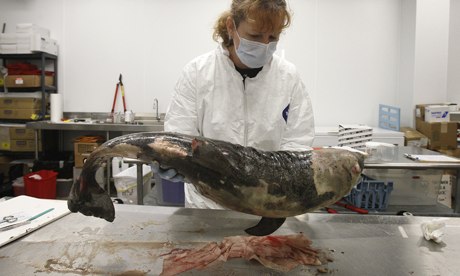
Spreading: Researchers now fear that the outbreak will get worse with herbs moving south for the winter. Above, researchers conduct a necropsy on a dead dolphin in Virginia Beach, Virginia in August


Largest in history: The current outbreak has already eclipsed the last largest outbreak of morbillivirus which killed 740 dolphins between August 1987 and April 1988


While the virus hasn't impacted other species of dolphins in the North and Mid-Atlantic, there is evidence that it may be killing some whales after the bodies of three humpback whales and two pygmy whales were recently found decaying on beaches.
Researchers at the National Oceanic and Atmospheric Administration (NOAA) haven't been able to confirm yet whether these whales were suffering from the same virus since their bodes were 'very decomposed'.
Teri Rowles, of the NOAA Fishers Marine Mammal Stranding Response Program, said in a conference call today that the number of dead beached whales is 'slightly' elevated' from usual but that it's too early to know if it's an outbreak in the whale population.

..........

Dolphin-killing virus reaches Florida, and is infecting whales, too


Nov. 8, 2013 at 3:11 PM ET

Wild bottlenose dolphins play off the bow of a sportfishing boat Friday, Aug. 8, 2008, off the Florida Keys near Islamorada, Fla. (AP Photo/Florida Ke...
Michael Newman / Florida Keys News Bureau via AP 
Wild bottlenose dolphins, off the Florida Keys near Islamorada, Fla.
The bottlenose dolphin die-off that began in July has been traveling steadily south with migrating Atlantic herds, and now diseased and dead dolphins are turning up in Florida. The culprit, a measles-like virus, has claimed 753 victims and counting, making this the worst outbreak ever recorded. Recently, the bug has also been spotted in two species of whale.
Three humpback whales and two pygmy whales, stranded and decaying, tested positive for the dolphin morbillivirus, preliminary sequencing has confirmed. NOAA researchers are doing more tests to find out if it was the virus, usually rare in these animals, that killed them.
"Most of them are very decomposed," Teri Rowles, of the NOAA Fishers Marine Mammal Stranding Response Program, told reporters on a teleconference call Friday. This has made observing the appearance of the disease in tissue samples harder, she said.
"Slightly elevated" stranding numbers for whales have been recorded in New York and Delaware, but it is too early to say if there is an outbreak. Researchers have tested three other marine mammal species for the virus: Common dolphins, spotted dolphins and harp seals sampled in various locations off the East coast seem free of the infection so far.
Meanwhile, the bug continues to take its toll on bottlenose herds. The last great die-off — classified by NOAA as an Unusual Mortality Event — killed about 740 dolphins off the Atlantic coast between August 1987 and April 1988. If this year's outbreak follows the same pattern, "we are less than half way through the time frame" the disease will take to fizzle out, Rowles said, and the death toll has already crossed that historical mark.
Resident Florida bottlenose herds could catch the virus, which spreads through close contact or shared air, Rowles said. Researchers are studying how much the local hosts interact with the visiting migrants, but they can't stop the virus from hopping.
"There is no vaccine that can be deployed for a large bottlenose dolphin population or any cetacean species," Rowles said. "Currently there is nothing that can be done to prevent the infection spreading, or prevent animals that get infected from having severe clinical disease."

Read more Here...........

Enhanced by Zemanta

Monday, August 26, 2013

Biological Hazard - MultiStates, [States of Virginia and New Jersey coastal region] : UPDATE Dolphin Deaths

Earth Watch Report  -  Biological Hazards  -  Mass Animal Die Off (Dolphins)

More than 250 of them -- dead or dying -- have washed up on beaches over the past two months.
/ CBS News
...
24.08.2013Biological HazardUSAMultiStates, [States of Virginia and New Jersey coastal region]Damage level Details
...
Biological Hazard in USA on Tuesday, 06 August, 2013 at 09:06 (09:06 AM) UTC.
Back
Updated:Saturday, 24 August, 2013 at 04:11 UTC
Description
This has been a very bad summer for dolphins along the East Coast. More than 250 of them -- dead or dying -- have washed up on beaches over the past two months, and no one is quite sure why. The first dead dolphins washed up in New Jersey and Virginia in June. Since then more have been found in Maryland and New York. Biologist Kim Durham's rescue team has recovered 27 dead dolphins. Durham doesn't know why it's happening. "When we were doing examinations, we would find they were very skinny animals," she says. "They were compromised animals. Some of them had skin lesions -- they were just very sick individuals." Marine biologists believe the dolphins could be suffering from a bacterial or viral infection with symptoms that resemble measles. It was a virus that killed nearly 750 dolphins from New York to Florida in the late '80s. Charles Potter studied that epidemic. He's a marine mammal biologist at the Smithsonian. He believes pollution could be weakening the dolphins' immune system. "As the animals migrate south, passing back through Virginia and are going down to the Carolinas, if this event follows what we saw in 1987, we can expect the epicenter of the epidemic to move south with the dolphins," Potter says. Late Friday, another dolphin was found dead on the Jersey Shore.
...
(CBS News) RIVERHEAD, N.Y. -- This has been a very bad summer for dolphins along the East Coast. More than 250 of them -- dead or dying -- have washed up on beaches over the past two months, and no one is quite sure why.
More than 250 of them -- dead or dying -- have washed up on beaches over the past two months.
/ CBS News
The first dead dolphins washed up in New Jersey and Virginia in June. Since then more have been found in Maryland and New York. Biologist Kim Durham's rescue team has recovered 27 dead dolphins.
Durham doesn't know why it's happening.
"When we were doing examinations, we would find they were very skinny animals," she says. "They were compromised animals. Some of them had skin lesions -- they were just very sick individuals."
Marine biologists believe the dolphins could be suffering from a bacterial or viral infection with symptoms that resemble measles.


Read More  and  Watch Video Here
...
...
Enhanced by Zemanta