Showing posts with label Gulf of Mexico. Show all posts

Saturday, December 21, 2013

Study links BP oil spill to dolphin deaths

Study links BP oil spill to dolphin deaths

US government scientists have for the first time found direct evidence of toxic exposure in the Gulf of Mexico
A dolphin is seen swimming through an oil sheen from the Deepwater Horizon oil spill
A dolphin is seen swimming through an oil sheen from the Deepwater Horizon oil spill off East Grand Terre Island, where the Gulf of Mexico meets Barataria Bay, on the Louisiana coast, July 31, 2010. Photograph: Gerald Herbert/AP
US government scientists have for the first time connected the BP oil disaster to dolphin deaths in the Gulf of Mexico, in a study finding direct evidence of toxic exposure.
The study, led by scientists from the National Oceanic and Atmospheric Administration, found lung disease, hormonal abnormalities and other health effects among dolphins in an area heavily oiled during the BP spill.
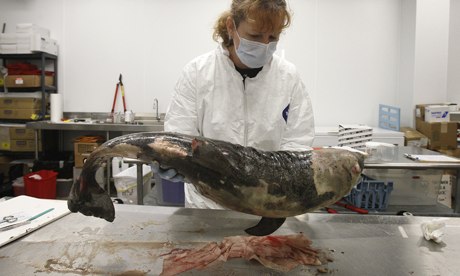
A dead bottlenose dolphin that was found on Ono Island
An Institute for Marine Mammal Studies veterinary technician examines a dead bottlenose dolphin that was found on Ono Island. Photograph: Patrick Semansky/AP
The diseases found in the dolphins at Barataria Bay in Louisiana – though rare – were consistent with exposure to oil, the scientists said.
"Many disease conditions observed in Barataria Bay dolphins are uncommon but consistent with petroleum hydrocarbon exposure and toxicity," the scientists said.
Half of the dolphins were given a guarded prognosis, and 17% were expected to die of the disease, the researchers found.
"I've never seen such a high prevalence of very sick animals – and with unusual conditions such as the adrenal hormone abnormalities," Lori Schwake, the study's lead author, said in a statement.
Read More Here
.....
LiveScience

BP Oil Spill May Have Contributed to Dolphin Deaths, Study Finds


The 2010 BP oil spill contributed to an unusually high death rate for dolphins in the Gulf of Mexico, a new study suggests.
Between January and April 2011, 186 dead bottlenose dolphins washed ashore between Louisiana and western Florida. Most alarmingly, nearly half of these casualties were calves, which is more than double the usual proportion of young to old dolphins found dead. Scientists now blame both natural factors and human catastrophe for the unusual die-off.
"Unfortunately, it was a 'perfect storm' that led to the dolphin deaths," study researcher Graham Worthy, a biologist at the University of Central Florida, said in a statement. "The oil spill and cold water of 2010 had already put significant stress on their food resources. … It appears the high volumes of cold freshwater coming from snowmelt water that pushed through Mobile Bay and Mississippi Sound in 2011 was the final blow." [Gulf Oil Spill: Animals at Risk]

Cold water and spilled oil
The winter of 2010 was a cold one, the researchers reported July 18 in the open-access journal PLoS ONE. Oil began spilling into the Gulf in April 2011, after the Deepwater Horizon platform exploded following a blowout.
The unusually harsh winter of 2010 already dealt wildlife a disadvantage, Worthy and his colleagues wrote. Finfish, marine birds, sea turtles and manatees had been hit hard, with about 6 percent of the U.S. population of manatees lost to cold weather.
Just before the baby dolphins began washing ashore in January 2011, meltwater from an unusually heavy Mobile Bay watershed snowfall hit the Gulf. A comparison of dolphin stranding sites and water conditions revealed that the discovery of the carcasses followed temperature dips from meltwater by two to three weeks, indicating that the dolphins were stressed, died, washed ashore and were eventually found and recorded.
Read More Here
.....
.....
Enhanced by Zemanta

Monday, September 16, 2013

Tropical Depression Ingrid - Gulf Of Mexico September 14th, 2013

Earth Watch Report  -  Storms

...
 Active tropical storm system(s)
Name of storm systemLocationFormedLast updateLast categoryCourseWind SpeedGustWaveSourceDetails
...
Ingrid (AL10)Gulf of Mexico12.09.201314.09.2013Tropical Depression15 °93 km/h111 km/h2.74 mNOAA NHCDetails
...
 photo TropicalDepressionIngrid-GulfofMexicoSeptember14th2013_zps03150d98.jpg
...
 Tropical Storm data
Storm name:Ingrid (AL10)
Area:Gulf of Mexico
Start up location:N 19° 42.000, W 94° 0.000
Start up:13th September 2013
Status:Active
Track long:82.88 km
Top category.: 
Report by:NOAA NHC
Useful links:
 
Past track
DateTimePositionSpeed
km/h
Wind
km/h
Gust
km/h
CategoryCourseWavePressureSource
 
Current position
DateTimePositionSpeed
km/h
Wind
km/h
Gust
km/h
CategoryCourseWave
feet
PressureSource
14th Sep 201314:23:21N 19° 48.000, W 95° 0.000693111Tropical Depression15 °9991 MBNOAA NHC
 
Forecast track
DateTimePositionCategoryWind
km/h
Gust
km/h
Source
16th Sep 201300:00:00N 22° 18.000, W 97° 30.000Hurricane II130157NOAA NHC
17th Sep 201300:00:00N 22° 24.000, W 99° 6.000Tropical Depression6583NOAA NHC
18th Sep 201300:00:00N 22° 0.000, W 100° 0.000Tropical Depression3756NOAA NHC
...
(Photo: National Hurricane Center)

Story Highlights

    • Could become a hurricane shortly before hitting land near Tampico sometime late Sunday or early Monday
    • Tropical Storm Ingrid lashed Mexico's Gulf Coast with heavy rains on Friday
    • State officials imposed an orange alert, the highest possible, in parts of southern Veracruz
Tropical Storm Ingrid, which formed in the southern Gulf of Mexico on Friday morning, is bringing heavy rains and flooding to Mexico's Gulf Coast.
Ingrid could become a hurricane shortly before hitting land near the Gulf coast port city of Tampico sometime late Sunday or early Monday, according to the U.S. National Hurricane Center.
It is the ninth named storm of the 2013 Atlantic hurricane season. So far, eight of the nine named storms have been tropical storms, with only one hurricane (Humberto).
Early Friday, Ingrid had winds of 60 mph and entered about 60 miles east of Veracruz, Mexico. The storm was stationary.
The greatest impacts from Ingrid will likely be heavy rainfall, flash flooding and mudslides in eastern Mexico, according to AccuWeather meteorologist Alex Sosnowski.
A wide swath of eastern Mexico near and inland of the Gulf Coast has the potential to pick up 10 to 15 inches of rainfall, with isolated amounts over 25 inches, AP reported.
The flooding could be "life-threatening," according to the hurricane center. State officials imposed an orange alert, the highest possible, in parts of southern Veracruz.
At least three major rivers in the eastern state of Veracruz were flooding or close to overflowing their banks and hundreds of people were evacuating low-lying areas, AP reported.
The storm could also bring needed rainfall farther north along the Mexico coast and perhaps as far north as South Texas, depending on its track, AccuWeather reports. "Any reasonable rainfall will be welcomed by many residential and agricultural interests over the Rio Grande Valley," Sosnowski says.
There are now three active, named systems in the Atlantic basin. Ingrid joins Tropical Storm Humberto and Tropical Depression Gabrielle, which are both spinning in the open Atlantic Ocean and are expected to continue to weaken on Friday.


Read More Here
...
...
Enhanced by Zemanta

Monday, July 29, 2013

Researchers seeking clues in ‘unprecedented’ dolphin die-off


Researchers seeking clues in ‘unprecedented’ dolphin die-off // VIDEO, MAP, PHOTO GALLERY

Dolphin mystery
Dolphin mystery
Bottle-nosed dolphin Roux, right, clowns around with his friend Jett at Gulf World in Panama City Beach. Roux was rescued from Louisiana and participates in a few of the dolphin shows, while Jett was born at the marine park.

Heather Leiphart | The News Herald
Published: Saturday, July 27, 2013 at 18:03 PM.
PANAMA CITY BEACH — For the last three years, dolphins have been dying at an unprecedented rate in the Gulf of Mexico, and experts say there’s still no end in sight.
“The length and the severity of this event is unprecedented in the Gulf,” said Chris Robbins, a scientist and senior manager for restoration planning with Ocean Conservancy. “More than 1,000 animals have stranded and more than 95 percent of those have been dead. … The mortalities we’re seeing are far above what the historical average has been.”
Under the Marine Mammal Protection Act, the National Oceanic and Atmospheric Administration (NOAA) declared an Unusual Mortality Event (UME) in December 2010 for dolphins in the northern Gulf of Mexico, the area from the Texas/Louisiana border to Franklin County.
Since the event began in February 2010, 1,026 strandings have occurred through July 21. The event is the most severe ever recorded in the Gulf, with 95 percent of strandings ending in mortality.
“It’s the longest in duration and highest number of strandings in the UME program,” said Erin Fougeres, Marine Mammal Stranding Network Program administrator for NOAA. “In this case, this unusual mortality event has been going on since just prior to the oil spill.”
By NOAA definition, a UME is “a stranding that is unexpected, involves a significant die-off of any marine mammal population and demands immediate response.”
But, response is difficult when the cause of the UME is still unknown.

Click for  video
See more photos
Interactive map

Oil’s role
Although the UME began two months prior to the 2010 Deepwater Horizon oil spill, researchers are not ruling out oil dispersant as a factor.
“This unusual mortality event actually started before the oil spill in February 2010, but when the oil spill happened there was a spike in strandings, and they’ve been high ever since,” Robbins said. “It does raise aquestion to the extent of which the oil spill has exacerbated the UME.”
Robbins said many of the symptoms observed in the stranding events are consistent with those of marine mammals that have been exposed to oil.
“What they’re seeing in these animals is a compromised immune system,” Robbins said. “It may be like a cancer patient with a compromised immune system coming down with something else because they’ve been exposed to a virus or some other type of contaminant.”
Experts are investigating what role brucella bacteria may have in relation to the UME. Thus far, 27 out of 107 dolphins were positive or suspected to be positive for brucella, a common cause of abortions in the marine mammals.
Some animals also are showing signs of pneumonia and adrenal gland abnormalities, Fougeres reported.
“We don’t have any definitive cause of the mortalities at this point,” Fougeres said. “There may not be any one thing that’s killing off the animals. There may be more than one factor involved.”
NOAA has formally recognized 59 marine mammal UMEs in the U.S. since 1991, but has determined cause for just 25 of them.
In the same timeframe, the Gulf of Mexico has seen 11 UMEs involving dolphins. Fougeres reported the most common cause of the previous events was morbillivirus, a highly infectious virus that includes agents of measles and canine distemper.
“We’re trying to rule out the most common causes of UMEs that have happened in the Gulf in the past,” Fougeres said. Morbillivirus “doesn’t appear to be the case.”
The highest number of strandings has occurred in Louisiana, followed by Mississippi, Alabama and the Florida Panhandle.
“Fortunately, for the Florida Panhandle, they haven’t really been too much above average since 2010,” Fougeres said.


Read More Here


***************************************************************
File:Bottlenose dolphin with young.JPG

File:Bottlenose Dolphins.jpg

File:Dolphins gesture language.jpg

File:Bottlenose Dolphin KSC04pd0178 (cropped).jpg
Author : NASA
 
***************************************************************
Enhanced by Zemanta

Thursday, July 25, 2013

HAZMAT - Gulf of Mexico (Louisiana), [Hercules 265 oil rig] : UPDATE

Earth Watch Report  -  Hazmat


( HANDOUT, Reuters / July 24, 2013 )
Handout photo showing a cloud of natural gas rising from the Hercules 265 drilling rig located 55 miles off the coast of Louisiana
...
24.07.2013HAZMATUSAGulf of Mexico (Louisiana), [Hercules 265 oil rig]Damage level
Details
...

HAZMAT in USA on Wednesday, 24 July, 2013 at 03:30 (03:30 AM) UTC.


Description
Forty-four workers evacuated a jack-up rig in the Gulf of Mexico on Tuesday and two Houston-based companies worked to curb uncontrolled flow of natural gas from a well on which the rig was working. Hercules Offshore said its Hercules 265 rig is operating for Walter Oil & Gas Corp. No one was injured in the evacuation, and no oil was spilled, said Tim O'Leary, a spokesman for Walter Oil & Gas. The Bureau of Safety and Environmental Enforcement said the well is 55 miles off the coast of Louisiana in 154 feet of water. Walter Oil & Gas reported the loss of well control to the safety bureau Tuesday morning, the agency said. Bureau inspectors reported a dissipating light sheen on the Gulf surface, 50 feet by one-half mile in size. The rig was working on a sidetrack well - drilled adjacent to an existing one - in preparation for production, the safety bureau said. Earlier this month, a 40-year-old well owned by a subsidiary of Houston-based Talos Energy well leaked natural gas into the Gulf for four days before responders plugged the leak and permanently sealed the well with cement.
...

HAZMAT in USA on Wednesday, 24 July, 2013 at 03:30 (03:30 AM) UTC.


Back

Updated: Wednesday, 24 July, 2013 at 17:04 UTC
Description
A shallow-water Gulf of Mexico drilling rig on fire because of a ruptured natural gas well has partially collapsed, U.S. regulators said on Wednesday. The U.S. Bureau of Safety and Environmental Enforcement said beams supporting the derrick and rig floor on the Hercules Offshore rig collapsed over the structure. BSEE also said a third firefighting vessel was enroute to the scene, though no sheen was seen on the water's surface during overflights conducted on Wednesday morning.
...

Gulf rig partially collapses in fire off Louisiana


A fire broke out on a gas well in the Gulf of Mexico late Tuesday, hours after dozens of workers were evacuated due to an out-of-control leak. No injuries are reported. Officials haven't said how or when they'll attempt to put out the blaze. (July 24)


HOUSTON (Reuters) - A shallow-water Gulf of Mexico drilling rig has partially collapsed off the coast of Louisiana after catching fire because of a ruptured natural gas well, U.S. regulators said on Wednesday.

The U.S. Bureau of Safety and Environmental Enforcement said beams supporting the derrick and rig floor on the Hercules Offshore jackup rig had crumpled over the rig structure. A third firefighting vessel was en route to the scene, though no sheen was seen on the water's surface during overflights conducted on Wednesday morning, the regulator said.

The fire ignited shortly before 11 p.m. CDT on Tuesday. The Walter Oil & Gas-owned well had ruptured hours earlier as Hercules worked to prepare it for production. The well released natural gas, but no oil, according to BSEE.

No one was on board when the rig caught fire, BSEE said. Hercules said 44 people were evacuated after the rupture and no injuries were reported. The rig is in 154 feet of water about 55 miles south of the coast of Louisiana.

Read More  and  Watch Video Here
...

...
Enhanced by Zemanta