Showing posts with label The Sun. Show all posts

Tuesday, October 6, 2015

NASA's SDO Sees a Huge Coronal Hole Spread out Over Almost the Entire Northern Hemisphere of the Sun


Published on Oct 6, 2015
NASA's SDO Sees a Huge Coronal Hole Spread out Over Almost the Entire Northern Hemisphere of the Sun.

NASA's Solar Dynamics Observatory captured a picture of the sun on October 6, 2015, showing two huge coronal holes.

The larger coronal hole spread out over almost the entire northern hemisphere of the sun, covers an estimated 8 to 10-percent of the total solar surface, making it one of the largest polar holes scientists have observed in decades. Solar wind flowing from these two coronal holes should reach Earth on Oct 8-9.

A coronal hole is an area of the sun's atmosphere, the corona, where the magnetic field opens up and the material flows quickly out. This results in a cooler and less dense atmosphere than the surrounding areas.

Coronal holes spew out fast solar wind, probably traveling at about 400-500 miles per second. This is roughly twice the speed of the normal solar wind, the solar material that is constantly streaming off the sun in every direction to fill the solar system.

These images were taken by NASA's SDO solar spacecraft
http://sdo.gsfc.nasa.gov/data/

Images credit: NASA/SDO and SOHO
http://sdo.gsfc.nasa.gov/assets/img/l...
http://sohowww.nascom.nasa.gov/data/r...

Coronal hole
https://en.wikipedia.org/wiki/Coronal...

What is a coronal hole?
http://www.ips.gov.au/Educational/2/1/5
http://www.spaceweatherlive.com/en/he...

Monday, August 5, 2013

Monday, July 22, 2013

Solar Activity Monday July 22nd , 2013


Solar wind
speed: 401.2 km/sec
density: 4.0 protons/cm3
explanation | more data
Updated: Today at 0107 UT
X-ray Solar Flares
6-hr max: B4
2040 UT Jul21
24-hr: C3
0844 UT Jul21
explanation | more data
Updated: Today at: 2359 UT

Daily Sun: 21 July 13

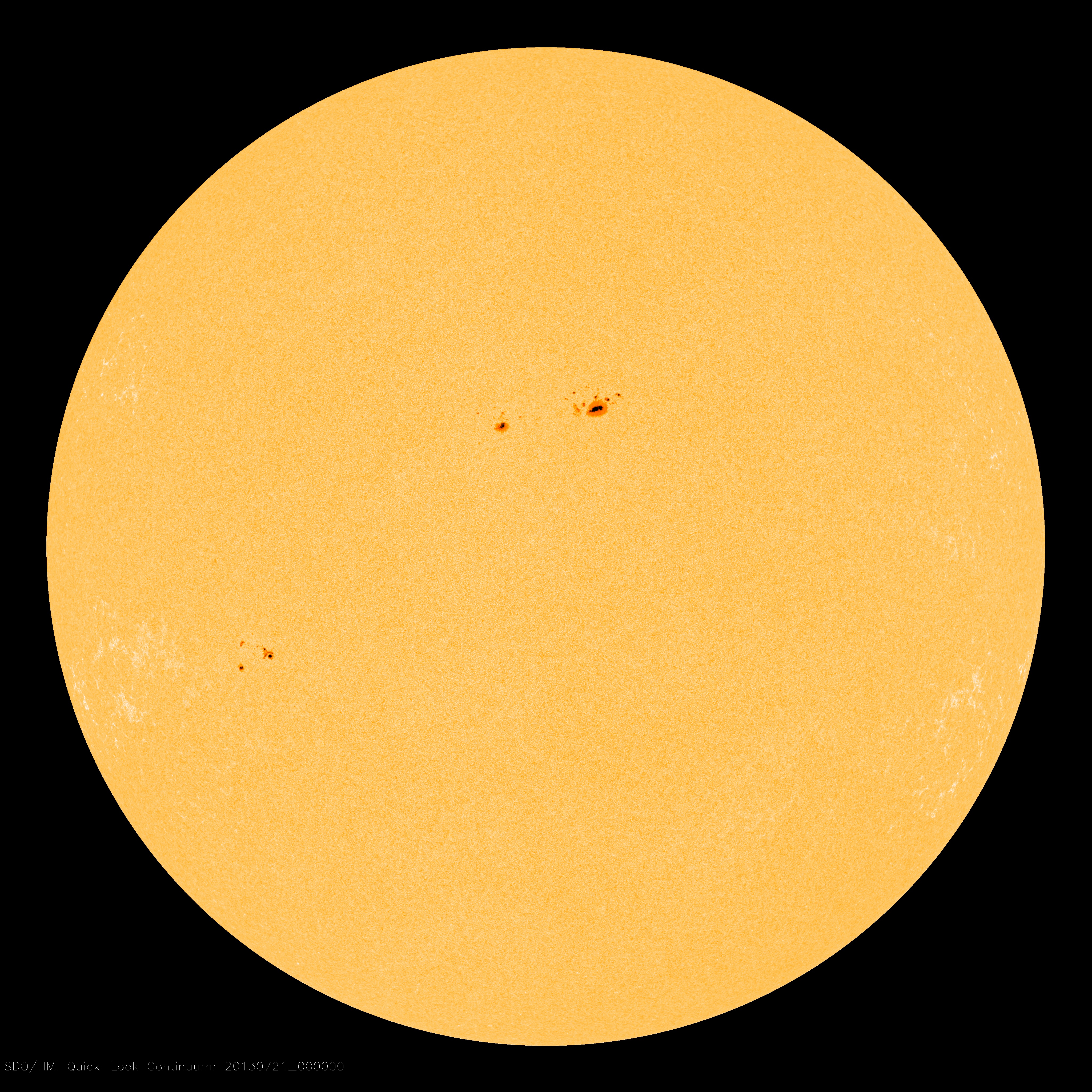
Sunspot AR1793 has a beta-gamma magnetic field that harbors energy for M-class solar flares. However, the sunspot is quiet. Credit: SDO/HMI

QUIET SUN:

Solar activity is low. The biggest sunspot on the Earthside of the sun, AR1783, has been quiet for days even though it has a 'beta-gamma' magnetic field that harbors energy for M-class solar flares. NOAA forecasters estimate a slim 10% chance that AR1783 will break the quiet with an M-flare on July 21st.

Current Auroral Oval:

Switch to: Europe, USA, New Zealand, Antarctica
Credit: NOAA/POES

Planetary K-index
Now: Kp= 2 quiet
24-hr max: Kp= 2
quiet
explanation | more data

Interplanetary Mag. Field
Btotal: 5.1 nT
Bz: 2.0 nT north
explanation | more data
Updated: Today at 0107 UT

Coronal Holes: 21 Jul 13


Earth is inside a solar wind stream flowing from the indicated coronal hole. Credit: SDO/AIA.
Enhanced by Zemanta