Showing posts with label Coronal hole. Show all posts

Tuesday, October 6, 2015

NASA's SDO Sees a Huge Coronal Hole Spread out Over Almost the Entire Northern Hemisphere of the Sun


Published on Oct 6, 2015
NASA's SDO Sees a Huge Coronal Hole Spread out Over Almost the Entire Northern Hemisphere of the Sun.

NASA's Solar Dynamics Observatory captured a picture of the sun on October 6, 2015, showing two huge coronal holes.

The larger coronal hole spread out over almost the entire northern hemisphere of the sun, covers an estimated 8 to 10-percent of the total solar surface, making it one of the largest polar holes scientists have observed in decades. Solar wind flowing from these two coronal holes should reach Earth on Oct 8-9.

A coronal hole is an area of the sun's atmosphere, the corona, where the magnetic field opens up and the material flows quickly out. This results in a cooler and less dense atmosphere than the surrounding areas.

Coronal holes spew out fast solar wind, probably traveling at about 400-500 miles per second. This is roughly twice the speed of the normal solar wind, the solar material that is constantly streaming off the sun in every direction to fill the solar system.

These images were taken by NASA's SDO solar spacecraft
http://sdo.gsfc.nasa.gov/data/

Images credit: NASA/SDO and SOHO
http://sdo.gsfc.nasa.gov/assets/img/l...
http://sohowww.nascom.nasa.gov/data/r...

Coronal hole
https://en.wikipedia.org/wiki/Coronal...

What is a coronal hole?
http://www.ips.gov.au/Educational/2/1/5
http://www.spaceweatherlive.com/en/he...

Wednesday, May 14, 2014

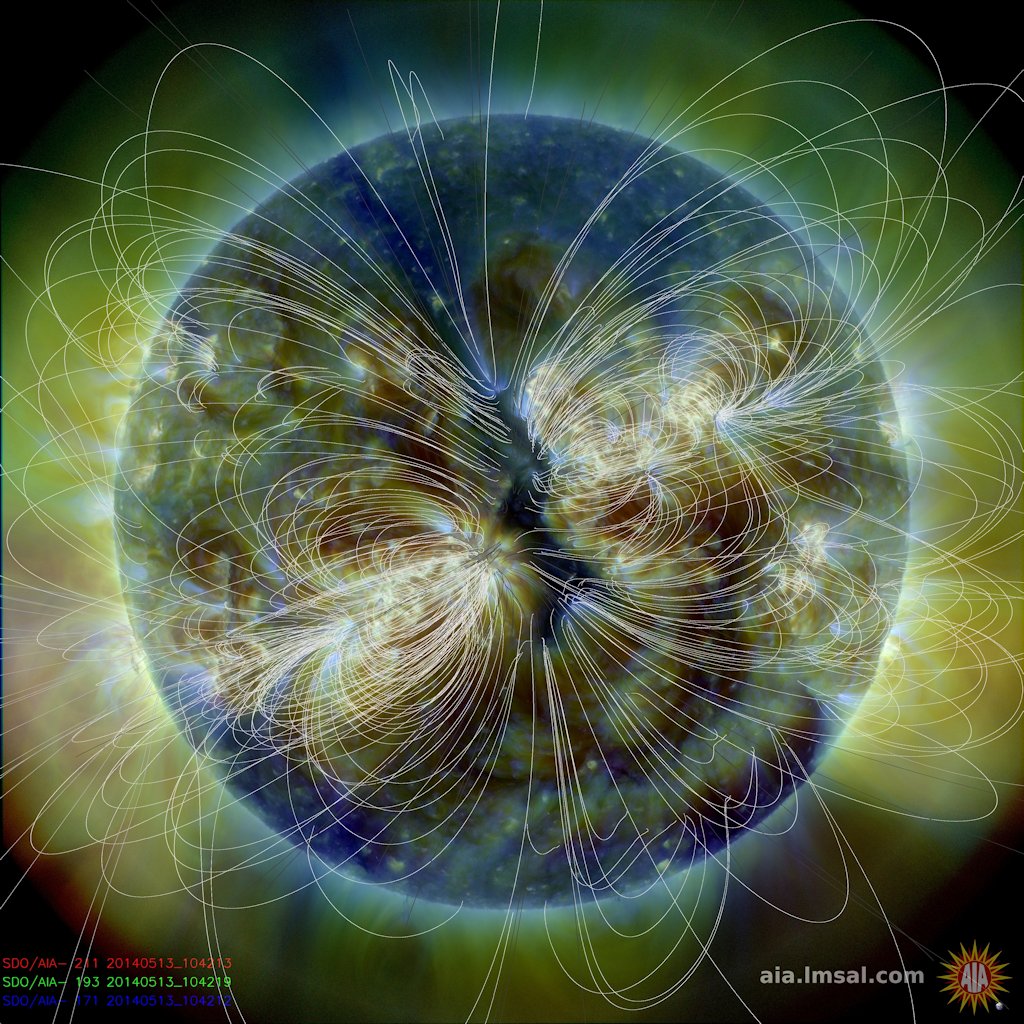
The sun's atmosphere is split down the middle by a canyon-shaped coronal hole, which is almost directly facing Earth

Earth Watch Report  -  Solar Activity


.....

Space Weather

by Dr. Tony Phillips.

CORONAL CANYON:

Today, the sun's atmosphere is split down the middle by a canyon-shaped coronal hole. NASA's Solar Dynamics Observatory photographed the chasm, which is almost directly facing Earth:
Coronal holes are places where the sun's magnetic field opens up and allows solar wind to escape. This hole is straddling the sun's equator so the solar wind stream emerging from it will intersect Earth's orbit. ETA: May 16-17. High-latitude sky watchers should be alert for auroras on those dates.

.....


Enhanced by Zemanta

Huge ‘coronal hole’ spotted on Sun

Earth Watch Report  -  Solar Activity


.....

Space Weather

by Dr. Tony Phillips.

SOUTHERN CORONAL HOLE:

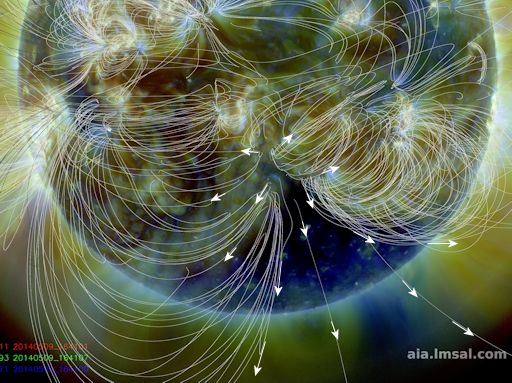
Imagine what it would be like if, from time to time, a hole opened up in Earth's atmosphere and air went blowing out into space. On the sun, this happens all the time. The openings are called "coronal holes." NASA's Solar Dynamics Obervatory is monitoring one right now; it is the dark wedge-shaped region in this extreme ultraviolet image of the sun's southern hemisphere:
Coronal holes are places in the sun's atmosphere where the magnetic field bends back and allows gas to escape. From such openings, solar wind blows out into space. A stream of solar wind flowing from this particular coronal hole could reach Earth on May 11-12, sparking auroras when it arrives. On the other hand, the stream might sail south of our planet, delivering only a glancing blow. Stay tuned for updates.

.....

Huge square-shaped ‘coronal hole’ spotted on Sun (VIDEO)

Published time: May 13, 2014 12:00

NASA / SDO / GODDARD SPACE CENTER
A gigantic square hole has been video-captured on the Sun’s surface by NASA’s Solar Dynamics Observatory (SDO). The particularly large monstrosity, known as a “coronal hole”, is an indicator of solar winds ejected out of the star at insane speeds.

Read More and Watch Video Here

.....
Enhanced by Zemanta

Thursday, December 12, 2013

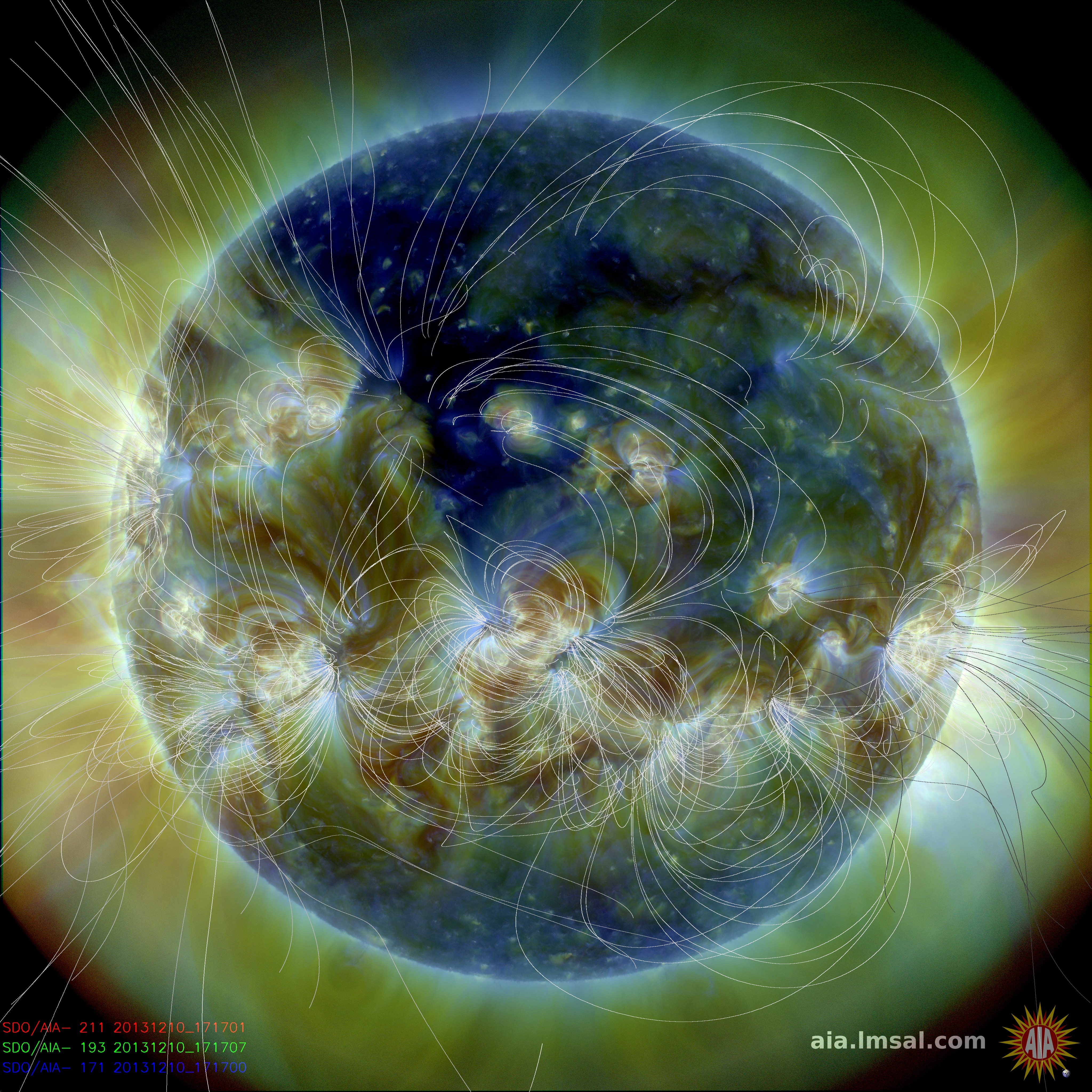
NASA's Solar Dynamics Observatory is monitoring a large coronal hole in the sun's northern hemisphere.

Spaceweather.com

by Dr. Tony Phillips.

CORONAL HOLE:

Shown here in an extreme ultraviolet photo taken Dec. 11th, the UV-dark chasm overlies more than 500 billion square kilometers of solar terrain:


Coronal holes are places in the sun's atmosphere where the magnetic field opens up and allows solar wind to escape. A broad stream of solar wind flowing from this particular coronal hole should reach Earth on Dec. 15-17.
The last time a solar wind stream blew past Earth, on Dec. 7th, the impact sparked Northern Lights in the United States as far south as Montana and Michigan. A repeat performance could be in the offing. High-latitude sky watchers should be alert for auroras early next week.


.....

Solar Storm Forecast 12-10-13 


TamithaSkov


Published on Dec 10, 2013
Even while busy with Comet ISON, the Sun managed to launch three partially Earth-directed solar storms this week, two of which have hit the Earth causing a geomagnetic storm as of this posting. The East limb is also buzzing with new activity and 5 new sunspots have emerged on the Earth-facing solar disk in the past few days alone. All of this means more activity is in store for us this week. Find out the details of when and how this activity will affect your mobile devices and your life this week.

Follow @TamithaSkov on Twitter for Daily Space Weather Forecasts

For a more in-depth look at the data and images highlighted in this video see these links below.

Comet ISON and aurora photography:
links coming momentarily...

Solar Imaging and Analysis:
SDO: http://sdo.gsfc.nasa.gov/data/
Helioviewer: http://www.helioviewer.org/
Flare Analysis: http://www.lmsal.com/solarsoft/latest...
Computer Aided CME Tracking CACTUS: http://www.sidc.oma.be/cactus/out/lat...
GOES Xray: http://www.swpc.noaa.gov/rt_plots/xra...
SOHO: http://sohodata.nascom.nasa.gov/
Stereo: http://stereo.gsfc.nasa.gov/
NOAA Sunspot Classifications: http://www.swpc.noaa.gov/ftpdir/lates...
GONG: http://gong2.nso.edu/dailyimages/
GONG Magnetic Maps: http://gong.nso.edu/data/magmap/
LMSAL Heliophysics Events HEK http://www.lmsal.com/isolsearch

Solar Wind:
NOAA/SWPC: http://www.swpc.noaa.gov
ACE Solar Wind: http://www.swpc.noaa.gov/ace/ace_rtsw...
Wang-Sheeley-Arge Solar Wind Prediction Model: http://www.swpc.noaa.gov/ws/
NASA ENLIL SPIRAL: http://iswa.gsfc.nasa.gov:8080/IswaSy...
NOAA ENLIL SPIRAL: http://www.swpc.noaa.gov/wsa-enlil/

Magnetosphere, Ionosphere, Atmosphere:
GOES Magnetometer: http://www.swpc.noaa.gov/rt_plots/mag...
Ionosphere D-Region Absorption (DRAP) model: http://www.swpc.noaa.gov/drap/
Auroral Oval Ovation Products: http://helios.swpc.noaa.gov/ovation/
POES Auroral Global Maps: http://www.swpc.noaa.gov/pmap/
Global 3-hr Kp index: http://www.swpc.noaa.gov/rt_plots/kp_...
Wing Kp index prediction: http://www.swpc.noaa.gov/wingkp/index...
USGS Ground Magnetometers: http://geomag.usgs.gov/realtime/
USGS Disturbance Storm-Time (Dst): http://geomag.usgs.gov/realtime/dst/
HAARP Data Meters: http://www.haarp.alaska.edu/haarp/

Multi-Purpose Space Environment Sites:
SOLARHAM: http://www.solarham.net/index.htm
Spaceweather: http://spaceweather.com
SOLARIMG: http://solarimg.org/artis/
iSWA: http://iswa.gsfc.nasa.gov/iswa/iSWA.html

Definition of Geomagnetic Storm, Radiation Storm, and Radio Blackout Levels:
http://www.swpc.noaa.gov/NOAAscales/


None of this would be possible without the hard work and dedication of those who have provided all of this data for public use.

Images c/o NASA/ESA/CSA (most notably the superb SDO, SOHO, ACE, STEREO, CCMC, JPL & DSN teams, amazing professionals, hobbyists, institutions, organizations, agencies and amateurs such as those at the USAF/HAARP, NICT, NOAA, USGS, Environment Canada, Natural Resources Canada, Intellicast, Catatania, rice.edu, wisc.edu, sonoma.edu ucalgary.ca, rssi.ru, ohio-state.edu, solen.info, and more. Thanks for making Space Weather part of our every day dialogue.
 .....


Enhanced by Zemanta