Posted by
Friday 14 March 2014 14.28 EDT
Natural and social scientists develop new model of how 'perfect storm' of crises could unravel global system
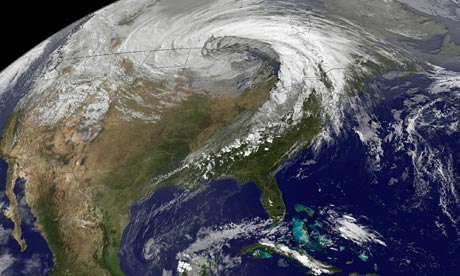
This
Nasa Earth Observatory image shows a storm system circling around an
area of extreme low pressure in 2010, which many scientists attribute to
climate change. Photograph: AFP/Getty Images
A new study
sponsored by Nasa's Goddard Space Flight Center has highlighted the
prospect that global industrial civilisation could collapse in coming
decades due to unsustainable resource exploitation and increasingly
unequal wealth distribution.
Noting that warnings of 'collapse'
are often seen to be fringe or controversial, the study attempts to make
sense of compelling historical data showing that "the process of
rise-and-collapse is actually a recurrent cycle found throughout
history." Cases of severe civilisational disruption due to "precipitous
collapse - often lasting centuries - have been quite common."
The
research project is based on a new cross-disciplinary 'Human And Nature
DYnamical' (HANDY) model, led by applied mathematician Safa Motesharri
of the US National Science Foundation-supported
National Socio-Environmental Synthesis Center,
in association with a team of natural and social scientists. The study
based on the HANDY model has been accepted for publication in the
peer-reviewed Elsevier journal, Ecological Economics.
It finds
that according to the historical record even advanced, complex
civilisations are susceptible to collapse, raising questions about the
sustainability of modern civilisation:
"The fall of
the Roman Empire, and the equally (if not more) advanced Han, Mauryan,
and Gupta Empires, as well as so many advanced Mesopotamian Empires, are
all testimony to the fact that advanced, sophisticated, complex, and
creative civilizations can be both fragile and impermanent."
By
investigating the human-nature dynamics of these past cases of
collapse, the project identifies the most salient interrelated factors
which explain civilisational decline, and which may help determine the
risk of collapse today: namely, Population, Climate, Water, Agriculture,
and
Energy.
These
factors can lead to collapse when they converge to generate two crucial
social features: "the stretching of resources due to the strain placed
on the ecological carrying capacity"; and "the economic stratification
of society into Elites [rich] and Masses (or "Commoners") [poor]" These
social phenomena have played "a central role in the character or in the
process of the collapse," in all such cases over "the last five thousand
years."
Currently, high levels of economic stratification are
linked directly to overconsumption of resources, with "Elites" based
largely in industrialised countries responsible for both:
"...
accumulated surplus is not evenly distributed throughout society, but
rather has been controlled by an elite. The mass of the population,
while producing the wealth, is only allocated a small portion of it by
elites, usually at or just above subsistence levels."
The study challenges those who argue that technology will resolve these challenges by increasing efficiency:
"Technological
change can raise the efficiency of resource use, but it also tends to
raise both per capita resource consumption and the scale of resource
extraction, so that, absent policy effects, the increases in consumption
often compensate for the increased efficiency of resource use."
Productivity
increases in agriculture and industry over the last two centuries has
come from "increased (rather than decreased) resource throughput,"
despite dramatic efficiency gains over the same period.
Read More Here