Showing posts with label Polar Ice Packs. Show all posts

Sunday, January 26, 2014

As Arctic ice melts, polar bears switch diets to survive, studies say


Arctic polar bears may be adjusting their eating habits as their sea ice habitat melts and the furry white predators stand to lose the floating platform they depend on to hunt seals, their primary food. According to researchers, however, the bears are displaying flexible eating habits as their world changes around them.
Indeed, scientific studies indicate polar bear populations are falling as the sea ice disappears earlier each spring and forms later in the fall. But a series of papers based on analysis of polar bear poop released over the past several months indicate that at least some of the bears are finding food to eat when they come ashore, ranging from bird eggs and caribou to grass seeds and berries.
"What our results suggest is that polar bears have flexible foraging strategies," Linda Gormezano, a biologist at the American Museum of Natural History in New York and a co-author of several of the papers, told NBC News.

Quinoa, a dog, finds polar bear scat
Robert Rockwell / American Museum of Natural History
Quinoa, a Dutch shepherd who was trained to sniff out polar bear scat, sits next to find. Analysis of the polar bear scat reveals the animals have a flexible foraging strategy.
The results stem from research in western Hudson Bay, near Chruchill, Manitoba, Canada, which is in the southern extent of polar bear habitat and serves as a harbinger of what the animals are likely to face throughout their Arctic range as the climate continues to warm and sea ice breaks up earlier and earlier each spring.
The flexible foraging strategy of polar bears "means that there may be more to this picture in terms of how polar bears will adjust to changing ice conditions" than indicated by models based on the spring breakup date of the sea ice and thus their access to seals, Gormezano said.
She added that nobody knows for sure how well polar bears will adapt to the changing food supply, but a big step toward an answer is to study what they eat on land "rather than assume that they may just be fasting."
Let them eat car parts
In addition to berries, birds and eggs, Andrew Derocher, a University of Alberta polar bear biologist who was not involved with the recent studies, said people have seen a polar bear drink hydraulic fluid as it was drained out of a forklift, chomp the seats of snow machines, and eat lead acid batteries.
"Polar bears will eat anything," he told NBC News. "The question is: Does is it do them any good? And everything we can see from what bears eat when they are on land is it has a very, very minimal energetic return relative to the cost."
Gormezano said the plants found in any given pile of poop were usually the same, suggesting the bears eat whatever they find in their immediate surroundings — they don't spend a lot energy searching for food. Mothers and cubs, who wander farthest inland, feast on berries found there. On the coast, where adult males linger, the poop is predominantly shoreline grass seeds.
Animal remains, however, showed no pattern, which fits with a landscape rich with nesting birds and caribou and polar bears opportunistically eating whatever crosses their path, according to a paper Gormenzano and colleague Robert Rockwell published in BMC Ecology in December 2013.
In a paper published in Polar Biology in May 2013, the researchers report observations of polar bears chasing and capturing snow geese with the efficiency of a skilled hunter — snagging one right after the other.
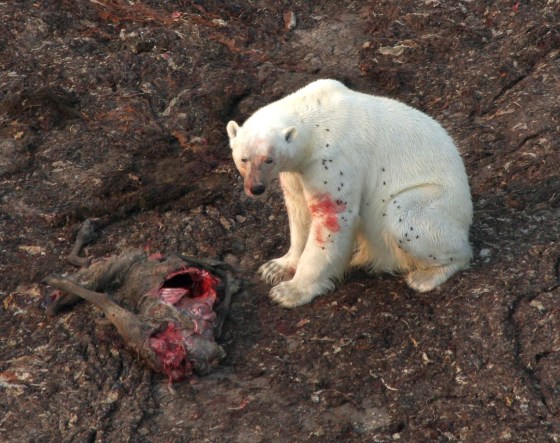
Polar bear eats a caribou
Robert Rockwell / American Museum of Natural History
A polar bear eats a caribou on land. Recent studies suggest polar bears have a flexible foraging strategy, which help them survive as they come ashore earlier due to melting Arctic sea ice.
"Previously, it had been thought that that would not be a very energetically profitable thing for a polar bear to do because they expend more energy in the chase than they get from consuming the food," Gormezano noted.

Read More Here


Enhanced by Zemanta

Saturday, September 28, 2013

The Arctic icepack reached its summer low on Sept. 13, the National Snow and Ice

LiveScience


2013's Summer Arctic Sea Ice a Top 10 Low

 
Arctic sea ice
A satellite image of Arctic sea ice snapped on Sept. 12, 2013.
Credit: NASA's Goddard Space Flight Center Scientific Visualization Studio
It's official: The Arctic icepack reached its summer low on Sept. 13, the National Snow and Ice Data Center (NSIDC) in Boulder, Colo., said today (Sept. 20).
The Arctic ice cover melted down to 1.97 million square miles (5.10 million square kilometers) — about the size of Texas and California combined.
The final tally puts 2013 in sixth place out of the top 10 record low ice years since tracking began with satellites 30 years ago. It also continues an overall downward trend in the extent of summer sea ice, the NSIDC said. (2012 is the top record holder, with the lowest summer ice extent ever recorded.)

The rebound in ice cover after a record low year was expected, Walt Meier, a glaciologist at NASA’s Goddard Space Flight Center in Greenbelt, Md., said in a statement. "There is always a tendency to have an uptick after an extreme low; in our satellite data, the Arctic sea ice has never set record low minimums in consecutive years.

 [Video: Watch the 2013 summer ice melt]


Read More Here


Enhanced by Zemanta

Wednesday, July 24, 2013

New study looks at planetary, social and economic impacts of increasingly perilous Arctic melting


- Jon Queally, staff writer
Permafrost on the northeastern side of Spitsbergen, Svalbard, an island in the arctic region between Norway and the North Pole. (Photo: Olafur Ingolfsson.)Warning that a dramatic "burp" or "pulse" of methane from beneath the fragile permafrost of the Arctic caused by continued global warming would set off a "climate catastrophe," a new study says that the continued melting is also an economic "time bomb" that could cost the global economy $60 trillion.
Billions upon billions of tons of methane remain stored in the permafrost throughout the Arctic regions, but specific concern has been placed on the enormous reserves that sit locked beneath the East Siberian Arctic Shelf. Scientists have repeatedly warned that if these deposits—many frozen in the form of methane hydrates—were released, they would trigger massive feedback loops and dramatically increase the rate of global warming.
The new study confirms these established fears, but also looks at the potential social and economic costs that would follow.
Though the corporate scavengers of the fossil fuel and mining companies are drooling over the prospects of a melting arctic in order to exploit previously inaccessible reserves of mineral and energy resources, the climate researchers say both the planetary and economic impacts should be taken extremely seriously.
The report's authors say that global financial and political leaders of the world continue to avoid the warnings of scientists when it comes to the dangers posed by the melting arctic.
As the Guardian's John Vidal reports:
Governments and industry have expected the widespread warming of the Arctic region in the past 20 years to be an economic boon, allowing the exploitation of new gas and oilfields and enabling shipping to travel faster between Europe and Asia. But the release of a single giant "pulse" of methane from thawing Arctic permafrost beneath the East Siberian sea "could come with a $60tn [£39tn] global price tag", according to the researchers who have for the first time quantified the effects on the global economy.
Even the slow emission of a much smaller proportion of the vast quantities of methane locked up in the Arctic permafrost and offshore waters could trigger catastrophic climate change and "steep" economic losses, they say.
"The global impact of a warming Arctic is an economic time bomb," said Gail Whiteman, a climate policy analyst at Erasmus University in Rotterdam and one of the authors of the report.
"The imminent disappearance of the summer sea ice in the Arctic will have enormous implications for both the acceleration of climate change, and the release of methane from off-shore waters which are now able to warm up in the summer," added Cambridge University's Peter Wadhams, another co-author.
As Vidal notes:
The Arctic sea ice, which largely melts and reforms each year, is declining at an unprecedented rate. In 2012, it collapsed to under 3.5m sqkm by mid September, just 40% of its usual extent in the 1970s. Because the ice is also losing its thickness, some scientists expect the Arctic ocean to be largely free of summer ice by 2020.
The growing fear is that as the ice retreats, the warming of the sea water will allow offshore permafrost to release ever greater quantities of methane. A giant reservoir of the greenhouse gas, in the form of gas hydrates on the East Siberian Arctic Shelf (ESAS), could be emitted, either slowly over 50 years or catastrophically fast over a shorter time frame, say the researchers.
A "massive methane boost," explained Wadhams, "will have major implications for global economies and societies. Much of those costs would be borne by developing countries in the form of extreme weather, flooding and impacts on health and agricultural production."


________________________________________


Enhanced by Zemanta