Showing posts with label Evolution. Show all posts

Sunday, November 29, 2015

A new study has sequenced the first tardigrade (Water Bear) genome. Findings : 17.5% foreign species DNA.


tardigrade_fam
5. They’ve been around longer than nearly every other living organism.
Tardigrades roamed the earth and seas far before humans did – and will most likely outlast us. Will the tardigrades be nature’s last organisms standing? Only time will tell.

5 Reasons Why The Tardigrade Is Nature’s Toughest Animal
Read More Here

Sunday, January 26, 2014

As Arctic ice melts, polar bears switch diets to survive, studies say


Arctic polar bears may be adjusting their eating habits as their sea ice habitat melts and the furry white predators stand to lose the floating platform they depend on to hunt seals, their primary food. According to researchers, however, the bears are displaying flexible eating habits as their world changes around them.
Indeed, scientific studies indicate polar bear populations are falling as the sea ice disappears earlier each spring and forms later in the fall. But a series of papers based on analysis of polar bear poop released over the past several months indicate that at least some of the bears are finding food to eat when they come ashore, ranging from bird eggs and caribou to grass seeds and berries.
"What our results suggest is that polar bears have flexible foraging strategies," Linda Gormezano, a biologist at the American Museum of Natural History in New York and a co-author of several of the papers, told NBC News.
Quinoa, a dog, finds polar bear scat
Robert Rockwell / American Museum of Natural History
Quinoa, a Dutch shepherd who was trained to sniff out polar bear scat, sits next to find. Analysis of the polar bear scat reveals the animals have a flexible foraging strategy.
The results stem from research in western Hudson Bay, near Chruchill, Manitoba, Canada, which is in the southern extent of polar bear habitat and serves as a harbinger of what the animals are likely to face throughout their Arctic range as the climate continues to warm and sea ice breaks up earlier and earlier each spring.
The flexible foraging strategy of polar bears "means that there may be more to this picture in terms of how polar bears will adjust to changing ice conditions" than indicated by models based on the spring breakup date of the sea ice and thus their access to seals, Gormezano said.
She added that nobody knows for sure how well polar bears will adapt to the changing food supply, but a big step toward an answer is to study what they eat on land "rather than assume that they may just be fasting."
Let them eat car parts
In addition to berries, birds and eggs, Andrew Derocher, a University of Alberta polar bear biologist who was not involved with the recent studies, said people have seen a polar bear drink hydraulic fluid as it was drained out of a forklift, chomp the seats of snow machines, and eat lead acid batteries.
"Polar bears will eat anything," he told NBC News. "The question is: Does is it do them any good? And everything we can see from what bears eat when they are on land is it has a very, very minimal energetic return relative to the cost."
Gormezano said the plants found in any given pile of poop were usually the same, suggesting the bears eat whatever they find in their immediate surroundings — they don't spend a lot energy searching for food. Mothers and cubs, who wander farthest inland, feast on berries found there. On the coast, where adult males linger, the poop is predominantly shoreline grass seeds.
Animal remains, however, showed no pattern, which fits with a landscape rich with nesting birds and caribou and polar bears opportunistically eating whatever crosses their path, according to a paper Gormenzano and colleague Robert Rockwell published in BMC Ecology in December 2013.
In a paper published in Polar Biology in May 2013, the researchers report observations of polar bears chasing and capturing snow geese with the efficiency of a skilled hunter — snagging one right after the other.
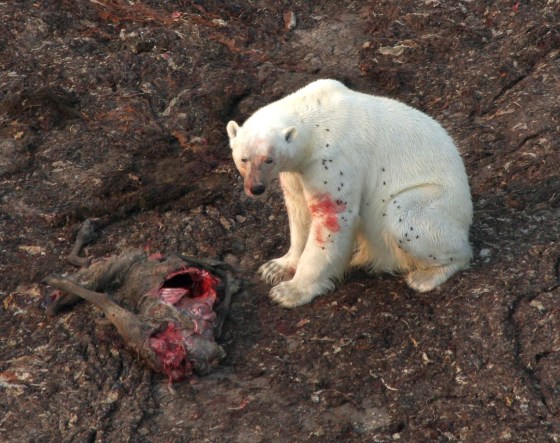
Polar bear eats a caribou
Robert Rockwell / American Museum of Natural History
A polar bear eats a caribou on land. Recent studies suggest polar bears have a flexible foraging strategy, which help them survive as they come ashore earlier due to melting Arctic sea ice.
"Previously, it had been thought that that would not be a very energetically profitable thing for a polar bear to do because they expend more energy in the chase than they get from consuming the food," Gormezano noted.

Read More Here


Enhanced by Zemanta

Monday, August 5, 2013

As Antarctic Sea Ice Melts, Seaweed Smothers Seafloor

File:Iceberg with hole crop.jpg

Image Source  :  Wikimedia Commons
Author Brocken Inaglory
*******************************************************************************

Live Science


Seaweed could smother polar underwater ecosystems as melting sea ice exposes the seafloor to more sunlight, new research shows.
Animals that dwell on the seafloor of the Arctic and Antarctic spend most of their lives in total darkness: Sea ice blocks rays during the spring and early summer, and the sun sets completely in the winter. Late summer and early fall — when the ocean warms up enough to thaw the ice — often marks the only time these critters see light.
But as climate change causes sea ice to begin melting earlier and earlier in the summer, shallow-water ecosystems will soak up increasingly more rays. New research from a team of Australian biologists suggests this could cause a major shift in the seafloor communities along the coast of Antarctica, where invertebrates like sponges, worms and tunicates — globular organisms that anchor to rocks on the seafloor — currently dominate. A manuscript of the report is currently in press at the journal Global Change Biology. [6 Unexpected Effects of Climate Change]

"Some areas where ice breaks out early in summer are already shifting to algal domination," said Graeme Clark, a biologist at the University of New South Wales who was involved in the study.
Seasons and tipping points
Early-summer ice melt not only lengthens the amount of time photosynthesizing organisms like macroalgae (or seaweed) can thrive under the sun during the summer, but it also increases the intensity of that exposure. The sun sits highest in the sky during the summer solstice — the period when Earth tilts most directly toward the sun — that occurs between June 20 and 23 in the Northern Hemisphere and Dec. 20 and 23 in the Southern Hemisphere, depending on the phase of the Earth's orbit. Rays travel directly to the seafloor during this time. During spring and fall, however, low-angle rays reflect off the sea surface and often never make it to the seafloor.
This compounding effect of a longer sunlit season and higher-intensity rays could exponentially increase the amount of sunlight hitting benthic, or seafloor, communities in the coming decades and cause major tipping points for those invertebrate-dominated ecosystems, Clark said.
Tipping points occur when relatively minor environmental changes — like sea ice melting several days earlier than usual — cause rapid and significant ecological transformation. In this case, the tipping point would push ecosystems from invertebrate-dominated to algae-dominated.


Read More and Watch Video  Here


Enhanced by Zemanta