Showing posts with label Solar Dynamics Observatory. Show all posts

Wednesday, May 14, 2014

The sun's atmosphere is split down the middle by a canyon-shaped coronal hole, which is almost directly facing Earth

Earth Watch Report  -  Solar Activity


.....

Space Weather

by Dr. Tony Phillips.

CORONAL CANYON:

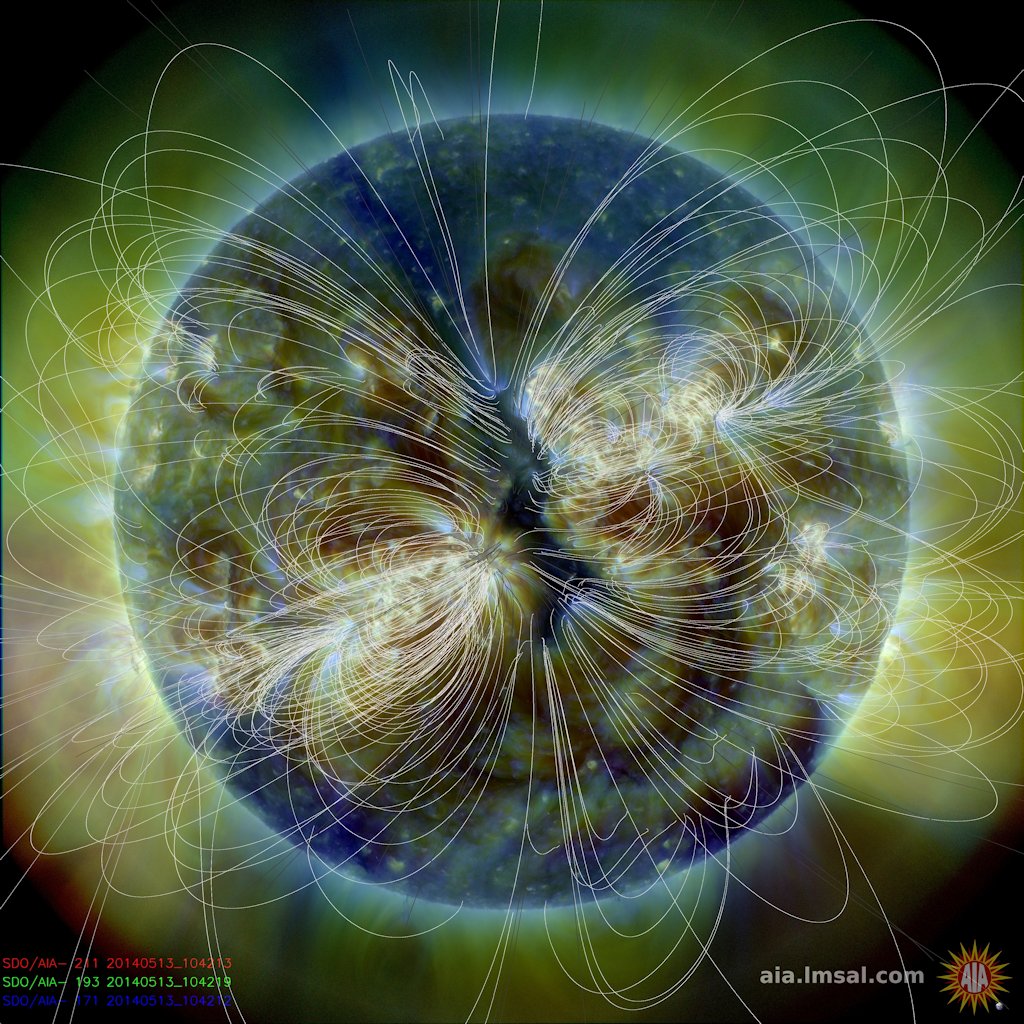
Today, the sun's atmosphere is split down the middle by a canyon-shaped coronal hole. NASA's Solar Dynamics Observatory photographed the chasm, which is almost directly facing Earth:
Coronal holes are places where the sun's magnetic field opens up and allows solar wind to escape. This hole is straddling the sun's equator so the solar wind stream emerging from it will intersect Earth's orbit. ETA: May 16-17. High-latitude sky watchers should be alert for auroras on those dates.

.....


Enhanced by Zemanta

Huge ‘coronal hole’ spotted on Sun

Earth Watch Report  -  Solar Activity


.....

Space Weather

by Dr. Tony Phillips.

SOUTHERN CORONAL HOLE:

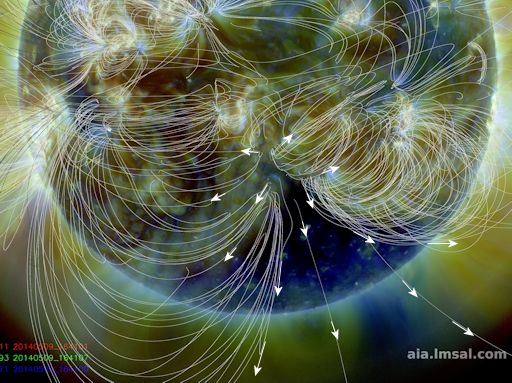
Imagine what it would be like if, from time to time, a hole opened up in Earth's atmosphere and air went blowing out into space. On the sun, this happens all the time. The openings are called "coronal holes." NASA's Solar Dynamics Obervatory is monitoring one right now; it is the dark wedge-shaped region in this extreme ultraviolet image of the sun's southern hemisphere:
Coronal holes are places in the sun's atmosphere where the magnetic field bends back and allows gas to escape. From such openings, solar wind blows out into space. A stream of solar wind flowing from this particular coronal hole could reach Earth on May 11-12, sparking auroras when it arrives. On the other hand, the stream might sail south of our planet, delivering only a glancing blow. Stay tuned for updates.

.....

Huge square-shaped ‘coronal hole’ spotted on Sun (VIDEO)

Published time: May 13, 2014 12:00

NASA / SDO / GODDARD SPACE CENTER
A gigantic square hole has been video-captured on the Sun’s surface by NASA’s Solar Dynamics Observatory (SDO). The particularly large monstrosity, known as a “coronal hole”, is an indicator of solar winds ejected out of the star at insane speeds.

Read More and Watch Video Here

.....
Enhanced by Zemanta

Tuesday, April 29, 2014

An X-class solar flare on April 25th irradiated Earth's upper atmosphere with extreme ultraviolet radiation, causing a widespread blackout of shortwave radio transmissions.

 Space Weather. com

by Dr. Tony Phillips.

RADIO BLACKOUT:

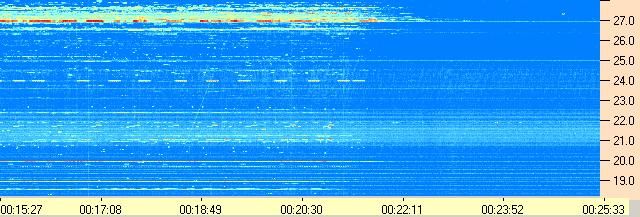
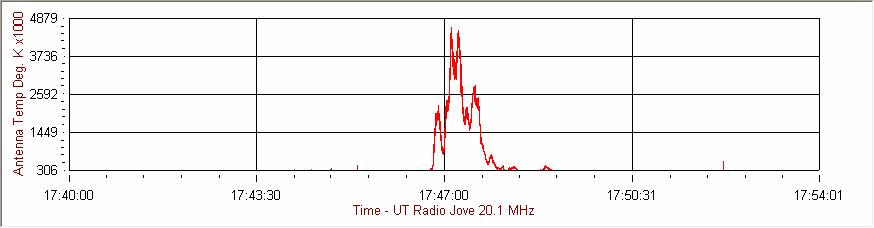
An X-class solar flare on April 25th irradiated Earth's upper atmosphere with extreme ultraviolet radiation. Waves of ionization rippled around the dayside of the planet, causing a widespread blackout of shortwave radio transmissions. Radio astronomer Dick Flagg recorded the event at his observatory at the Windward Community College on Oahu:
"This is a dynamic spectrum," explains Flagg. "The vertical axis is frequency (MHz) and the horizontal axis is time (UTC)." All of the horizontal lines corresponding to terrestrial radio stations vanished in the aftermath of the flare.
The active region responsible for the flare rotated off the solar disk yesterday, so even if it flares again, another radio blackout is unlikely this weekend. NOAA forecasters estimate the odds of an X-flare on April 26th to be a scant 1%.

.....

Space .com

Sun Unleashes Major Solar Flare (Video)

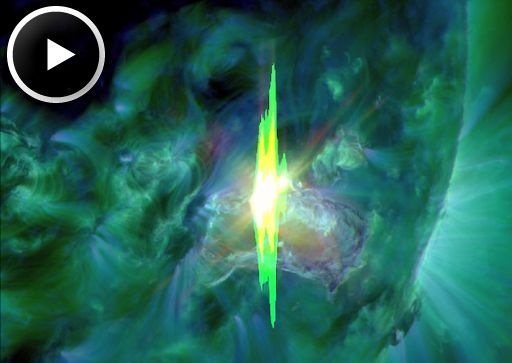
An X1.3-class solar flare (far right) erupts from the surface of the sun on April 24, 2014 EDT  (April 25 GMT).
An X1.3-class solar flare (far right) erupts from the surface of the sun on April 24, 2014 EDT (April 25 GMT).
Credit: NASA/Solar Dynamics Observatory
X-class flares top the scale with the most energy and potential to disrupt communications on Earth.
X-class flares top the scale with the most energy and potential to disrupt communications on Earth. See how solar flares compare to each other in this Space.com inforgraphic.
Credit: Karl Tate, SPACE.com Contributor

Enhanced by Zemanta

Tuesday, April 1, 2014

Rare Ripple in Earth's Magnetic Field Occurred During Last X1 Solar Flare!


by Dr. Tony Phillips.
Enhanced by Zemanta

Wednesday, March 12, 2014

NOAA forecasters estimate a 70% chance of M-class flares and a 15% chance of X-class flares during the next 24 hours.

Earth Watch Report  -  Solar Activity


.....

Space Weather

by Dr. Tony Phillips.

GROWING CHANCE OF FLARES:

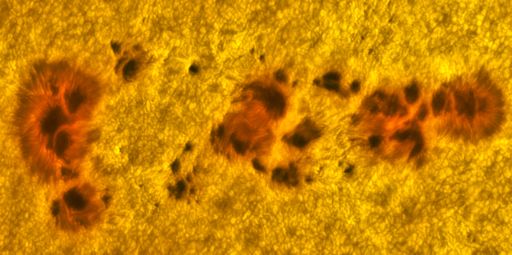
Sunspot AR2002 poses a growing threat for solar flares. Since the week began, the active region has more than tripled in size. It now has more than a dozen dark cores and sprawls across 100,000 km of solar terrain. Karzaman Ahmad sends this picture from the Langkawi National Observatory in Malaysia:
"AR2002 is so large," says Ahmad, "that I was able to photograph it using an ordinary 11-inch Celestron telescope capped with a Thousand Oaks Glass Filter." The exceptionally crisp image shows thousands of boiling granules surrounding the sunspot's dark cores. Each granule is about the size of Texas.
A 48-hour movie from NASA's Solar Dynamics Observatory shows the sunspot's development:
The rapid growth of AR2002 has destabilized its magnetic field, which makes it more likely to erupt. NOAA forecasters estimate a 70% chance of M-class flares and a 15% chance of X-class flares during the next 24 hours.

.....
Enhanced by Zemanta

Wednesday, February 26, 2014

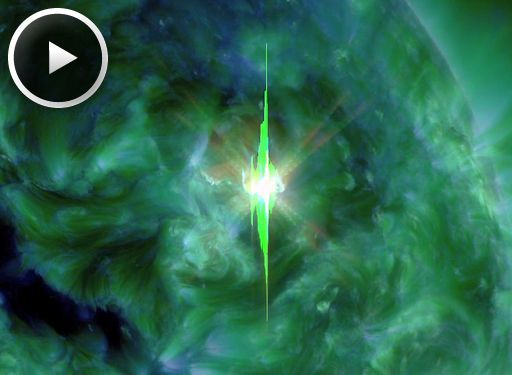
X4.9-class solar flare eruption from sunspot AR1967 on the Earthside of the sun


LiveScience

Sun Unleashes Monster Solar Flare, Biggest of 2014


The sun fired off a major solar flare late Monday (Feb. 24), making it the most powerful sun eruption of the year so far and one of the strongest in recent years.
The massive X4.9-class solar flare erupted from an active sunspot, called AR1990,  at 7:49 p.m. EST (0049 Feb. 25 GMT). NASA's Solar Dynamics Observatory captured high-definition video of the monster solar flare. The spaceecraft recording amazing views the solar flare erupting with a giant burst of plasma, called a coronal mass ejection, or CME.


Earth isn't in danger from the latest eruption of space weather activity, according to officials with Spaceweather.com, which tracks space weather and stargazing events. Sunspot AR1990 (previously named AR1967) is located on the southeastern limb of the sun, pointed away from Earth. This is the third time this sunspot has rotated onto the Earth-facing side of the sun. [Photos: The Biggest Solar Flares of 2014]
X4.9 Solar Flare of Feb. 24/25 2014
A giant solar flare, an X4.9-class sun storm, erupts from the sun at 00:49 GMT on Tuesday, Feb. 25 (7:49 p.m. Monday, Feb. 24 EST). This image of the flare was captured by NASA's sun-watching Solar Dynamics Observatory.
Credit: NASA/SDO
"Long-lived sunspot AR1967 returned to the Earthside of the sun on Feb. 25th and promptly erupted, producing an X4.9-class solar flare," astronomer Tony Phillips wrote in a Spaceweather.com alert. "This is the strongest flare of the year so far and one of the strongest of the current solar cycle."

Read More Here

.....

Space Weather

by Dr. Tony Phillips.

X-FLARE!


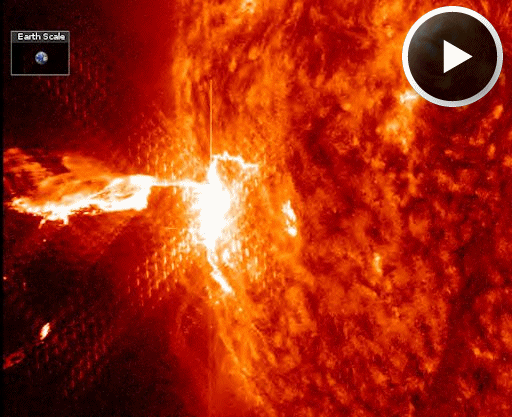
Long-lived sunspot AR1967 returned to the Earthside of the sun on Feb. 25th and promptly erupted, producing an X4.9-class solar flare.  This is the strongest flare of the year so far and one of the strongest of the current solar cycle. A movie from NASA's Solar Dynamics Observatory shows the explosion hurling a loop of hot plasma away from the blast site:
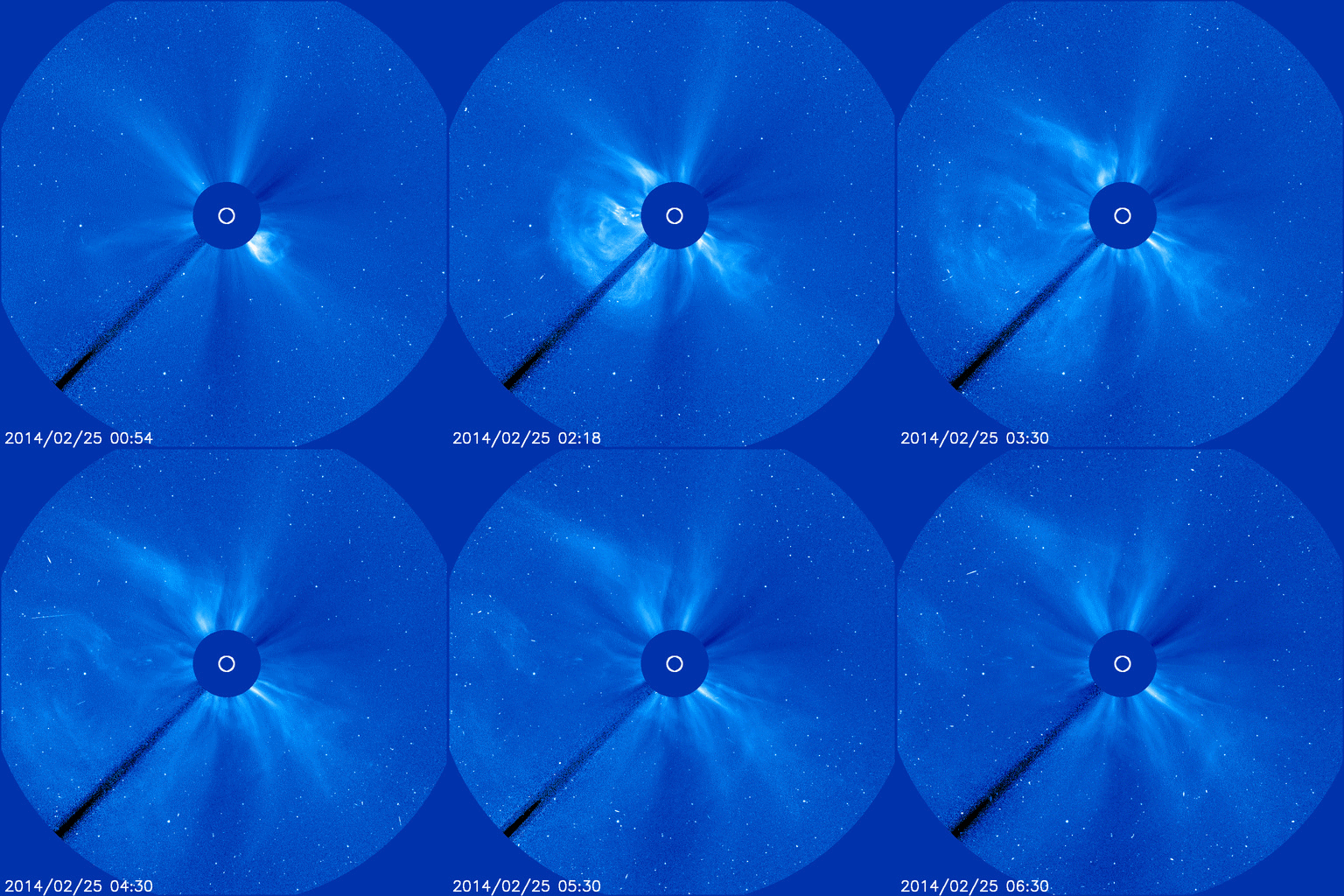
Coronagraphs onboard the Solar and Heliospheric Observatory tracked this material as it raced away from the sun, eventually forming a bright CME, pictured below.. Radio emissions from shock waves at the leading edge of the CME suggest an expansion velocity near 2000 km/s or 4.4 million mph. If such a fast-moving cloud did strike Earth, the resulting geomagnetic storms could be severe. However, because its trajectory is so far off the sun-Earth line, the CME will deliver a no more than a glancing blow. NOAA forecasters expect a weak impact late in the day on Feb. 26th.
The source of the eruption is long-lived sunspot AR1967, now beginning its third trip across the Earthside of the sun. This region was an active producer of flares during its previous transits, and it looks like the third time will be no different. By tradition, sunspots are renumbered each time they return, so AR1967 has been given a new name, AR1990. After today, that is what we will call it

.....
Enhanced by Zemanta

Thursday, January 2, 2014

Large Debris Around the Sun.Update.

BPEarthWatch BPEarthWatch·


Published on Jan 2, 2014
2 large objects caputured on Lasco C2 During a solar flare.
Solar,Quake and Weather Links....http://www.BPEarthWatch.com
http://www.blogtalkradio.com/bpearthw...


.....

Spaceweather

SOLAR ACTIVITY UPDATE:

by Dr. Tony Phillips.
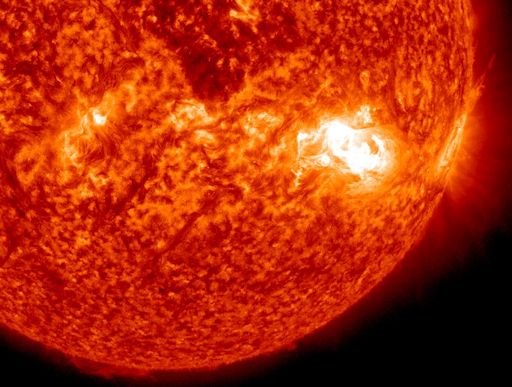
2014 began with a bang. At 18:54 UT on January 1st, big sunspot AR1936 erupted, producing a strong M9-class solar flare. NASA's Solar Dynamics Observatory captured the explosion's extreme ultraviolet flash:
The movie shows a dark filament of plasma racing away from the blast site, but most of the material fell back to the stellar surface. Nevertheless, the explosion did produce a CME that could deliver a glancing blow to Earth's magnetic field later this week. NOAA analysts are still evaluating this possibility.
The M9-flare of New Year's Day followed close on the heels of an M6-flare on New Year's Eve. Sunspot AR1936 produced both explosions. The New Year's Eve event produced a minor, slow-moving CME that is not expected to disturb Earth's magnetic field if and when it does arrive.
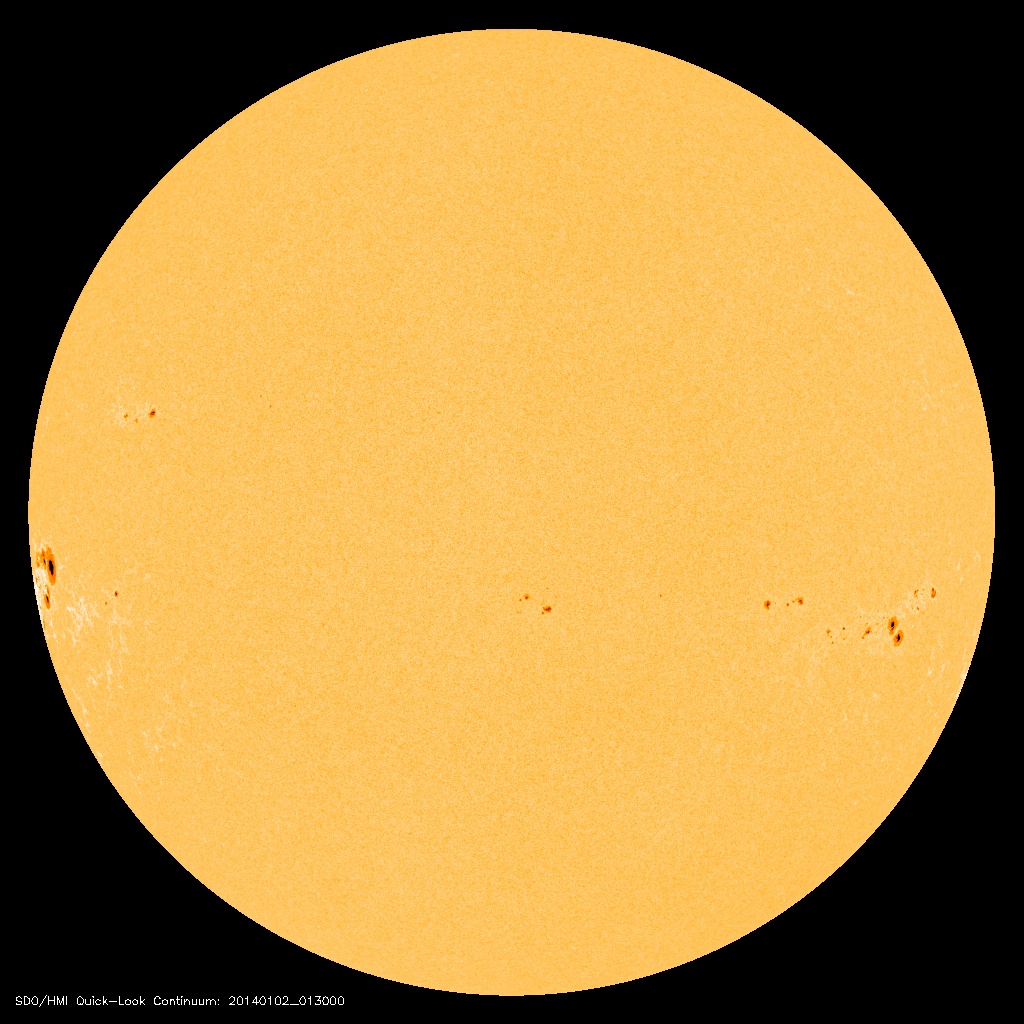
Sunspot AR1936 is active, but new sunspot AR1944 looks even more potent. The behemoth active region emerged over the sun's southeastern limb on Jan 1st:
Because of foreshortening near the sun's limb, the complexity of AR1944's magnetic field is still unknown. The sheer size of the sunspot, however, suggests it is capable of strong flares. The emergence of AR1944 combined with the ongoing activity from AR1936 has prompted NOAA forecasters to raise the odds of eruptions on Jan. 2nd to 70% for M-flares and 30% for X-flares.
.....
Enhanced by Zemanta