Global Weather Phenomenon-Natural/Technological Disasters-Space Events-Epidemic/Biological Hazards-
Nuclear Events :
News Affiliate of Family Survival Protocol.com
Worst
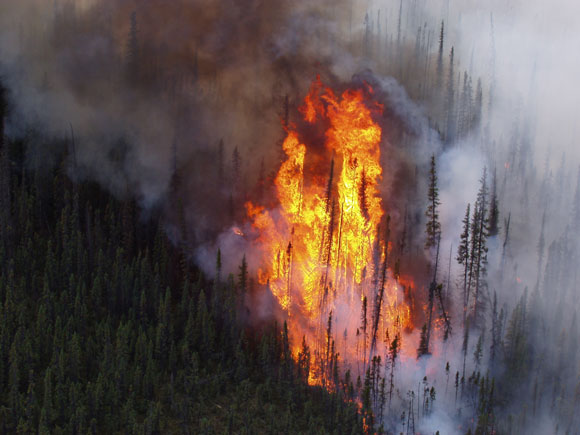
recorded years for U.S. wildfires are 2005, 2006, 2007, 2011 and 2012.
This year has already joined that list, and wildfire season is still
going strong.
The
2015 wildfire season in the United States has already broken records.
So far this year, more acres of land have burned as of mid-September
than the total annual amount in 2011, which was the 4th worst year for
wildfires at least since the 1960s. So will this year be the new fourth
worst, third worst, second worst, or worst wildfire year since then?
Read on, and take a guess.
The National Interagency Fire Center
in Boise, Idaho, publishes a ton of useful statistics on wildfires that
are critical for helping state and federal agencies manage the flames.
These records date back to the 1960s.
The chart below, created
with the National Interagency Fire Center data, shows that the worst
years for wildfires in the U.S., since these records began being kept,
were 2006 (9,873,745 acres burned), 2007 (9,328,045 acres burned), 2012
(9,326,238 acres burned), 2011 (8,711,367 acres burned), and 2005
(8,689,389 acres burned).
Already as of September 18, 2015,
8,821,040 acres of land have burned across the U.S., and this number
exceeds the total number of acres burned for 2011. Hence, 2015 has
already earned a spot as the 4th worst year on record, and the 2015
wildfire season is still going strong.
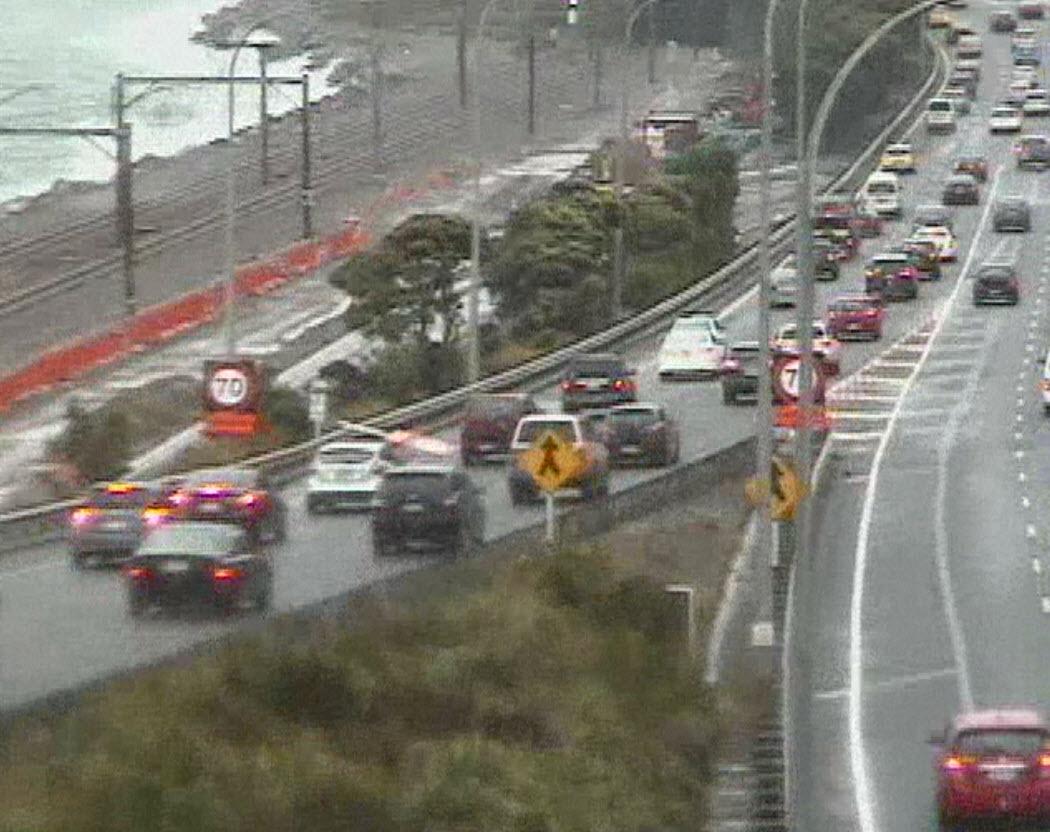
A car has been overcome by floodwaters near Gisborne as a southerly storm brings heavy rain, snow and gales to much of the country.
The bottom half of the North Island and northeast of the South Island are expected to be most severely affected.
In contrast West Coast, Otago and Southland should have a pleasant day.
Civil Defence said surface flooding had been reported across wide areas of the Gisborne region, with trees down in many places. "Motorists are advised to take extra care on the roads around the district today as rain continues to fall and rivers north and west of Gisborne city rise," Gisborne Civil Defence said. State Highway 35 had been closed around the East Cape between Waihau Bay and Tolaga Bay. "This morning, a car was overcome by floodwaters at Rototahi south of Tolaga Bay and a bus, with no children on board, was stuck at the top of the Waimata Valley." Civil Defence said no more information was available about either incident. Areas north of Gisborne had received more rain than forecast, with around 140mm falling in 24 hours. There are concerns the rising Kankanaia River could cause the closure of SH2 - the inland route between Gisborne and Opotiki - at Waipaoa, northwest of Gisborne. Civil Defence said surface flooding had been reported across wide areas of the Gisborne region, with trees down in many places. "Motorists are advised to take extra care on the roads around the district today as rain continues to fall and rivers north and west of Gisborne city rise," Gisborne Civil Defence said. State Highway 35 had been closed around the East Cape between Waihau Bay and Tolaga Bay. "This morning, a car was overcome by floodwaters at Rototahi south of Tolaga Bay and a bus, with no children on board, was stuck at the top of the Waimata Valley." Civil Defence said no more information was available about either incident. Areas north of Gisborne had received more rain than forecast, with around 140mm falling in 24 hours. There are concerns the rising Kankanaia River could cause the closure of SH2 - the inland route between Gisborne and Opotiki - at Waipaoa, northwest of Gisborne.
RSOE shall not be liable for any customer claims based on the content and services distributed by RSOE. RSOE states that the EDIS content means information collected from the related and approved sources and therefore RSOE shall not be responsible for the content of these information.
..........
Rain closes roads and damages crops around Gisborne
Thursday 14 Oct 2010 8:50 a.m.
Trucks cross a flooded Tauwhareparae Road after torrential rain across the Poverty Bay area (NZPA)
Extensive flooding up to 1m deep in the Gisborne region will likely cause headaches for horticulturists and grapegrowers, after the onslaught of heavy rain continued overnight.
Heavy downpours yesterday prompted the evacuation of a handful of households, forced the closure of rural schools and left dozens of homes without power.
A large number of roads in the region remain closed today due to surface flooding and slips.
Gisborne Civil Defence Controller Jon Davies said although the rain had eased and moved south, rivers remained high and would take some time to fall.
A Baghdad official on Sunday said cholera cases in the area of Abu Ghraib, west of Baghdad are on the rise. "Suspected cholera caused the death of four women and 48 cases were diagnosed with the illness across the country," the Iraqi Ministry of Health said. "There are, so far, 141 suspected cholera cases, including 37 cases diagnosed with the illness in Abu Ghraib, all of them are currently under treatment in the town's hospital," Osman Almaadidi, mayor of Abu Ghraib town, told Anadolu Agency. "The lack of pure drinking water in Abu Ghraib caused the outbreak." Meanwile, Qutaiba al-Jubouri, a member of the Iraqi parliament's health and environment committee, on Sunday called on the government to declare a state of emergency in the country because of the growing number of cases. "This deadly epidemic requires the government to declare a state of emergency and to take all necessary measures to contain its outbreak as soon as possible," Jubouri said, appealing to the World Health Organization, the United Nations and humanitarian organizations to help the Iraqi government fight the outbreak. This is the third cholera outbreak in Iraq in less than eight years, according to a WHO report.
Biohazard name:
Cholera (outbreak)
Biohazard level:
2/4 Medium
Biohazard desc.:
Bacteria and viruses that cause only mild disease to humans, or are difficult to contract via aerosol in a lab setting, such as hepatitis A, B, and C, influenza A, Lyme disease, salmonella, mumps, measles, scrapie, dengue fever, and HIV. "Routine diagnostic work with clinical specimens can be done safely at Biosafety Level 2, using Biosafety Level 2 practices and procedures. Research work (including co-cultivation, virus replication studies, or manipulations involving concentrated virus) can be done in a BSL-2 (P2) facility, using BSL-3 practices and procedures. Virus production activities, including virus concentrations, require a BSL-3 (P3) facility and use of BSL-3 practices and procedures", see Recommended Biosafety Levels for Infectious Agents.
Earthquake hits Tokyo and surrounding areas
Japan Sep. 11, 2015 - Updated 18:01 UTC-4
An earthquake has shaken Tokyo and surrounding areas.
The Meteorological Agency says a quake with an estimated magnitude of 5.3 occurred at around 5:49 AM Japan Time on Saturday.
The agency says the focus of the quake was 70 kilometers deep in Tokyo Bay.
It
registered intensities of 5 minus on the Japanese scale of 0 to 7 in
Chofu City in Tokyo and 4 in some areas in Tokyo as well as Saitama,
Chiba, and Kanagawa prefectures.
Agency officials say there is no possibility of a tsunami.
TV:
Floods threaten Fukushima plant structures… “Nuclear nightmare
territory then” — Expert: A lot of nuclear fuel has actually gone into
ground, and “will come out at the surface” if groundwater rises —
Radiation levels flowing into ocean much higher than usual (VIDEO) http://enenews.com/tv-floods-threaten...
Searches continue for 15 missing in flood
Japan Sep. 12, 2015 - Updated 19:43 UTC-4
Around
1,800 police officers, firefighters and self-Defense Force personnel
are taking part in searches for people missing in a flood-hit city to
the northeast of Tokyo on Sunday.
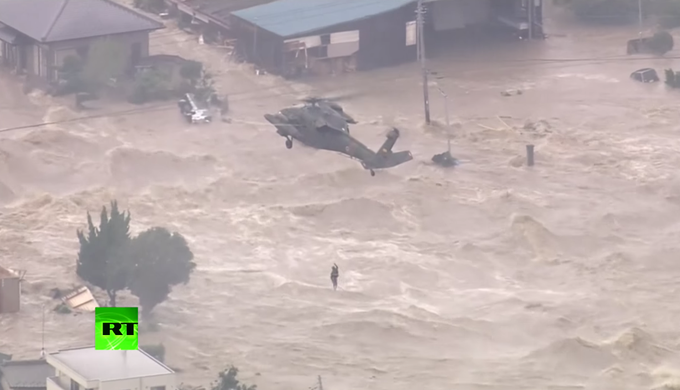
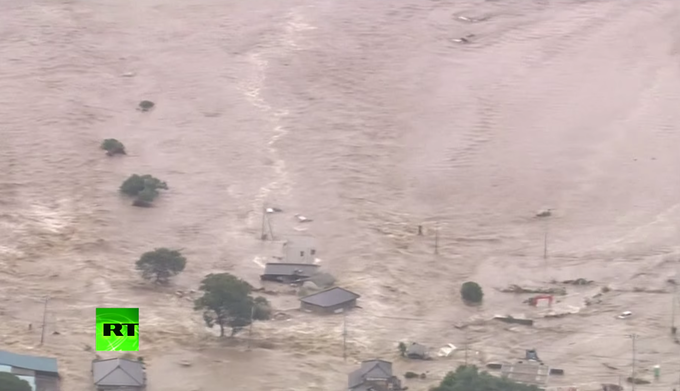
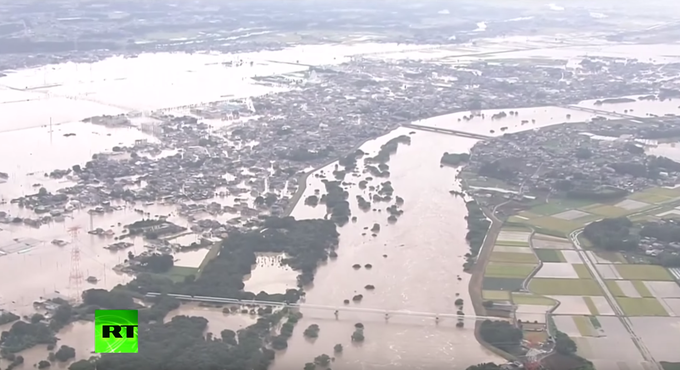
Wide areas of Joso City in Ibaraki Prefecture have been inundated since the dykes of the Kinugawa River broke on Thursday.
The search for 15 people who remain missing was suspended late Saturday night and resumed on Sunday.
Officials
say helicopters were deployed at the break of dawn for an aerial
search. Rescue workers are also entering houses in the area to look for
survivors.
Firefighters have resumed work to rescue people stranded in parts of the city where the water has not yet receded.
Local weather station officials say rain is expected in some parts of Ibaraki Prefecture on Sunday afternoon.
Authorities will keep close watch on the water levels of the Kinugawa River as they conduct the search.
The heavy rains also hit nearby Miyagi and Tochigi prefectures leaving 5 people dead.
Weather
officials forecast heavy rain with thunder in some parts of the wider
region from Sunday afternoon to evening as the rain front advances.
They urge people to be on alert against further flooding and landslides as water levels remain high and the ground is loose.
Evacuation order issued too late
Japan Sep. 12, 2015 - Updated 21:12 UTC-4
Officials
of flood-hit Joso City, northeast of Tokyo, failed to issue evacuation
orders to some residents for more than 2 hours after the riverbank
collapsed.
Municipal authorities in the Ibaraki Prefecture city
ordered residents of the Misakamachi area to evacuate at 10:30AM on
Thursday as the water level of the Kinugawa River rose.
At 12:50PM, the dyke broke and the whole of Misakamachi was inundated.
But
it was not until 2:55PM -- 2 hours after the river overflowed -- that
officials gave the evacuation order to 1,182 people of 382 households in
the area.
Most of their houses were damaged in the flooding.
City
officials say they issued evacuation orders to certain areas that
reported rising water. They say they became overwhelmed dealing with
flooding upstream and could not issue orders to other areas.
A similar story was reported in Osaki City, Miyagi Prefecture.
City
officials failed to inform residents early Friday morning when the
Shibui River broke its banks. City authorities had told people to
prepare for evacuation, but they did not issue evacuation advisory. They
later said they wanted to be careful as evacuation in the dark can be
dangerous.
Some residents told NHK they would rather have known as soon as the levee broke, and received evacuation instructions.
Heavy rain leaves 5 dead, 29 injured
Japan Sep. 13, 2015 - Updated 01:10 UTC-4
Heavy rains have left 5 people dead in eastern and northeastern Japan.
The
National Police Agency says a man was found dead in a submerged car in
Tochigi city on Sunday. This brought the number of deaths in Tochigi
Prefecture to 3. Another 2 people died in Miyagi Prefecture.
In Ibaraki Prefecture, 9 people were injured, some seriously. A total of 29 people have been hurt across 10 prefectures.
The leaked decontamination bag where to go? To the United States across the Pacific Ocean
Rainwater overflows from Fukushima plant
Nuclear & Energy Sep. 11, 2015 - Updated 01:34 UTC-4
The operator of the crippled Fukushima Daiichi nuclear power plant has found that rainwater has intermittently overflowed a drainage channel and spilled directly into the sea.
This happened after the area was hit by the recent heavy rains.
Tokyo Electric Power Company said on Friday that it confirmed the leaks through video footage of the complex. The operator said the leaks occurred at 3 AM, 5:20 AM and 6 AM on Friday -- for a total of more than 2 and a half hours.
TEPCO is now checking the radioactive levels of rainwater samples taken from the channel.
Radioactive rainwater was first found spilling into the sea from the channel in February.
As a stopgap measure, TEPCO built a barrier at the channel's far end to pump up water before it reached the sea.
The channel repeatedly floods during heavy rains.
Work to reroute the drainage channel so that the rainwater does not leak outside the plant's port, which began in May, has yet to be completed.
3 dead, 23 missing in eastern Japan floods
Japan Sep. 11, 2015 - Updated 03:22 UTC-4
Authorities in eastern Japan say massive floods and landslides caused by record-high rainfall have left three people dead and 23 missing.
Rescuers are searching for the missing, 22 of whom are from Joso City in Ibaraki Prefecture, north of Tokyo. A levee of the Kinugawa River gave way in the city on Thursday.
City officials had said 25 people were missing, but later contacted three of them.
The other missing person is from Kurihara City, Miyagi Prefecture.
One of the three dead, a man in his 20s, fell in a drain on Thursday while working at an overflowed river in Nikko, Tochigi Prefecture.
A 63-year-old woman died after her house was hit by a landslide in Kanuma City, also in Tochigi.
Officials in Kurihara say a 48-year-old woman died on Friday morning after her car was washed away by floodwaters.
Recovering radiation contaminated bags
Nuclear & Energy Sep. 11, 2015 - Updated 08:43 UTC-4
Floods have washed bags of material contaminated by radiation into river in a village in Fukushima prefecture. Some of them have reportedly been recovered, but others are still missing.
Environment ministry officials say they received a report on Friday morning that floods from heavy rain carried the plastic bags into the Niida River. They were being stored on farmland in Iitate village near the Crippled Fukushima Daiichi nuclear plant.
The bags contained grass and other materials tainted with radioactive substances from the 2011 nuclear accident. They were being kept outdoors near the river before being transferred to storage sites.
The officials say 82 bags have been washed into the Niida and nearby Hiso rivers. Workers involved in decontamination efforts reportedly recovered 37 of them as of 6 PM Friday.
The officials say they will continue searching for the remaining bags and check whether any other bags have been washed away.
Rescues continue along flooded Shibui River
Japan Sep. 10, 2015 - Updated 23:46 UTC-4
Emergency rescue teams are struggling to reach people stranded by floodwaters in a wide area along the Shibui River in Osaki City, Miyagi Prefecture, in northeastern Japan.
A 20-meter section of a levee collapsed on Friday morning. The area is the latest to suffer extreme damage from flooding caused by the recent record rains.
City authorities say calls for rescue are pouring in from stranded residents. Ground Self-Defense Force personnel called in to help say about 100 buildings have been inundated.
Firefighters and GSDF personnel are using boats and helicopters to try to get to the stranded people. Firefighters say they had rescued 66 people by noon on Friday.
City officials say more than 700 residents, including those who have been rescued, have evacuated to shelters. About 1,250 people live in the district where the levee broke.
The Meteorological Agency has issued an emergency warning for Miyagi Prefecture. Local municipalities are calling on residents to evacuate to safer places.
Earlier on Thursday, Tochigi and Ibaraki prefectures, south of Miyagi, suffered extreme damage from floods.
Twenty-five people are missing in Joso City, Ibaraki Prefecture. About 580 others remain stranded and are waiting for help.
Who Opens a Reactor Next to a Volcano? Japan’s New Nuclear Gamble
http://www.thedailybeast.com/articles...
Kyushu Electric begins putting nuclear fuel in 2nd reactor for restart
http://mainichi.jp/english/english/ne...
Energy Policy Agenda for the Next Administration and Congress
http://www.heritage.org/research/repo...
Fukushima leaks radioactive water after Typhoon Etau busts drainage system
Flooding from Typhoon Etau has caused new leaks of contaminated water to flow from the Fukushima nuclear power station into the ocean. The incident came after a rush of water overwhelmed the site’s drainage pumps.
Typhoon Etau brought lashing rains, floods and storm winds to Japan. Tens of thousands of Japanese people have been ordered to leave their homes across the country.
We
are now in the throws of the Earth's 6th Mass Extinction, and humans
will soon be on the endagered list; according to Stanford University,
Oxford, and others. Many studies are being done, and while they admit
that this extinction event is not a natural one, as the past 5
extinctions have been, (they say this one is caused by human beings) not
one of the studies covers, or at least admits the true, final cause...
man-made radiation.
Since
Fukushima, much interest has developed in the application of checking
food and water for possible radiation contamination. Here are your
options: Rely on government agencies, such as the EPA (Environmental
Protection Agency) and the FDA (Food and Drug Administration) in the US,
or Procure the same equipment used by those agencies and conduct
your own tests. These include specialized devices like Multi-Channel
Analyzers for Gamma Spectrometry, etc. which are quite thorough and able
to detect very low levels of contaminants, along with which isotopes
are present. Or, acquire a personal radiation detector which, while
not as effective or thorough as the above alternatives, is readily
available to the lay person and easy to use. http://www.geigercounters.com/FoodCon...
US
Gov’t Expert: Fukushima is always on people’s minds… a lot of concern
and worry about radiation’s role in unusual marine deaths — Reports of
shrunken or enlarged organs, black kidneys, sores on liver, slime in
mouth, discolored skin — Mortality in intertidal zone like “we haven’t
seen before” (VIDEO) http://enenews.com/govt-expert-fukush...
Fukushima fishermen to allow discharge into sea
Nuclear & Energy Aug. 11, 2015 - Updated 01:16 UTC-4
Fukushima's
fisheries federation is planning to conditionally allow decontaminated
underground water from the crippled nuclear power plant to be discharged
into the sea.
In exchange, it has asked the government and the
operator of the Fukushima Daiichi nuclear power plant to take measures
to prevent negative harmful rumors.
The Fukushima Prefectural
Federation of Fisheries Co-operative Associations reached this decision
on Tuesday after a conditional agreement by a fishermen's group in Iwaki
City.
The group handed a written request to officials from the central government and TEPCO.
It
is asking that strict operational standards be observed for the
discharge and that the process be subject to monitoring by a third
party. It also asks that compensation be paid for harmful rumors.
Tokyo
Electric Power Company is planning to pump up contaminated ground water
from wells near the reactor buildings, decontaminate the water, and
then release it into the ocean.
This measure will be taken to deal with the 300 tons of contaminated water that is being produced at the facility every day.
But
TEPCO's plan has been suspended. In February, local distrust of the
operator mounted after it was found to have failed to disclose leaks of
contaminated rainwater into the ocean.
The federation's chairman
Tetsu Nozaki said it was a very troubling decision, but measures to deal
with the contaminated water are necessary. He said they will make a
final decision after receiving a response.
TEPCO's Tsunemasa Niitsuma said they appreciate the understanding of the plan, and will try to respond quickly.
Reactor at Sendai plant reaches criticality
Nuclear & Energy Aug. 11, 2015 - Updated 11:07 UTC-4
A nuclear reactor has been restarted in Japan for the first time in nearly 2 years.
The
No.1 reactor at the Sendai nuclear plant in Kagoshima Prefecture,
southwestern Japan, is the first to go back online under the new
regulations introduced after the 2011 Fukushima nuclear accident.
On Tuesday morning, workers in the plant's central control room operated a lever to pull out the reactor's 32 control rods.
The
plant's operator, Kyushu Electric Power Company, says the reactor
achieved a sustained nuclear chain reaction later on Tuesday and there's
been no trouble so far.
If all goes well, the reactor is due to
begin generating power on Friday. After gradually raising its output,
Kyushu Electric plans to begin commercial operations in early September.
The
utility says it will watch carefully for any abnormalities in the
operation of the equipment, as the reactor has been kept offline for
more than 4 years.
Last year, the 2 reactors at the Sendai plant
cleared the new, rigorous regulations introduced after the 2011 accident
at the Fukushima Daiichi nuclear plant. The necessary inspections were
completed on Monday.
The reactor is the first to go online since September 2013, when the Ohi nuclear plant in central Japan halted operations.
The operator of the crippled Fukushima Daiichi nuclear power plant on
Thursday began pumping up groundwater from wells around the reactor
buildings as part of its plan to dump it into the ocean after treatment.
The plan is aimed at curbing the amount of toxic water buildup at the
complex. Tokyo Electric Power Co says radiation levels in the
groundwater are much lower than in the highly toxic water being pooled
inside the reactor buildings, adding it will discharge it only after
confirming it does not contain radioactive materials exceeding the
legally allowable limit.
Even so, fishermen in Fukushima Prefecture had long opposed the plan
amid concerns over pollution of the ocean and marine products. They
approved it last week on condition that the government and TEPCO
continue paying compensation to them for as long as the nuclear crisis
continues to cause damage to their business, among other requirements.





 Trucks cross a flooded Tauwhareparae Road after torrential rain across the Poverty Bay area (NZPA)