Global Weather Phenomenon-Natural/Technological Disasters-Space Events-Epidemic/Biological Hazards-
Nuclear Events :
News Affiliate of Family Survival Protocol.com
Posted: Nov 03, 2015 5:15 PM CST Updated: Nov 03, 2015 5:39 PM CST
By JJ Bailey, Online News Producer
ST. PETERS, Mo. (KMOV.com) - Residents
in St. Charles County are familiar with seeing trains. Locomotives roll
through the county several times a day, but a topic under discussion involving the Westlake Landfill has some on edge.
If
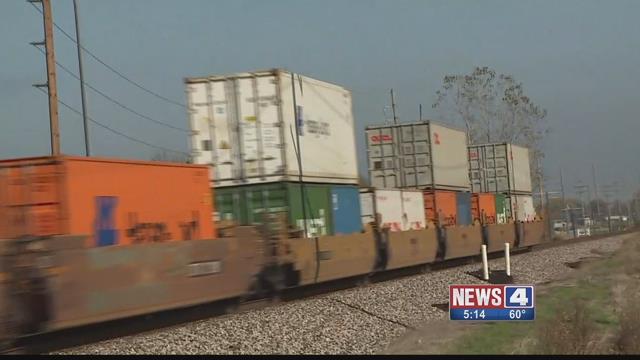
a decision is made to remove radioactive waste from Westlake, railways
could end up transporting it. A derailment is always a risk near any set
of tracks, but if train carrying radioactive waste is the one that
derails, it could be a catastrophe.
“Basically, what we want is to
have the trains run at a slower speed coming through the towns,” said
St. Peters Alderman Rock Reitmeyer. “We don't want to see any accidents
coming through our area and dropping all this waste. It could have a
hazardous effect.”
Monday, November 02, 2015 by: L.J. Devon, Staff Writer
(NaturalNews)
A five-year fire is burning beneath a landfill in a St. Louis suburb,
and it's rapidly approaching an old cache of nuclear waste.
At
present, St. Louis County emergency officials are unsure whether or not
the fire will set off a reaction that releases a radioactive plume over
the city. An emergency plan was put together in October 2014 to "save
lives in the event of a catastrophic event at the West Lake Landfill."
St.
Louis County officials warn, "There is a potential for radioactive
fallout to be released in the smoke plume and spread throughout the
region."
Many residents are taking precautions; some are buying
gas masks, while others are considering moving away. Just recently, over
500 local residents discussed the precarious situation at a church
meeting which usually draws in less than 50 people.
EPA not worried about the fire or the nuclear waste
Nothing
stands in the way of the uncontrollable landfill fire, which is
smoldering hot underneath the trash of the West Lake Landfill of
Bridgeton County, St. Louis. This "smoldering event" is not uncommon.
Fires ignite and smolder under landfills because the trash becomes so
compact and hot. In this case, the fire is brewing less than a quarter
mile from an old deposit of nuclear waste that threatens to spread
cancer-causing radon gas.
EPA
officials admit that although the waste may eventually emit radon gas,
it won't affect anything outside the landfill property. This is the same
EPA that polluted the Colorado River with 3 million gallons of toxic
sludge full of lead, arsenic and other heavy metals. EPA
contractors breached a mine, sending the sludge flowing into the Animas
river, which quickly turned putrid and murky. That pollution has now
spread to New Mexico, Utah and Arizona, infiltrating the countryside
with toxic elements. Why should anyone in St. Louis County trust the EPA with radioactive waste?
To
make matters worse, the EPA isn't even worried about the fire reaching
the nuclear waste. "We just do not agree with the finding that the
subsurface smoldering event is approaching the radiologically impacted
material," said Mary Peterson, director of the Superfund division for
EPA Region 7.
There have been no plans to remove the radioactive
waste as of yet, leaving local residents baffled and worried. Most
residents were unaware of the existence of the radioactive waste, which
had been dumped there illegally four decades ago. If it weren't for
activists educating the public about the waste, no one would know.
Radioactive waste comes back to haunt St. Louis
The
radioactive waste includes 8,700 tons of leached barium sulfate
residue. It was illegally dumped in the West Lake Landfill by Cotter
Corporation sometime after World War II and wasn't discovered by
investigators until 1973. The radioactive waste was left behind due to
the mishandling of uranium by Mallinckrodt Chemical Works, a company
that started out working for the federal government's Manhattan Project.
Since 1990, the West Lake Landfill
has been managed by the EPA and deemed a Superfund site. The U.S.
Department of Health and Human Services Agency for Toxic Substances and
Disease Registry recently warned all agencies not to disturb the surface
of the landfill.
They warned that radium-226, radon-222 and radium-228 could be released
into the air, putting people near the landfill at risk.
The
agency reported that radon levels in the area are often measured above
regulations "by as much as 10 to 25 times at individual surface test
locations." Moreover, radium increases people's risk of developing bone,
liver and breast cancer.
The EPA is downplaying the potential for a Chernobyl or Fukushima-like disaster,
but residents have every reason not to trust the agency's guesswork,
given its decades-long refusal to safely remove the radioactive material
from the area.
The
NaturalNews Network is a non-profit collection of public education
websites covering topics that empower individuals to make positive
changes in their health, environmental sensitivity, consumer choices and
informed skepticism. The NaturalNews Network is owned and operated by
Truth Publishing International, Ltd., a Taiwan corporation. It is not
recognized as a 501(c)3 non-profit in the United States, but it
operates without a profit incentive, and its key writer, Mike Adams,
receives absolutely no payment for his time, articles or books other
than reimbursement for items purchased in order to conduct product
reviews.
The vast majority of our content is freely given away at
no charge. We offer thousands of articles and dozens of downloadable
reports and guides (like the Honest Food Guide)
that are designed to educate and empower individuals, families and
communities so that they may experience improved health, awareness and
life fulfillment.
Tonya
Mason, who works just feet away from the fence line of Republic
Services' landfill in Bridgeton, expresses anger that the air from
burning underground material has never been tested for contaminants on
Thursday, Oct. 15, 2015 at a meeting by Just Moms at John Calvin
Presbyterian Church. Hundreds of people gathered to hear about the
ongoing problems at the site. Photo by Christian Gooden,
cgooden@post-dispatch.com
More
than 40 years ago, radioactive waste was dumped at the West Lake
Landfill in Bridgeton. The decades since have been filled with legal and
political moves that have not gotten the site cleaned up.
Now
a growing number of residents want to know how dangerous it is to live
and work in the area as a fire burns underground in the adjoining
Bridgeton Landfill. More than 500 people showed up at a Bridgeton church
on Thursday for a meeting organized by residents. The monthly meetings
held for the last two years typically attract no more than 50.
The
surge in public interest comes after state reports showed the fire is
moving toward the nuclear waste, and radioactive materials can be found
in soil, groundwater and trees outside the perimeter of the landfill.
At
least six school districts have sent letters home in the last week
outlining their plans for a potential nuclear emergency. St. Louis
County recently released its own emergency evacuation plan that was
written last year.
Underground fires are common in
landfills as buried garbage can get hot, much like the bottom of a
compost pile. Typically they are monitored and allowed to burn out. But
none of the fires have gotten so close to nuclear waste, which was
created during the World War II era for St. Louis’ part in the
production of the atomic bomb.
Over 700 Fukushima waste bags swept away by torrential floods
Extensive
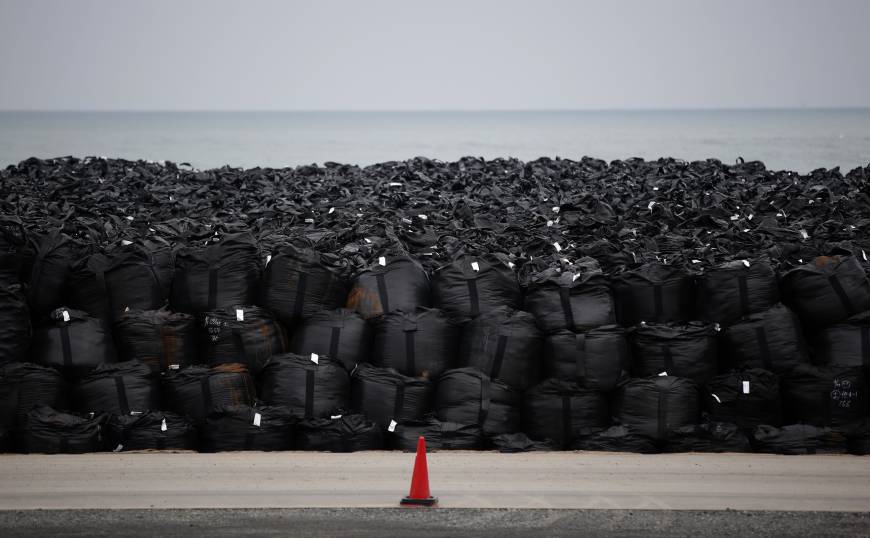
and destructive floods across eastern Japan have swept more than 700
bags containing Fukushima-contaminated soil and grass into Japan’s
rivers, with many still unaccounted for and some spilling their
radioactive content into the water system.
Authorities
in the small city of Nikko in Japan’s Tochigi Prefecture, some 175 km
away from the Fukushima nuclear power plant, have said that at least 334
bags containing radioactive soil have been swept into a tributary of
the Kinugawa river, The Asahi Shimbun reports.
According to the
city’s authorities, the washed-away waste was only part of hundreds of
bags being stored at the Kobyakugawa Sakura Koen park alongside the
river. Another 132 bags of waste reportedly rolled down the slopes.
The
incident happened after Tropical Storm Etau caused vast flooding across
Japan forcing the Kinugawa River to burst its banks on September 10.
Twenty bags were found empty downstream on Thursday. Three hundred and
fourteen bags, each with a capacity of one cubic meter, remain
unaccounted for.
A
crane works on the building covering No. 1 reactor (L) at the TEPCO's
tsunami-crippled Fukushima Daiichi nuclear power plant in this file
photo. Reuters
TOKYO —
Tokyo
Electric Power Co turned down requests in 2009 by the nuclear safety
agency to consider concrete steps against tsunami waves at the Fukushima
Daiichi nuclear plant, which suffered a tsunami-triggered disaster two
years later, government documents showed Friday.
“Do you think you
can stop the reactors?” a TEPCO official was quoted as telling Shigeki
Nagura of the now-defunct Nuclear and Industrial Safety Agency, who was
then assigned to review the plant’s safety, in response to one of his
requests.
The detailed exchanges between the plant operator and
regulator came to light through the latest disclosure of government
records on its investigation into the nuclear crisis, adding to evidence
that TEPCO failed to take proper safety steps ahead of the world’s
worst nuclear accident since the 1986 Chernobyl disaster.
According to records of Nagura’s accounts, Nagura heard TEPCO’s explanations of its tsunami estimates at the agency office in Tokyo
in August and September 2009 as it was becoming clear that the coastal
areas of Fukushima and Miyagi prefectures were hit by massive tsunami in
an 869 earthquake.
TEPCO said the height of waves was estimated
to be around 8 meters above sea level and will not reach the plant site
located at a height of 10 meters, they show.
But Nagura said he
remembered thinking pumps with key cooling functions, which are located
on the ground at a height of 4 meters, “will not make it” and told
TEPCO, “If this is the outcome, you better consider concrete responses.”
Report: Radioactive Leak at Nuclear Waste Site in the US Was Avoidable
- Report says leak at Waste Isolation Pilot Plant in New Mexico could have been avoided
Earlier
this year, on February 16, the Department of Energy in the United
States announced that excessive levels of radiation had been documented
at a nuclear waste site in New Mexico. The site in question is known as
the Waste Isolation Pilot Plant, and it presently accommodates for
transuranic waste.
Recent news on the topic says that,
according to a report shared with the public by the Department of Energy
this past Thursday, this incident at said nuclear waste site in New
Mexico could have been avoided.
As previously reported, traces of
radiation were picked up by underground sensors at the Waste Isolation
Pilot Plant on Friday, February 14. This increase in radiation levels
most likely occurred as a result of a leak inside one of the facility's
waste-storage vaults.
Despite the fact that these waste-storage
vaults sit at a depth of about 2,000 feet (nearly 610 meters), some
radioactive contamination somehow worked its way above ground. There is
evidence to indicate that this happened due to the fact that the
emergency filtration system failed to contain it. NPR
informs that, in its report, the Department of Energy argues that the
waste storage vault leaked partly due to improper maintenance, poor
management, and unsuitable training and oversight.
A
radiation release from the federal government's underground nuclear
waste dump in southeastern New Mexico was the result of a slow erosion
of the safety culture at the 15-year-old site, which was evident in the
bungled response to the emergency, federal investigators said in a
report released Thursday.
The report from the U.S. Department of
Energy's Accident Investigation Board cited poor management, ineffective
maintenance and a lack of proper training and oversight at the Waste
Isolation Pilot Plant near Carlsbad. The report also found that much of
the operation failed to meet standards for a nuclear facility.
The
series of shortcomings are similar to those found in a probe of the
truck fire in the half-mile-deep mine just nine days before the Feb. 14
radiation release that shuttered the plant indefinitely.
Given the
latest findings, watchdog Don Hancock said the leak that contaminated
21 workers with low doses of radiation in mid-February was a "best-case
scenario."
"Everything conspired for the least bad event to occur,
based on what we know — and there is a still a lot we don't know," he
said.
Last month, the head of the Defense Nuclear Safety Board,
which has staff monitoring the Waste Isolation Pilot Project, called the
accidents "near misses."
Defense Nuclear Facilities Safety Board
Chairman Peter Winokur said that for six days after the fire, no
underground air monitors were operational, meaning that if that system
had failed when the leak occurred Feb. 14, "or if the release event had
occurred three days earlier, the release of radioactive material from
the aboveground mine exhaust would have been orders of magnitude
larger."
DOE Accident Investigation Board Chairman Ted Wyka
previewed the findings of the latest report at a community meeting
Wednesday night, identifying the root cause as a "degradation of key
safety management and safety culture."
Crews locate area of radiation leak at New Mexico nuclear waste site
Published time: April 18, 2014 19:25
While
the cause of a radiation leak at the United States’ first nuclear waste
repository remains unknown, officials have reportedly pinpointed the
facility’s contaminated area.
According to the Associated Press,
the Department of Energy’s Tammy Reynolds told residents in Carlsbad,
New Mexico, that no definitive conclusions can be made regarding the
latest discovery, but that further investigation into the area should
produce some information next week.
The Waste Isolation Pilot
Plant (WIPP) has been shut down since February 14, when increased
radiation levels were detected inside and outside the plant.
On
Wednesday, crews investigating the leak made their way into the WIPP and
inspected the facility’s various panels, or the large underground salt
beds where nuclear waste is stored. These panels are located about a
half-mile below the Earth’s surface, and after five hours of inspection
they found that Panel 7 was the source of the leaked contamination.
Search crew finds location but not source of leak at New Mexico nuclear waste storage site
By D. Lencho 21 April 2014
On
April 16, more than two months after an underground air monitor
detected airborne radiation underground at the Waste Isolation Pilot
Plant (WIPP) nuclear waste burial site in Carlsbad, New Mexico (see “Thirteen workers exposed to radiation in New Mexico nuclear waste site” ), a search team clad in heavy protective gear discovered the location of the contamination.
Since
moving in the heavy-duty suits is slow and laborious, and the team’s
respiratory equipment was running low, the team turned back before
pinpointing the exact source of the leak, determining only that it is in
a storage unit known as panel seven. This means that more trips to the
2,150-feet-deep panel will be required to find the source and to deal
with it.
On the night of February 14, the monitor set off an
alert, causing evacuation of the area and a halt to deliveries. Since
then, the number of WIPP workers found to be contaminated with radiation
has risen from 13 to 21. In addition, increased radiation has been
detected in surrounding areas above ground.
The leak followed on
the heels of an incident on February 5 in which a salt-hauling truck
caught fire underground. 86 workers had to be evacuated. Six were
hospitalized for smoke inhalation and seven others were treated on site.
A
March 14 DOE (Department of Energy) Office of Environment Management
report on the fire “identifies shortcomings in the preventive
maintenance program, emergency management, and emergency response
training and drills by the Nuclear Waste Partnership LLC managing and
operating DOE Waste Isolation Pilot Plant (WIPP) near Carlsbad, N.M.,
and it also faults the oversight provided by DOE’s Carlsbad Field
Office,” according to an ohsonline.com article.
The article adds
that the report “finds the NWP/Carlsbad Field Office emergency
management program is not fully compliant with DOE’s requirements for a
comprehensive emergency management system. While the report identified
the direct cause of the incident…the investigative board identified 21
error precursors on the date of the fire. The truck operator’s training
and qualification were inadequate to ensure proper response to a vehicle
fire, and he did not initially notify the Central Monitoring Room that
there was a fire or describe the fire’s location.”
Joe Franco,
DOE’s Carlsbad Field Office manager, claimed, “We take these findings
seriously and, in fact, we are already implementing many of the
corrective actions in the report.”
However, criticism of WIPP from
outside the DOE—from scientific, community and environmental
organizations—has been constant since planning for the project began
decades ago.
WIPP’s history traces its roots to the emergence of
the US as a nuclear power during and after World War II. As the
development of nuclear weapons picked up its pace, the problem of the
accumulation of so-called transuranic waste, or TRU, developed along
with it. TRU contains the elements americium and plutonium—which has a
half-life in the tens of thousands of years—and contact with or
ingestion of it, although it is categorized as “low-level,” is
carcinogenic in minute amounts.
The Department of Energy began a
search for a location to dispose of TRU, and after other proposed sites
were rejected, decided in the early 1970s to begin testing on an area
known as the Delaware Basin in southeastern New Mexico, about 26 miles
east of the town of Carlsbad. A salt basin formed about 250 million
years ago, and below some 300 meters (1,000 feet) of soil and rock, it
was promoted by government officials and some scientists as an ideal
waste disposal spot.
What's Leaking From the Nuclear Waste Isolation Pilot Program Located
near Carlsbad, New Mexico this Department of Energy (DOE) experimental
nuclear waste dump is attempting to store leftover radioactive plutonium
and americium from the US weapons program. On February 14, 2014 there
was a nuclear safety failure at the site and the Department of Energy is
not being honest about it. In this film Fairewinds Energy Education's
Arnie Gundersen pieces together what happened and points out Fairewinds'
major concerns about the facility, the accident, and the lack of
transparency at the DOE. http://fairewinds.org/media/fairewind...|
US
Gov't: Never faced challenge like this, but "not giving up hope" at
WIPP; Salt from contaminated mine to be sold as feed to dairy farms —
TV: "Residents flat out concerned for their safety"; "I want to believe
them... but I don't" — Reuters: 'Falling slabs' may have breached waste
drums (VIDEO) http://enenews.com/us-govt-weve-never...
Subsidence
concerns at WIPP nuclear dump — Over 100 operating oil and gas wells
within mile of site, a 'very active' area — Reserves 'directly
underneath' buried waste — Fracking to take place nearby? (VIDEO) http://enenews.com/concerns-about-sub...
"WIPP
release story doesn't add up... accident is unbelievable" — New tests
show "high level" release underground — "Contains things far more
radioactive than High Level Waste" — "I want to hear what really
happened down there" (VIDEO) http://enenews.com/accident-at-wipp-i...
WIPP
Expert: Nuclear waste is getting out above ground — Plutonium /
Americium found in "every single worker" on site when leak began — New
Mexico officials 'totally unsatisfied' with lack of info from Feds — "We
don't know how far away it's gone" — Continuing threat for long time to
come (AUDIO) http://enenews.com/wipp-expert-radioa...
Major Nuclear Dump Has Leaked, But Does US Gov't Have a Plan B? Experts
warn that troubled repository does not bode well for U.S. strategy for
disposal of waste from nuclear weapons development http://2knowabout.blogspot.ca/2014/03...
.....
The radiation leak site that wants more nuclear waste
By Taylor Kate BrownBBC News, New Mexico
The BBC's Jane O'Brien takes an underground tour of the nuclear waste site before the radiation leak
A
recent radiation leak at America's only nuclear waste repository
threatens the future of waste storage in the country. But leaders in the
city of Carlsbad, New Mexico, still want their area to be a destination
for America's radioactive history.
Carlsbad works underground.
On the road into the city, derricks pump oil from deep in the Earth.
Residents go to work mining potash, a raw material used in fertiliser. Others give tours at Carlsbad Caverns National Park.
And some of Carlsbad's underground workers make a half-mile
(0.8km) journey into the earth not to take from the ground, but to bury
the wastes of human invention.
This is WIPP, the Waste Isolation Pilot Plant, the only long-term geologic repository for nuclear waste in the United States.
WIPP opened in south-eastern New Mexico in 1999
While other locales across the US have fought mightily to
prevent the establishment of similar operations, almost all of Carlsbad
is sanguine about the storage of nuclear materials just a 40-minute
drive from the centre of town.
That confidence has been tested this month after a radiation
leak and the initial report 13 workers had tested positive for
radioactive contamination.
And as the only permanent storage facility for nuclear waste,
problems at WIPP create problems for the larger US nuclear defence
complex, including delays of already scheduled shipments from around the
country.
But it is the first serious incident in WIPP's history, and
Carlsbad still appears to have confidence, albeit slightly shaken, in
the site.
In fact, town officials are hoping their corner of New Mexico can be the home of even more nuclear waste.
New Mexico sets deadlines for handling WIPP nuke waste
By SUSAN MONTOYA BRYAN / Associated Press
Posted:
03/04/2014 07:25:28 AM MST
ALBUQUERQUE
- The federal government's only underground nuclear waste dump remained
shuttered Monday and state environment officials said they have set
deadlines for the U.S. Department of Energy and its contractor to deal
with radioactive waste left above ground at the repository.
Dozens of drums and other special containers that have been shipped to
the Waste Isolation Pilot Plant from federal facilities around the
country are being stored in a parking area at the plant and inside the
facility's waste handling building.
From there, the waste is usually taken to its final resting place deep
in underground salt beds. However, the repository has been closed since
early February due to back-to-back accidents, including a radiation
release that exposed at least 13 workers and set off air monitoring
devices around the plant.
Under its permit with the state, the dump can keep waste stored in the
parking area for only 30 days and up to 60 days in the handling
building. Due to the closure, the state is extending those deadlines to
60 days and 105 days, respectively. The federal government would have to
develop an alternative storage plan if the underground dump remains
off-limits for more than three months.
The Environment Department outlined the deadlines, along with
requirements for weekly reports and a mandatory inspection before
operations resume, in an administrative order made public Monday.
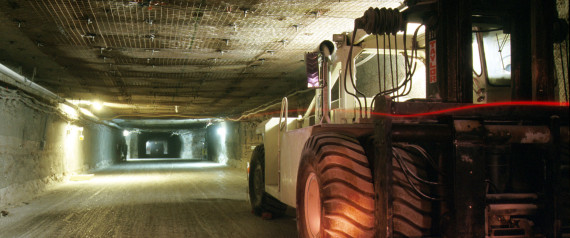
Machinery
sits in one of the underground tunnels that will used to transport
nuclear waste to be stored in underground chambers at WIPP, the
controversial nuclear waste dump site in New Mexico. | Joe Raedle via
Getty Images
ALBUQUERQUE,
N.M. (AP) — Employees who were working at the nation's underground
nuclear waste dump when it started leaking didn't show signs of external
contamination, but officials say biological samples show 13 workers
suffered some exposure to radiation.
The U.S. Department of Energy
and the contractor that runs the Waste Isolation Pilot Project declined
to comment further on the preliminary test results announced Wednesday,
saying they'll discuss the issue at a news conference Thursday
afternoon.
"It is important to note that these are initial sample
results," the DOE and Nuclear Waste Partnership, the plant operator,
said in a joint statement. "These employees, both federal and
contractor, will be asked to provide additional samples in order to
fully determine the extent of any exposure."
All employees who
were working at the southeastern New Mexico plant when the leak occurred
late Feb. 14 were checked for contamination before being allowed to
leave, the news release said. But biological samples were also taken to
check for possible exposure from inhaling radioactive particles. Read More Here
MATTHEW DALY, SUSAN MONTOYA BRYAN, Associated PressFebruary 28, 2014 8:45 PM
FILE
– This undated file aerial photo shows the Waste Isolation Pilot Plant
near Carlsbad, N.M. Back-to-back accidents and a
never-supposed-to-happen above-ground radiation release have shuttered
the federal government’s only deep underground nuclear waste dump
indefinitely, raising questions about a cornerstone of the Department of
Energy’s $5 billion-a year-program for cleaning up legacy waste
scattered across the country from decades of nuclear bomb making.
Thirteen workers have tested positive for radiation exposure after a
recent leak. (AP Photo/Carlsbad Current Argus, File)
ALBUQUERQUE, N.M. (AP) — The radiation exposure of at least 13
workers at a nuclear dump in a New Mexico salt bed more than 2,000 feet
below the ground has brought new attention to the nation’s long struggle
to find places to dispose of tons of Cold War-era waste.
The above-ground radiation release that exposed the workers during a
night shift two weeks ago shut down the facility as authorities
investigate the cause and attempt to determine the health effects on the
employees. The mishap has also raised questions about a cornerstone of
the Department of Energy’s $5-billion-a-year program for cleaning up
waste scattered across the country from decades of nuclear-bomb making.
With operations at the Waste Isolation Pilot Plant on hold, so are
all shipments, including the last of nearly 4,000 barrels of toxic waste
that Los Alamos National Laboratory has been ordered to remove from its
campus by the end of June. Other waste from labs in Idaho, Illinois and
South Carolina is also without a home while operations are halted.












 KFWB NEWS TALK 980


