Showing posts with label Radioactive Contamination. Show all posts

Friday, December 11, 2015

Radiation from the 2011 Fukushima nuclear disaster in Japan has been detected at an increased number of sites off U.S. shores, including the highest level in the area detected to date, scientists announced Thursday.


Home
Published on
by

'Fukushima Fingerprint': Highest-Yet Radiation Levels Found Off US Coast

'The changing values underscore the need to more closely monitor contamination levels across the Pacific.'


Scientists test seawater samples off the coast of Japan near the Fukushima Daiichi nuclear power station. (Photo: IAEA Imagebank/flickr/cc)
Radiation from the 2011 Fukushima nuclear disaster in Japan has been detected at an increased number of sites off U.S. shores, including the highest level in the area detected to date, scientists announced Thursday.

While the levels are still too low to be considered a threat to human or marine life by the government's standards, tests of hundreds of samples of Pacific Ocean water reveal that the Fukushima Daiichi plant has continued to leak radioactive isotopes more than four years after the meltdown—and must not be dismissed, according to Woods Hole Oceanographic Institution (WHOI) marine radiochemist Ken Buesseler.

"Despite the fact that the levels of contamination off our shores remain well below government-established safety limits for human health or to marine life, the changing values underscore the need to more closely monitor contamination levels across the Pacific," Buesseler said Thursday. "[F]inding values that are still elevated off Fukushima confirms that there is continued release from the plant."
Scientists from the WHOI and Buesseler's citizen-science project Our Radioactive Ocean discovered trace amounts of cesium-134, the "fingerprint" of Fukushima, in 110 new Pacific samples off U.S. shores in 2015 alone.

The isotope is unique to Fukushima and has a relatively short two-year half life, which means "the only source of this cesium-134 in the Pacific today is from Fukushima," Buesseler said.


Map shows the location of seawater samples taken by scientists and citizen scientists that were analyzed at the Woods Hole Oceanographic Institution for radioactive cesium as part of Our Radioactive Ocean. Cesium-137 is found throughout the Pacific Ocean and was detectable in all samples collected, while cesium-134 (yellow/orange dots), an indicator of contamination from Fukushima, has been observed offshore and in select coastal areas. (Figure by Jessica Drysdale, Woods Hole Oceanographic Institution)Map shows the location of seawater samples taken by scientists and citizen scientists that were analyzed at the Woods Hole Oceanographic Institution for radioactive cesium as part of Our Radioactive Ocean. Cesium-137 is found throughout the Pacific Ocean and was detectable in all samples collected, while cesium-134 (yellow/orange dots), an indicator of contamination from Fukushima, has been observed offshore and in select coastal areas. (Figure by Jessica Drysdale, Woods Hole Oceanographic Institution)

One sample collected roughly 1,600 miles west of San Francisco revealed the highest radiation level detected to date off the West Coast, the researchers said in a post on the project's website. "[In] one cubic meter of seawater (about 264 gallons), 11 radioactive decay events per second can be attributed to cesium atoms of both isotopes. That is 50 percent higher than we've seen before."

"[T]hese long-lived radioisotopes will serve as markers for years to come for scientists studying ocean currents and mixing in coastal and offshore waters," Buesseler continued.

The 2011 accident, prompted by an earthquake and tsunami off Japan's east coast, was the world's worst nuclear disaster since Chernobyl in 1986 and resulted in the near-total meltdown of three nuclear reactors at the Fukushima plant and a mass evacuation of the prefecture. Despite ongoing warnings about long-term health and environmental impacts and widespread opposition to nuclear power in the wake of the meltdown, Japan in August restarted a reactor at the Sendai power plant, about 620 miles southwest of Tokyo.


...............................................................

...................................

Wednesday, November 18, 2015

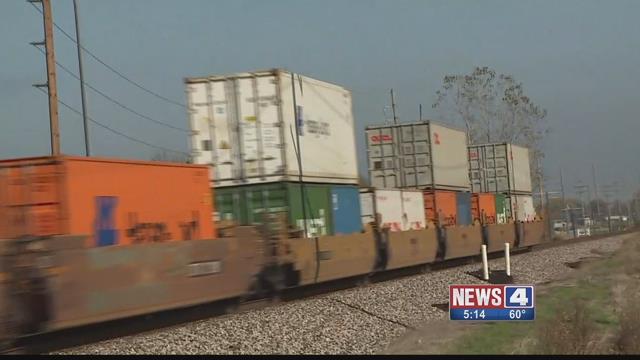
Trains could carry radioactive waste from Westlake Landfill though St. Charles County


Posted: Nov 03, 2015 5:15 PM CST Updated: Nov 03, 2015 5:39 PM CST 


ST. PETERS, Mo. (KMOV.com) - Residents in St. Charles County are familiar with seeing trains. Locomotives roll through the county several times a day, but a topic under discussion involving the Westlake Landfill has some on edge.

If a decision is made to remove radioactive waste from Westlake, railways could end up transporting it. A derailment is always a risk near any set of tracks, but if train carrying radioactive waste is the one that derails, it could be a catastrophe.

“Basically, what we want is to have the trains run at a slower speed coming through the towns,” said St. Peters Alderman Rock Reitmeyer. “We don't want to see any accidents coming through our area and dropping all this waste. It could have a hazardous effect.”


Read More Here

Fukushima News 11/4/15: “Deadly” Radiation Levels Detected Outside Fukushima Reactor 2 Vessel


Thursday, November 5, 2015

The same EPA that unleashed massive pollution in Colorado river now denying risk of harmful radioactive activity in St. Louis


NaturalNews's profile photo
NaturalNews
EPA


(NaturalNews) A five-year fire is burning beneath a landfill in a St. Louis suburb, and it's rapidly approaching an old cache of nuclear waste.

At present, St. Louis County emergency officials are unsure whether or not the fire will set off a reaction that releases a radioactive plume over the city. An emergency plan was put together in October 2014 to "save lives in the event of a catastrophic event at the West Lake Landfill."

St. Louis County officials warn, "There is a potential for radioactive fallout to be released in the smoke plume and spread throughout the region."

Many residents are taking precautions; some are buying gas masks, while others are considering moving away. Just recently, over 500 local residents discussed the precarious situation at a church meeting which usually draws in less than 50 people.

EPA not worried about the fire or the nuclear waste

Nothing stands in the way of the uncontrollable landfill fire, which is smoldering hot underneath the trash of the West Lake Landfill of Bridgeton County, St. Louis. This "smoldering event" is not uncommon. Fires ignite and smolder under landfills because the trash becomes so compact and hot. In this case, the fire is brewing less than a quarter mile from an old deposit of nuclear waste that threatens to spread cancer-causing radon gas.

Surprisingly, the Environmental Protection Agency (EPA) isn't taking the situation very seriously.

EPA officials admit that although the waste may eventually emit radon gas, it won't affect anything outside the landfill property. This is the same EPA that polluted the Colorado River with 3 million gallons of toxic sludge full of lead, arsenic and other heavy metals. EPA contractors breached a mine, sending the sludge flowing into the Animas river, which quickly turned putrid and murky. That pollution has now spread to New Mexico, Utah and Arizona, infiltrating the countryside with toxic elements. Why should anyone in St. Louis County trust the EPA with radioactive waste?

To make matters worse, the EPA isn't even worried about the fire reaching the nuclear waste. "We just do not agree with the finding that the subsurface smoldering event is approaching the radiologically impacted material," said Mary Peterson, director of the Superfund division for EPA Region 7.

There have been no plans to remove the radioactive waste as of yet, leaving local residents baffled and worried. Most residents were unaware of the existence of the radioactive waste, which had been dumped there illegally four decades ago. If it weren't for activists educating the public about the waste, no one would know.

Radioactive waste comes back to haunt St. Louis

The radioactive waste includes 8,700 tons of leached barium sulfate residue. It was illegally dumped in the West Lake Landfill by Cotter Corporation sometime after World War II and wasn't discovered by investigators until 1973. The radioactive waste was left behind due to the mishandling of uranium by Mallinckrodt Chemical Works, a company that started out working for the federal government's Manhattan Project.

Since 1990, the West Lake Landfill has been managed by the EPA and deemed a Superfund site. The U.S. Department of Health and Human Services Agency for Toxic Substances and Disease Registry recently warned all agencies not to disturb the surface of the landfill. They warned that radium-226, radon-222 and radium-228 could be released into the air, putting people near the landfill at risk.

The agency reported that radon levels in the area are often measured above regulations "by as much as 10 to 25 times at individual surface test locations." Moreover, radium increases people's risk of developing bone, liver and breast cancer.

The EPA is downplaying the potential for a Chernobyl or Fukushima-like disaster, but residents have every reason not to trust the agency's guesswork, given its decades-long refusal to safely remove the radioactive material from the area.

Sources:
LATimes.com

Collapse.news

STLToday.com

WashingtonTimes.com
............................................................................................

About NaturalNews

The NaturalNews Network is a non-profit collection of public education websites covering topics that empower individuals to make positive changes in their health, environmental sensitivity, consumer choices and informed skepticism. The NaturalNews Network is owned and operated by Truth Publishing International, Ltd., a Taiwan corporation. It is not recognized as a 501(c)3 non-profit in the United States, but it operates without a profit incentive, and its key writer, Mike Adams, receives absolutely no payment for his time, articles or books other than reimbursement for items purchased in order to conduct product reviews.

The vast majority of our content is freely given away at no charge. We offer thousands of articles and dozens of downloadable reports and guides (like the Honest Food Guide) that are designed to educate and empower individuals, families and communities so that they may experience improved health, awareness and life fulfillment.
Learn More About Natural News Here

.................................................................................................

stl today.com

Residents demand answers about radioactive Bridgeton landfill

October 15, 2015 10:45 pm  • 


Tonya Mason, who works just feet away from the fence line of Republic Services' landfill in Bridgeton, expresses anger that the air from burning underground material has never been tested for contaminants on Thursday, Oct. 15, 2015 at a meeting by Just Moms at John Calvin Presbyterian Church. Hundreds of people gathered to hear about the ongoing problems at the site. Photo by Christian Gooden, cgooden@post-dispatch.com


More than 40 years ago, radioactive waste was dumped at the West Lake Landfill in Bridgeton. The decades since have been filled with legal and political moves that have not gotten the site cleaned up.
Now a growing number of residents want to know how dangerous it is to live and work in the area as a fire burns underground in the adjoining Bridgeton Landfill. More than 500 people showed up at a Bridgeton church on Thursday for a meeting organized by residents. The monthly meetings held for the last two years typically attract no more than 50.


The surge in public interest comes after state reports showed the fire is moving toward the nuclear waste, and radioactive materials can be found in soil, groundwater and trees outside the perimeter of the landfill.

At least six school districts have sent letters home in the last week outlining their plans for a potential nuclear emergency. St. Louis County recently released its own emergency evacuation plan that was written last year.

Underground fires are common in landfills as buried garbage can get hot, much like the bottom of a compost pile. Typically they are monitored and allowed to burn out. But none of the fires have gotten so close to nuclear waste, which was created during the World War II era for St. Louis’ part in the production of the atomic bomb.


Read More Here

Friday, October 16, 2015

HAZMAT - State of New Mexico, Los Alamos [Los Alamos National Lab]


..........
 HAZMATUSAState of New Mexico, Los Alamos [Los Alamos National Lab]Damage levelDetails
..........
HAZMAT in USA on Wednesday, 14 October, 2015 at 03:19 (03:19 AM) UTC.
Description
Not a very smart thief, stealing lab tools contaminated with radiation from Los Alamos National Laboratory. Investigators believe a LANL contractor might have done just that, and put the public at risk in what is just the latest problem with theft at the high security lab. Los Alamos Police are calling the man a "person of interest," but not a suspect. Richard Atencio, an employee of Compra Industries, had total access to LANL's Technical Area-54, which is a radioactive waste storage area. The incident started as a theft, but quickly turned into a full-on HAZMAT situation last month. According to a search warrant, on September 29, a witness saw a man in a brown shirt throwing things out of the trunk of a Honda Accord into bushes on LANL grounds. The man was tossing the things across the way from TA-54, where items have been reported missing over the past year. Los Alamos Police came out to the scene of the dump and found a laundry list of stuff. One of the items, a band saw, had "TA-54" on it, meaning it was likely contaminated. Turns out, it was, along with a pair of gloves and a bag. Police tracked down Richard Atencio, who was wearing a brown shirt and owns a Honda Accord. When officers searched Atencio's Accord, they noticed his trunk carpet was missing. A HAZMAT sweep of his car found radiation levels on Atencio's steering wheel, gear shift and passenger door. The FBI then searched Atencio's Española home on October 9, suspecting he might have contaminated his own stuff. No LANL property or radioactive items were found. Atencio has not yet been charged with anything. LANL didn't comment on the thefts; the company that Atencio works for, Compra Industries, didn't get back to KRQE News 13. The search warrant also revealed a disturbing fact, that there have been 76 reported cases of theft of LANL property by LANL employees in the last year.
...........


13 October 2015 Tuesday 16:10

Thief steals radioactive items from Los Alamos National Lab

LOS ALAMOS, N.M. (KRQE) –Investigators believe a LANL contractor might have done just that, and put the public at risk in what is just the latest problem with theft at the high security lab.


Thief steals radioactive items from Los Alamos National Lab
Not a very smart thief, stealing lab tools contaminated with radiation from Los Alamos National Laboratory.LOS ALAMOS, N.M. 


Investigators believe a LANL contractor might have done just that, and put the public at risk in what is just the latest problem with theft at the high security lab.

Los Alamos Police are calling the man a “person of interest,” but not a suspect.
Richard Atencio, an employee of Compra Industries, had total access to LANL’s Technical Area-54, which is a radioactive waste storage area.

The incident started as a theft, but quickly turned into a full-on HAZMAT situation last month.
According to a search warrant, on September 29, a witness saw a man in a brown shirt throwing things out of the trunk of a Honda Accord into bushes on LANL grounds. The man was tossing the things across the way from TA-54, where items have been reported missing over the past year.
Los Alamos Police came out to the scene of the dump and found a laundry list of stuff. One of the items, a band saw, had “TA-54” on it, meaning it was likely contaminated. Turns out, it was, along with a pair of gloves and a bag.


Read More Here
...........

Sunday, September 27, 2015

Fukushima The Gift That Keeps on Giving : Floods across eastern Japan have swept more than 700 bags containing Fukushima-contaminated soil and grass into Japan’s rivers


 RT

Over 700 Fukushima waste bags swept away by torrential floods

©
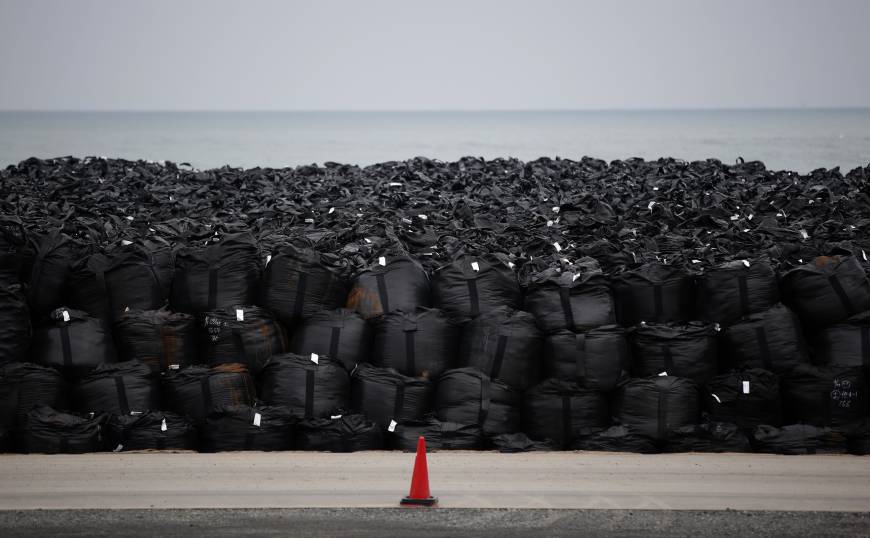
Extensive and destructive floods across eastern Japan have swept more than 700 bags containing Fukushima-contaminated soil and grass into Japan’s rivers, with many still unaccounted for and some spilling their radioactive content into the water system.
 
Authorities in the small city of Nikko in Japan’s Tochigi Prefecture, some 175 km away from the Fukushima nuclear power plant, have said that at least 334 bags containing radioactive soil have been swept into a tributary of the Kinugawa river, The Asahi Shimbun reports.

According to the city’s authorities, the washed-away waste was only part of hundreds of bags being stored at the Kobyakugawa Sakura Koen park alongside the river. Another 132 bags of waste reportedly rolled down the slopes.


TEPCO rejected requests for anti-tsunami steps before nuclear crisis


Japan Today


TEPCO rejected requests for anti-tsunami steps before nuclear crisis
A crane works on the building covering No. 1 reactor (L) at the TEPCO's tsunami-crippled Fukushima Daiichi nuclear power plant in this file photo. Reuters

TOKYO —
Tokyo Electric Power Co turned down requests in 2009 by the nuclear safety agency to consider concrete steps against tsunami waves at the Fukushima Daiichi nuclear plant, which suffered a tsunami-triggered disaster two years later, government documents showed Friday.

“Do you think you can stop the reactors?” a TEPCO official was quoted as telling Shigeki Nagura of the now-defunct Nuclear and Industrial Safety Agency, who was then assigned to review the plant’s safety, in response to one of his requests.

The detailed exchanges between the plant operator and regulator came to light through the latest disclosure of government records on its investigation into the nuclear crisis, adding to evidence that TEPCO failed to take proper safety steps ahead of the world’s worst nuclear accident since the 1986 Chernobyl disaster.

According to records of Nagura’s accounts, Nagura heard TEPCO’s explanations of its tsunami estimates at the agency office in Tokyo in August and September 2009 as it was becoming clear that the coastal areas of Fukushima and Miyagi prefectures were hit by massive tsunami in an 869 earthquake.

TEPCO said the height of waves was estimated to be around 8 meters above sea level and will not reach the plant site located at a height of 10 meters, they show.
But Nagura said he remembered thinking pumps with key cooling functions, which are located on the ground at a height of 4 meters, “will not make it” and told TEPCO, “If this is the outcome, you better consider concrete responses.”


Read More Here


Sunday, May 18, 2014

Environment Pollution - Iraq, Province of Missan, [Karima village area] : discovery of dangerous radioactive contamination that is attributed to the 2003 US-led war on Iraq.


Earth Watch Report  -  Environmental Pollution

du_rounds
US allegedly poisoned Iraqi village with lethal radioactive material - local official

.....
Environment PollutionIraqProvince of Missan, [Karima village area]Damage levelDetails

.....

RSOE EDIS

Description
The official environmental authority in the Iraqi governorate of Missan, which is located 390 kilometres away from Baghdad, has announced the discovery of dangerous radioactive contamination that is attributed to the 2003 US-led war on Iraq. The director of the general authority for the environment in Missan, Samir Kadim, told the New Arab news website that the authority's specialised staff found radioactive material, mainly in military equipment and the skeletons of cars, in a small village south of Missan known as Karima. Kadim explained that the ministry's authority is cautiously entering the three areas where radioactive material was discovered and is taking strict procedures to remove it. The village witnessed one of the fiercest battles between the former Iraqi army and the US-led coalition forces in 2003. "Unfortunately, we have discovered it late, after a number of the village's residents have been diagnosed with various diseases," Kadim said.One of the village's residents told the New Arab in a phone interview that: "Cancer has spread among us, in addition to birth defects among new-born babies and other diseases that doctors cannot explain." "But it is only now that we have discovered the cause �" it is the US," said 45-year-old Abboud Moussa. Moussa described how a number of Karima's villagers, including children and his own mother, died as a result of this radioactive material. Doctors diagnosed his mother with skin cancer and bone disease, and they told him that she needed to receive medical treatment abroad, but she died very fast before she could travel. The village's mayor Mahmoud Abtan told the New Arab that a routine visit to the village by officials from the Ministry of Environment encouraged the villagers to ask them to examine a number of areas that had a bad smell. "A number of animals grazing near those areas have died ... people even thought that those areas were possessed. Then it turned out that they are not possessed at all, and our murderer is the US," he said.According to Missan's environment authority, Karima is the third place in the governorate where radioactive material has been discovered amid primitive treatment and an American refusal to take responsibility. Any US assistance in handling the radiation would be an acknowledgement of its use of internationally banned weapons in Iraq. Abdel Khalek Mahmoud, an environmental expert, told the New Arab that "radioactive contamination in Iraq is divided into two types: The first, which is rarely found in Iraq, is high-level radioactivity that can be discovered by electronic devices. The second is low-level radioactivity, which is more difficult to discover. It was caused by the waste of depleted uranium that was used by the US in its 2003 war on Iraq. This is abundantly found and it has caused a lot of lethal damage in the country." "We have often said that the reason why thousands of Iraqi soldiers went missing is that their bodies burnt as a result of uranium-saturated bombs. But the country's new leaders, who were empowered by the US, were not willing to bother the Americans," Mahmoud added.

.....
"

US allegedly poisoned Iraqi village with lethal radioactive material - local official

US allegedly poisoned Iraqi village with lethal radioactive material - local official
© Photo: Voice of Russia/Michael Shepetkov
The official environmental authority in the Iraqi governorate of Missan, located 390 kilometers away from Baghdad, has discovered radioactive material attributed to the 2003 US-led invasion of Iraq, Global Research reports. The director of the general authority for the environment, Samir Kadim, explained that dangerous contamination was found in military equipment left at a small village south of Karima that saw severe fighting between the Iraqi army and the US-led coalition forces in 2003.
Kadim laments that the contamination was not discovered soon after the military operation ended. Since then several people have been diagnosed with various serious diseases, from cancer to birth defects. "Unfortunately, we have discovered it late, after a number of the village’s residents have been diagnosed with various diseases."
Many need professional medical help only available abroad. Some succumbed to the disease without receiving any treatment.
Abboud Moussa told the New Arab: "Cancer has spread among us, in addition to birth defects among new-born babies and other diseases that doctors cannot explain."
"But it is only now that we have discovered the cause – it is the US."
Reportedly, this is the third case that radioactive material has been discovered in that area.
The village's mayor Mahmoud Abtan told the New Arab that a routine visit to the village by officials from the Ministry of Environment encouraged the villagers to ask them to examine a number of areas that had a bad smell. "A number of animals grazing near those areas have died … people even thought that those areas were possessed. Then it turned out that they are not possessed at all, and our murderer is the US," he said, as quoted by the Global Research.
Abdel Khalek Mahmoud, an environmental expert, told the New Arab that allegedly depleted uranium was used in Iraq by the US in 2003. "This is abundantly found and it has caused a lot of lethal damage in the country."

.....

 nuclear-news

USA, UK, France will not admit the growing radioactive pollution of Iraq, due to depleted uranium weapons

du_roundsThe health effects are disputed by the US and UK governments, who joined with France and Israel to vote against a resolution calling for “a precautionary approach” to the use of DU weapons at the United Nations general assembly in December; 155 countries voted in favour of the resolution.
Iraq’s depleted uranium clean-up to cost $30m as contamination spreads  guardian.co.uk,  6 March 2013 Report says toxic waste is being spread by scrap metal dealers, and describes its ‘alarming’ use in civilian areas during Iraq wars Cleaning up more than 300 sites in Iraq still contaminated by depleted uranium (DU) weapons will cost at least $30m, according to a report by a Dutch peace group to be published on Thursday.
The report, which was funded by the Norwegian Ministry of Foreign Affairs, warns that the contamination is being spread by poorly regulated scrap metal dealers, including children. It also documents evidence that DU munitions were fired at light vehicles, buildings and other civilian infrastructure including the Iraqi Ministry of Planning in Baghdad – casting doubt on official assurances that only armoured vehicles were targeted. “The use of DU in populated areas is alarming,” it says, adding that many more contaminated sites are likely to be discovered.
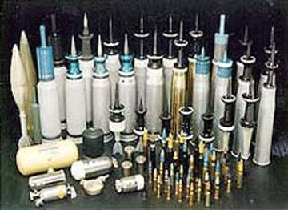
More than 400 tonnes of DU ammunition are estimated to have been fired by jets and tanks in the two Iraq wars in 1991 and 2003, the vast majority by US forces. The UK government says that British forces fired less than three tonnes.
DU is a chemically toxic and radioactive heavy metal produced as wasteby the nuclear power industry. It is used in weapons because it is an extremely hard material capable of piercing armour.

 Read More Here
.....
Enhanced by Zemanta

Sunday, April 27, 2014

DOE Report : Radioactive leak at Waste Isolation Pilot Plant in New Mexico was partly due to improper maintenance, poor management, and unsuitable training and oversight.

April 25th, 2014, 20:57 GMT · By

Report: Radioactive Leak at Nuclear Waste Site in the US Was Avoidable


Report says leak at Waste Isolation Pilot Plant in New Mexico could have been avoided Enlarge picture - Report says leak at Waste Isolation Pilot Plant in New Mexico could have been avoided

Earlier this year, on February 16, the Department of Energy in the United States announced that excessive levels of radiation had been documented at a nuclear waste site in New Mexico. The site in question is known as the Waste Isolation Pilot Plant, and it presently accommodates for transuranic waste.
Recent news on the topic says that, according to a report shared with the public by the Department of Energy this past Thursday, this incident at said nuclear waste site in New Mexico could have been avoided.
As previously reported, traces of radiation were picked up by underground sensors at the Waste Isolation Pilot Plant on Friday, February 14. This increase in radiation levels most likely occurred as a result of a leak inside one of the facility's waste-storage vaults.
Despite the fact that these waste-storage vaults sit at a depth of about 2,000 feet (nearly 610 meters), some radioactive contamination somehow worked its way above ground. There is evidence to indicate that this happened due to the fact that the emergency filtration system failed to contain it.

NPR
informs that, in its report, the Department of Energy argues that the waste storage vault leaked partly due to improper maintenance, poor management, and unsuitable training and oversight.

Read More Here

...

Management, Safety Cited for Radiation Release


A radiation release from the federal government's underground nuclear waste dump in southeastern New Mexico was the result of a slow erosion of the safety culture at the 15-year-old site, which was evident in the bungled response to the emergency, federal investigators said in a report released Thursday.
The report from the U.S. Department of Energy's Accident Investigation Board cited poor management, ineffective maintenance and a lack of proper training and oversight at the Waste Isolation Pilot Plant near Carlsbad. The report also found that much of the operation failed to meet standards for a nuclear facility.
The series of shortcomings are similar to those found in a probe of the truck fire in the half-mile-deep mine just nine days before the Feb. 14 radiation release that shuttered the plant indefinitely.
Given the latest findings, watchdog Don Hancock said the leak that contaminated 21 workers with low doses of radiation in mid-February was a "best-case scenario."
"Everything conspired for the least bad event to occur, based on what we know — and there is a still a lot we don't know," he said.
Last month, the head of the Defense Nuclear Safety Board, which has staff monitoring the Waste Isolation Pilot Project, called the accidents "near misses."
Defense Nuclear Facilities Safety Board Chairman Peter Winokur said that for six days after the fire, no underground air monitors were operational, meaning that if that system had failed when the leak occurred Feb. 14, "or if the release event had occurred three days earlier, the release of radioactive material from the aboveground mine exhaust would have been orders of magnitude larger."
DOE Accident Investigation Board Chairman Ted Wyka previewed the findings of the latest report at a community meeting Wednesday night, identifying the root cause as a "degradation of key safety management and safety culture."

Read More here

.....

Crews locate area of radiation leak at New Mexico nuclear waste site

Published time: April 18, 2014 19:25


The Waste Isolation Pilot Plant (WIPP), New Mexico. (Image from wikipedia.org user@Leaflet)
While the cause of a radiation leak at the United States’ first nuclear waste repository remains unknown, officials have reportedly pinpointed the facility’s contaminated area.
According to the Associated Press, the Department of Energy’s Tammy Reynolds told residents in Carlsbad, New Mexico, that no definitive conclusions can be made regarding the latest discovery, but that further investigation into the area should produce some information next week.
The Waste Isolation Pilot Plant (WIPP) has been shut down since February 14, when increased radiation levels were detected inside and outside the plant.
On Wednesday, crews investigating the leak made their way into the WIPP and inspected the facility’s various panels, or the large underground salt beds where nuclear waste is stored. These panels are located about a half-mile below the Earth’s surface, and after five hours of inspection they found that Panel 7 was the source of the leaked contamination.

Read More Here

......

Search crew finds location but not source of leak at New Mexico nuclear waste storage site

By D. Lencho
21 April 2014
On April 16, more than two months after an underground air monitor detected airborne radiation underground at the Waste Isolation Pilot Plant (WIPP) nuclear waste burial site in Carlsbad, New Mexico (see “Thirteen workers exposed to radiation in New Mexico nuclear waste site” ), a search team clad in heavy protective gear discovered the location of the contamination.
Since moving in the heavy-duty suits is slow and laborious, and the team’s respiratory equipment was running low, the team turned back before pinpointing the exact source of the leak, determining only that it is in a storage unit known as panel seven. This means that more trips to the 2,150-feet-deep panel will be required to find the source and to deal with it.
On the night of February 14, the monitor set off an alert, causing evacuation of the area and a halt to deliveries. Since then, the number of WIPP workers found to be contaminated with radiation has risen from 13 to 21. In addition, increased radiation has been detected in surrounding areas above ground.
The leak followed on the heels of an incident on February 5 in which a salt-hauling truck caught fire underground. 86 workers had to be evacuated. Six were hospitalized for smoke inhalation and seven others were treated on site.
A March 14 DOE (Department of Energy) Office of Environment Management report on the fire “identifies shortcomings in the preventive maintenance program, emergency management, and emergency response training and drills by the Nuclear Waste Partnership LLC managing and operating DOE Waste Isolation Pilot Plant (WIPP) near Carlsbad, N.M., and it also faults the oversight provided by DOE’s Carlsbad Field Office,” according to an ohsonline.com article.
The article adds that the report “finds the NWP/Carlsbad Field Office emergency management program is not fully compliant with DOE’s requirements for a comprehensive emergency management system. While the report identified the direct cause of the incident…the investigative board identified 21 error precursors on the date of the fire. The truck operator’s training and qualification were inadequate to ensure proper response to a vehicle fire, and he did not initially notify the Central Monitoring Room that there was a fire or describe the fire’s location.”
Joe Franco, DOE’s Carlsbad Field Office manager, claimed, “We take these findings seriously and, in fact, we are already implementing many of the corrective actions in the report.”
However, criticism of WIPP from outside the DOE—from scientific, community and environmental organizations—has been constant since planning for the project began decades ago.
WIPP’s history traces its roots to the emergence of the US as a nuclear power during and after World War II. As the development of nuclear weapons picked up its pace, the problem of the accumulation of so-called transuranic waste, or TRU, developed along with it. TRU contains the elements americium and plutonium—which has a half-life in the tens of thousands of years—and contact with or ingestion of it, although it is categorized as “low-level,” is carcinogenic in minute amounts.
The Department of Energy began a search for a location to dispose of TRU, and after other proposed sites were rejected, decided in the early 1970s to begin testing on an area known as the Delaware Basin in southeastern New Mexico, about 26 miles east of the town of Carlsbad. A salt basin formed about 250 million years ago, and below some 300 meters (1,000 feet) of soil and rock, it was promoted by government officials and some scientists as an ideal waste disposal spot.

Read More Here

.....

Enhanced by Zemanta